
Livraison le jour même ou le lendemain

Qualité garantie

Débloquez vos offres de bienvenue: Livraison GRATUITE | Jusqu'à -80 % | 30 jours d'essai gratuits à JoyPlus
Téléchargez l'application
Outdoor path lighting makes it safer to get around your home, gives your lawn definition and creates a pleasant atmosphere on a patio. But choosing the right lights is about more than design. An unsuitable setup may cast too little light, run out of charge quickly or require accessories you hadn’t planned for.
Before you buy, here are the main pitfalls to avoid and the criteria to consider when choosing garden path lights, bollard lights or LED landscape lighting that can withstand outdoor conditions in the UK.
An IP65 rating generally means protection against dust and water jets. It’s suitable for use in the rain, but it doesn’t mean the light can be submerged. Connections, transformers and sockets should be kept away from standing water.
For a long-lasting installation, also check:
Outdoor RGB lighting may offer a wide range of colours, but that doesn’t necessarily mean it will provide the right light for a path. To help guide your steps, colour temperature, light distribution and the height of the fitting matter just as much as lighting effects.
Warm white light at around 3,000 K is generally well suited to creating a soft atmosphere. For a walkway, also check the stated light output in lumens. A low-powered decorative light may be perfect for highlighting a border, but may not be bright enough to light a long path.
Garden solar lights rely directly on exposure to sunlight. A hedge, wall or tree can reduce daily charging and, in turn, shorten how long the lights stay on at night. Wired smart models, on the other hand, require a low-voltage power supply, a compatible network or, in some cases, a smart home bridge.
Before placing your order, measure the path, identify shaded areas and decide whether you’d prefer a cable-free installation or more advanced control from an app.
For a quick installation, solar stake lights are particularly convenient. The UME model featured below states that it needs 6 to 8 hours of sunlight to charge and offers up to 8 to 12 hours of battery life, depending on how it’s used. These figures may vary with the season, weather and panel orientation.
Low-voltage mains-powered bollard lights offer more consistent operation. However, you’ll need to plan the cable route and follow electrical safety instructions. Depending on your property, a fixed installation may require a professional.
For outdoor bollard lights, look for an IP rating suited to the conditions they’ll be exposed to, such as IP65, while bearing in mind its limitations. Aluminium, stainless steel and some durable plastics may be suitable, but the quality of the joints and seals is just as important.
Don’t install the light where water could collect. Remember to switch off the power before cleaning or adjusting it.
Smart outdoor lighting can be controlled through an app, on a schedule or using a voice assistant. However, check what’s needed for it to work: a wireless network, a connection bridge, a dedicated app and compatibility with Alexa or Google Assistant.
RGB features, music synchronisation and camera integration are mainly suited to decorative and occasional use. For lighting a path, prioritise even light distribution and careful positioning.
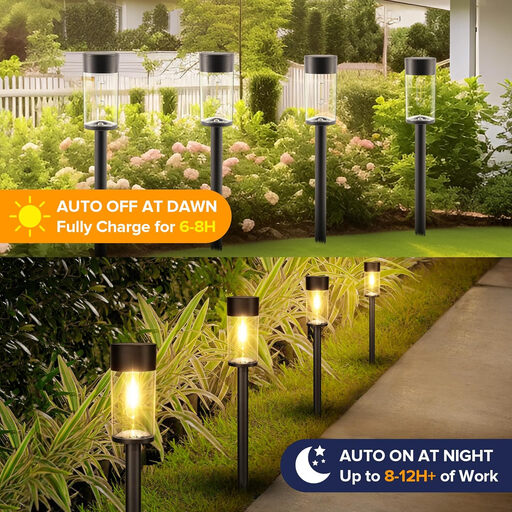
Why it’s a good fit: These solar lights push straight into the ground and switch on automatically at dusk. They’re suitable for a small path, lawn border or flower bed, with no electrical connection required.
Charging and automatic switching are built in, reducing the number of accessories you’ll need. However, the stated IP65 rating doesn’t mean the lights can be submerged, so choose a location where they won’t be immersed.
Warm white light at 3,000 K, 10 lumens per light, dusk sensor and a design combining a stake, ABS and stainless steel.
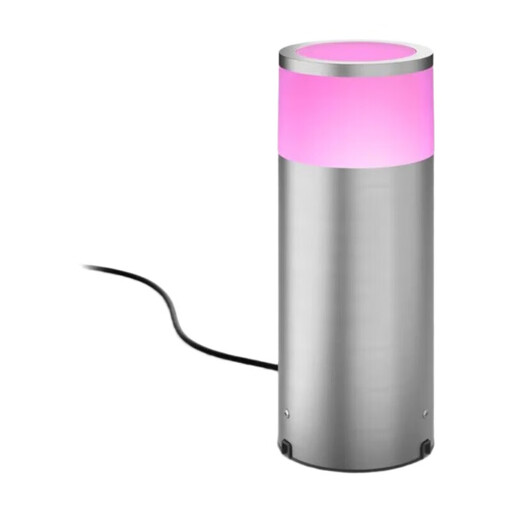
Why it’s a good fit: This bollard light is designed for households already using the Philips Hue ecosystem who want to schedule lighting for a garden, patio or path.
The product details state that connected control requires a Philips Hue Bridge. It’s worth checking compatibility before you buy rather than assuming that an app alone will be enough.
LED lighting with millions of colours and different shades of white, low-voltage outdoor power supply included, and control through the app, a voice assistant or automated routines.
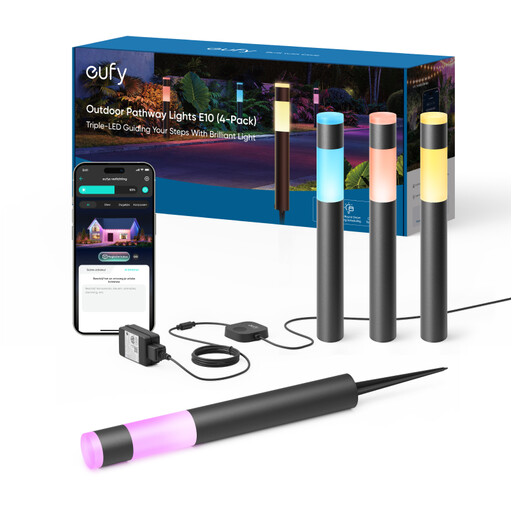
Why it’s a good fit: This wired kit is for anyone looking to create LED landscape lighting scenes, synchronise several lights or control the atmosphere on their patio from an app.
The kit is rated IP65 and is specified to operate between -20 °C and 45 °C. However, connections must still be kept secure and the adapter installed in a dry place.
RGBWW technology, stated brightness of up to 350 lumens, more than 80 scenes in the eufy Life app and stated compatibility with Alexa and Google Assistant.
We’ve put together a comprehensive, regularly updated selection of products that meet these demanding criteria and European safety requirements.
It depends on the light output, the height of the lights and the effect you’re looking for. For decorative lighting, evenly spaced lights are enough to highlight the path without overcrowding the garden. For a path you use every day, position lights closer together if each one gives off little light, and check the result after dark.
They can run for several hours after a full charge, but battery life varies depending on sunlight, the season, how clean the panel is and the temperature. Install them in an open area, clean the panel regularly and make sure the switch is set to ‘on’ the first time you use them.
Your budget should cover the light fitting, low-voltage power supply, any additional cables and, depending on the ecosystem you choose, a connection bridge. Remember to factor in electricity use too: LEDs are generally designed to keep power requirements low, but the cost depends on the number of lights, how long they’re switched on and how often you use lighting scenes.