
Same-day & Next-day Delivery

Quality Guaranteed

Unlock Your Welcome Offers: FREE Delivery | Up to 80% OFF | Free 30-day JoyPlus trial
Download the APP
Outdoor lighting should never be chosen at random. It can help make a pathway safer, create a more welcoming entrance, highlight an exterior wall or let you enjoy your patio after dark. Yet some purchases quickly disappoint, often because the technical specifications have been misunderstood or the chosen location is unsuitable.
Before comparing a solar garden spotlight, an outdoor wall light or an LED solar floodlight, start by identifying the specific requirements of your home.
The IP rating does not mean that a light fitting can be submerged. The first digit indicates its level of protection against solid objects and dust. The second shows how resistant it is to water under specific conditions.
An IP54 outdoor light may be suitable under a canopy or on a well-protected exterior wall. For a location directly exposed to rain and splashes, an IP65 or IP66 model offers greater protection. However, the location, quality of installation and condition of the seals remain essential.
The number of LEDs alone does not indicate the quality of the lighting. Instead, look at the luminous flux, measured in lumens, the colour temperature and the beam angle. Warm light, between 2,700 and 3,200 K, creates a soft and welcoming atmosphere. A higher colour temperature produces whiter, and potentially cooler, light.
For a pathway, an even light with minimal glare is generally preferable to a very powerful beam. On an exterior wall, the beam angle should be suited to the surface you want to highlight.
A wireless outdoor light may seem easy to install, but a solar model depends directly on its exposure to sunlight. Shade from a wall, tree or balcony can significantly reduce daily charging. Electric wall lights, meanwhile, require a suitable power supply and wiring.
Models fitted with a GU10 socket offer a degree of flexibility, but the bulb is sometimes sold separately. Also check the electrical class: a Class I appliance must be earthed and installed in accordance with the electrical regulations applicable in France.
A solar garden spotlight works without a mains connection. It can therefore be installed beside a pathway, on a lawn or in a flower bed away from the house. However, make sure that the panel receives enough sunlight, that the battery has suitable capacity and that the stated operating mode meets your needs: automatic switching, dusk sensor or motion detector.
An outdoor wall light powered by 220-240 V provides more consistent lighting. It is particularly suitable for an entrance, garage or patio that already has a power connection. Connected models, such as some outdoor recessed spotlights, allow you to adjust the brightness and colour temperature from an app.
Painted aluminium, glass and certain technical plastics are commonly used for LED outdoor light fittings. Check their resistance to splashes, the strength of the mounting and how easy it is to maintain the solar panel or diffuser.
Homes located near the coast require particular attention. Salt and moisture can accelerate corrosion. If the product information states that a light fitting is not suitable for coastal areas, take this into account before placing your order.
Measure the available space before choosing a wall light or outdoor recessed spotlight. For recessed installation, check the cut-out diameter, the required depth and compatibility with the insulation. The Dorado Smart model, for example, has a spotlight diameter of 7.2 cm, a height of 6.8 cm and an external diameter of 8.5 cm.
Also consider long-term maintenance: replacing a GU10 bulb, cleaning the solar panel, accessing the connection or the fact that an integrated LED light source cannot be replaced.

Why this choice suits this profile : This round solar light can be installed without wiring on a patio, along a pathway or in a garden. Its compact size and warm light are ideal for anyone looking for a simple lighting solution without taking on major building work.
The product information states that it has IP66 protection and that the panel must be exposed directly to sunlight. This helps prevent installation in an overly shaded spot.
Solar power, warm 3,200 K light, IP66 rating and a round 121.4 mm design.
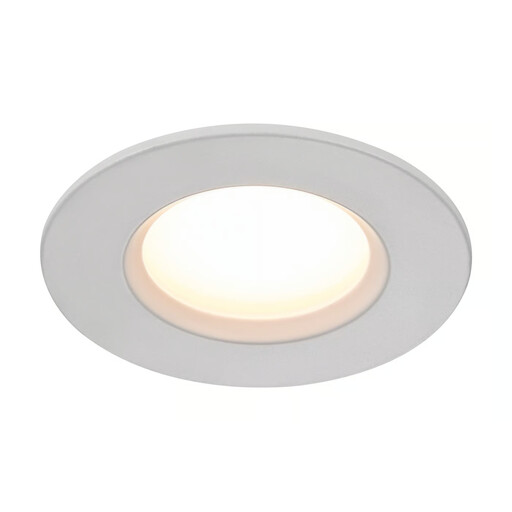
Why this choice suits this profile : This outdoor recessed spotlight is designed for those looking for precise settings and discreet integration into contemporary architecture.
The IP65 rating is clearly stated, along with the cut-out diameter and the integrated LED light source. You should still check that it is compatible with the mounting surface before installation.
360 lumens, adjustable temperature from 2,200 to 6,500 K, dimmable brightness, Bluetooth Mesh and a stated service life of 20,000 hours.
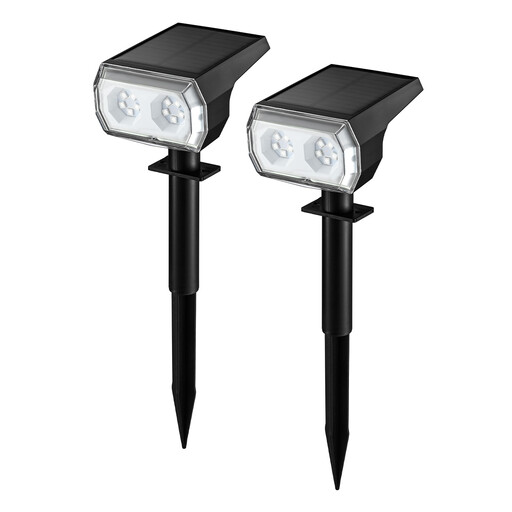
Why this choice suits this profile : This pack of two LED solar floodlights is ideal for lighting trees, walls or paths, as well as creating an inviting atmosphere during an evening outdoors.
The description mentions the solar panel, light sensor and automatic switching. However, the manufacturer recommends installing it in direct sunlight and cleaning it regularly.
48 RGB LEDs per floodlight, several colours, adjustable orientation, solar operation and a pack of two units.
We have put together a complete, real-time updated list of products that meet these demanding selection criteria and European safety standards.
For a GU10 wall light, check that there is a suitable power supply, that the mounting surface is sturdy and that the fitting is earthed if it is a Class I light. Bulbs are not always included, as is the case with several Nordlux models.
For a solar light fitting, install the panel away from any obstacles and clean it with a soft cloth. Do not dismantle or replace a lithium battery without carefully following the manufacturer’s instructions. In all cases, switch off the power before working on an appliance connected to the mains.
An IP65 rating is generally suitable for an outdoor light fitting exposed to water jets. An IP66 rating offers greater protection against powerful jets. IP54 may be sufficient in a more sheltered area, provided that the installation properly protects the connections.
Solar lighting does not use electricity from the mains while operating, but its battery life depends on sunlight levels, battery capacity and the season. In winter or overcast weather, the lighting time may be reduced. The position of the panel is therefore crucial.
The stated service life depends on the light source and the conditions in which it is used. Some manufacturers provide a theoretical service life, such as the 20,000 hours stated for the DORADO SMART. This figure does not remove the need to check the quality of the installation, ventilation, exposure to moisture and maintenance.