
Livraison le jour même ou le lendemain

Qualité garantie

Débloquez vos offres de bienvenue: Livraison GRATUITE | Jusqu'à -80 % | 30 jours d'essai gratuits à JoyPlus
Téléchargez l'application
A well-chosen outdoor light makes moving around safer, structures your garden and creates a pleasant atmosphere on the patio. Yet some purchases disappoint quickly: light that's too dim, a solar battery that struggles to recharge, or a fitting that weathers poorly over time.
Before comparing styles, it's worth reviewing a few practical criteria. Here are the points to check when choosing an outdoor lamp, a garden bollard light, a lantern or an outdoor LED light that suits your home.
A small warm light can work perfectly on a garden table, but it won't replace a pathway light or a lamp designed to secure an entrance. Decorative solar models often offer modest brightness – enough to mark a path or create an atmosphere, but too weak to properly illuminate a busy area.
On a patio, a soft-glowing outdoor lantern can do the job. For a gate, steps or a pathway, it's better to space multiple light points evenly or choose a fitting designed for more direct illumination.
The IP rating indicates a product's resistance to dust and water. It doesn't mean the fitting can be submerged or exposed indefinitely to powerful jets.
Even with a high IP rating, the connection, battery compartment cover and installation must follow the manufacturer's recommendations.
A solar garden light doesn't receive the same amount of energy on a north-facing balcony, under a tree or near a wall as it does in an open, well-exposed space. In winter or overcast weather, its battery life can also drop noticeably.
Before buying, check that the panel can be installed in a spot that gets enough daylight. Remember to clean its surface regularly too. A solar light shouldn't be chosen just because it avoids running a cable.
The material affects maintenance, durability and the fitting's appearance. Metal and stainless steel offer a more structured finish, while plastic is often lighter and more practical for a wireless lamp or portable option. Clear glass can improve light diffusion but requires more care when handling.
For patio lighting, a tabletop lantern or one with a handle can be moved around easily as needed. Along a border or pathway, a stake or small solar light installs without a fixed connection. Higher up, a garden bollard light is better suited to an entrance, driveway or area where you want a more permanent light presence.
A warm colour temperature, between 2,700 and 3,200 K, produces a soft light that works well in gardens, balconies and patios. A more neutral light can sometimes help identify obstacles, but its effect is generally less cosy.
Also check whether the bulb is included. The Nordlux VEJERS bollard light uses an E27 socket, accepts a bulb up to 60 W and can accommodate a dimmable model. In contrast, an integrated LED light usually doesn't allow you to replace the light source as easily.
A solar light runs independently but depends on sunlight. A USB-C rechargeable lamp offers more flexibility, provided you remember to charge it. A mains-connected fitting is suitable for a permanent installation, but it must be installed with the necessary electrical precautions.
For a wall or mains connection, especially with a smart outdoor light, you may need a qualified electrician. App control and integration with a smart home system add real convenience, but also require a more rigorous network and electrical setup.
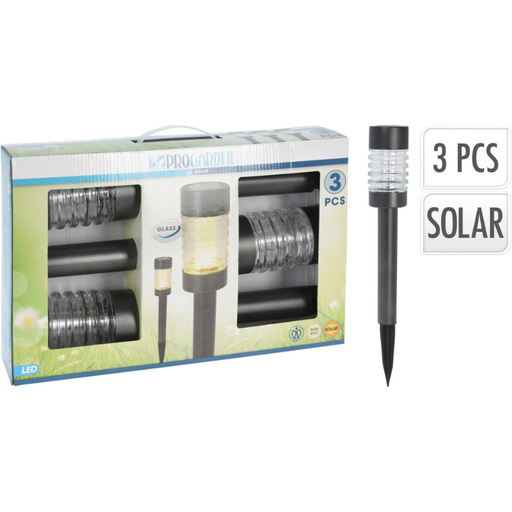
Why this choice suits this profile: This set lets you easily mark out a pathway, garden border or entrance without needing an electrical connection.
The listing clearly states a warm white light of 5 lumens and solar charging. This model is therefore suitable for decorative marking, not powerful illumination.
Set of three units, height of 540 mm with stake, stainless steel frame and glass diffuser.
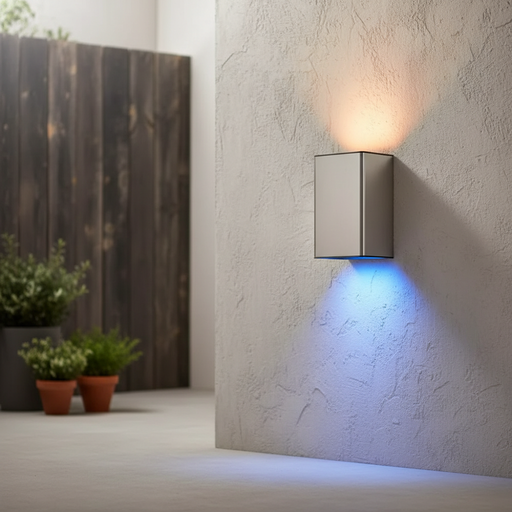
Why this choice suits this profile: This wall light is for those who want to adjust the atmosphere and automate the lighting of an entrance, facade or patio.
The listing specifies it's a mains-connected wall installation that needs a qualified electrician. So it can't be mistaken for a portable or solar lamp.
Adjustable white or coloured LED light, control via the Philips Hue app and compatibility with smart home systems.

Why this choice suits this profile: Its flat design and wireless operation suit exposed areas, borders, pathways and installations that need to stay discreet.
Its IP66 rating is clearly listed, but its location still needs enough sunlight to recharge the built-in battery.
IP66 protection, 0.6 W solar panel, 500 mAh battery and dimensions of 121.4 × 121.4 × 24.5 mm.
We've put together a comprehensive, real-time updated list of products that fully meet these strict selection criteria and European safety regulations.
The Nordlux VEJERS model, for example, combines a black metal structure with clear glass. It stands 92 cm tall and has an E27 socket. Its IP54 protection is suitable for outdoor use, provided the installation is appropriate. Depending on the setup, the anchor base or in-ground socket is sold separately: check this before ordering.
For simple decorative marking, a low wattage can be enough. An entrance, steps or a preparation area needs more light. Compare the number of lumens, the beam angle and the installation height, rather than focusing only on watts.
Yes, but its battery life can decrease when days are shorter or the panel receives less sunlight. Install it in an open space, clean it regularly and plan supplementary lighting for areas that need to stay lit continuously.
A solar light doesn't use mains electricity when operating. A rechargeable lamp uses electricity when charging, while a mains-connected fitting depends on its wattage, how long it's on and how often it's used. An LED bulb can reduce consumption compared to a more energy-hungry source, without eliminating maintenance or replacement needs.