
Livraison le jour même ou le lendemain

Qualité garantie

Débloquez vos offres de bienvenue: Livraison GRATUITE | Jusqu'à -80 % | 30 jours d'essai gratuits à JoyPlus
Téléchargez l'application
Good outdoor lighting can transform an entrance, make a pathway safer, or extend your evenings on the patio. However, some purchases don’t go to plan: light that’s too dim, a solar battery that struggles in winter, corrosion on a facade exposed to sea spray, or a smart installation that ends up costing far more than expected.
Before choosing an outdoor light, a wall light or an LED outdoor spotlight, it’s worth looking beyond the design and paying attention to a few technical details. Here are the points to check to find a weather-resistant outdoor light fitting that’s right for your home in the UK.
The term “outdoor” doesn’t mean the fitting can be submerged or withstand a high-pressure jet. An IP44 rating protects against water splashes, while an IP54 model also offers dust protection. IP65 and IP66 ratings go further against dust and water jets, but they don’t automatically make the product submersible.
The IP rating should be chosen based on the location: a covered porch, a wall exposed to rain, a pathway, a patio, or ground-level areas directly exposed to the elements.
A solar outdoor light depends directly on the duration and intensity of sunlight. A panel installed under a tree, facing north, or frequently in the shade can offer significantly lower battery life, especially in winter. The lighting durations quoted by manufacturers usually correspond to optimal charging conditions.
Also check whether the battery can be replaced, whether the panel is easy to clean, and whether the switch needs to be left in the “on” position to activate automatic lighting.
A smart outdoor light may require a bridge, a transformer, or specific wiring. Some Philips Hue lights, for example, work with a Hue Bridge sold separately, while a low-voltage system may need a compatible outdoor transformer.
For a wall light connected to the mains, installation and earthing must comply with current electrical regulations. The price of the light fitting, therefore, doesn’t always reflect the true cost of installation.
Here’s how to interpret the most common ratings:
The IP rating doesn’t directly indicate resistance to impact, UV rays, or sea salt. By the coast, the housing material and the quality of fixings are equally important.
An integrated LED typically uses little electricity and avoids the need to change bulbs regularly. On the downside, its light source isn’t always replaceable. With an E27 or GU10 socket, you can change the bulb and choose the colour temperature that suits you: warm white for a welcoming atmosphere, or a more neutral white for an entrance or garage.
Clean an outdoor light fitting with a soft, slightly damp cloth. Dust, salt, and pollen can affect light diffusion and accelerate surface ageing. Avoid abrasive products and high-pressure jets.
A solar solution avoids wiring work, but its performance depends on available sunlight. A mains-powered model offers more consistent brightness, at the cost of electrical installation. 24 V low voltage can be particularly suitable for a landscape layout that may evolve, especially if you want to add several compatible light points.
For Class I appliances, earthing is mandatory. Any work on an outdoor connection should be carried out by a qualified electrician when the setup requires it.
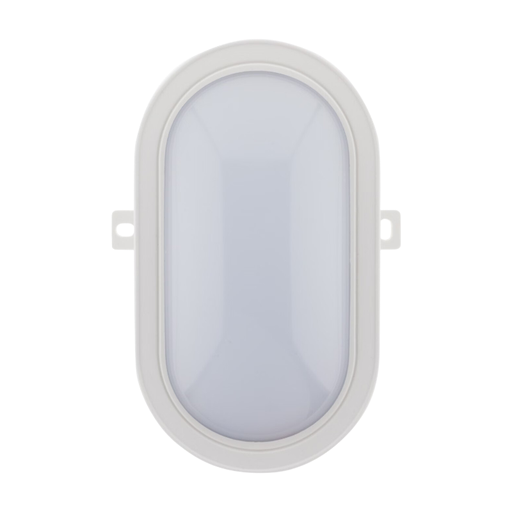
Why this choice suits this profile: This outdoor wall light is ideal for a patio, garage, or courtyard where you want a simple wall-mounted installation, with a warm white light at 2,700 K and a stated output of 400 lumens.
Its IP44 rating is clearly stated, and the 5W E27 LED bulb is replaceable. If it fails, you don’t need to replace the entire fitting.
Bulb included, protective grille, E27 socket, and warm colour temperature.
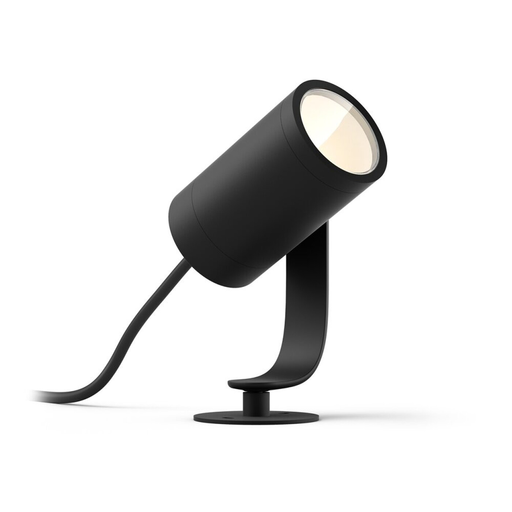
Why this choice suits this profile: This low-voltage LED outdoor spotlight is designed for those who want to control the lighting of their garden, facade, or trees from a Philips Hue setup.
The product page clearly distinguishes the necessary components: the 24V outdoor transformer and the Hue Bridge. This lets you budget ahead and check compatibility before ordering.
Adjustable white or coloured light, expandable system with compatible Lily heads, and control via the app.
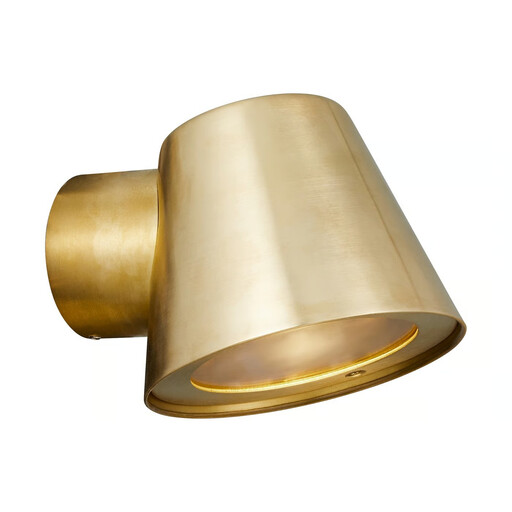
Why this choice suits this profile: Its solid brass is designed for coastal and humid environments. This wall light can find its place at an entrance, in a garage, or on a facade exposed to sea spray, with a natural patina that develops over time.
The material is stated as suitable for coastal areas, unlike a simple decorative finish whose salt resistance wouldn’t be specified. The IP44 rating must still be respected.
Solid brass, glass, GU10 socket up to 35W, and a stated 15-year guarantee against surface deterioration.

Why this choice suits this profile: This compact solar outdoor light installs without any electrical connection in a pathway, garden, or area where running a cable would be too difficult.
Its IP66 rating is clearly stated, but its operation still depends on a location with sufficient direct sunlight. This limitation must be considered before installation.
0.6W solar panel, warm light at 3,200 K, wireless design, and IP66 protection.
We’ve put together a comprehensive, real-time updated selection of products that meet these demanding criteria and comply with European safety regulations.
For a covered, sheltered area, IP44 may be sufficient. A facade directly exposed to rain or garden lighting will often require higher protection, such as IP54, IP65, or IP66, depending on the product and installation instructions. No rating removes the need to properly protect connections.
Yes, but its battery life can decrease when days are shorter or the panel receives less sunlight. Position it in a clear area, clean it regularly, and don’t rely on solar lighting as a constant light source without checking the stated usage conditions.
Consumption depends on the wattage, the number of lights, and how long they’re on. A timer, a sensor, or a smart outdoor lighting system can reduce running time. To compare two models, look at the wattage, the light output, and the necessary accessories, especially the transformer or bridge.