
Livraison le jour même ou le lendemain

Qualité garantie

Débloquez vos offres de bienvenue: Livraison GRATUITE | Jusqu'à -80 % | 30 jours d'essai gratuits à JoyPlus
Téléchargez l'application
Outdoor lighting has to contend with several challenges: it must withstand water splashes, provide light suited to its purpose, and blend harmoniously with your home’s architecture. Yet even a product that looks good on paper can disappoint once installed.
An IP44 rating protects the light fitting against water splashes from any direction. That does not mean it can be submerged or installed without care in an area where water pools. IP54 adds protection against dust, while offering comparable resistance to water splashes.
The IP rating is no substitute for careful installation: properly positioned seals, protected cables and a light fixed to a suitable surface are all essential.
A low-energy solar garden light can produce a pleasant glow for marking a border, but it will not replace a wall light designed to secure an entrance. The set shown below, for example, delivers 5 lumens per light. This is therefore more of an ambient or decorative marker light than a light source intended to effectively illuminate a walkway.
A wall light fitted with an E27 or GU10 socket is not necessarily supplied with its bulb. You also need to check its electrical class. A Class I appliance must be connected to earth, whereas a Class II model relies on double insulation and does not require an earth conductor.
For a mains-connected installation, particularly on a facade, using a qualified electrician ensures compliance with the applicable regulations for outdoor installations.
An E27 bulb gives you plenty of choice: warm light, dimmable models or a smart bulb compatible with a home automation system. The GU10 socket is typically used for directional lighting, ideal for highlighting a wall, staircase or entrance.
Remember to check the maximum permitted wattage. Some lights accept an E27 bulb up to 60 W, while others are limited to 10 W or 25 W.
A solar light is generally installed without any wiring, but its performance depends directly on the exposure of its panel and the amount of sunlight. For lighting a patio or programming your garden lighting, a smart model offers more possibilities, but may require a connection bridge.
The Philips Hue WCA Calla Outdoor Bollard, for example, works with a supplied low-voltage outdoor power supply. To access app control, voice assistants and automated scenes, you will however need a Philips Hue Bridge.
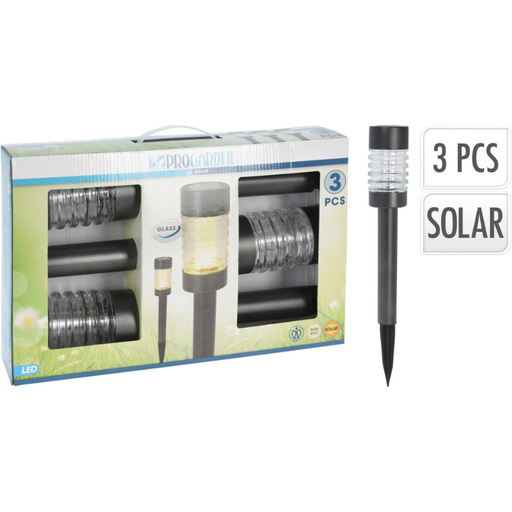
Why this choice suits this profile: This set of three solar lights lets you get started without planning any electrical connection. It is suitable for a driveway, garden border or small patio.
The stake installation avoids running a mains supply. At 5 lumens per light, its brightness level clearly defines its role: marking and creating an atmosphere, rather than providing the main lighting.
Stainless steel and glass construction, total height of 54 cm, integrated solar cell and supplied AA NiMH battery.
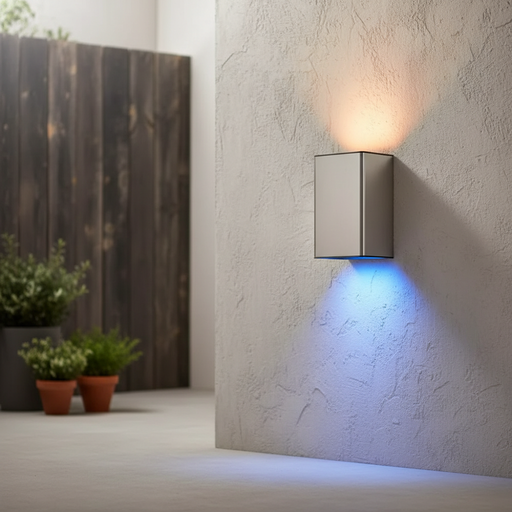
Why this choice suits this profile: This smart outdoor wall light is designed for those who want to adjust the atmosphere of a facade, patio or entrance directly from an app.
The specification mentions a construction in stainless steel, glass and plastic, along with suitable outdoor resistance. Mains connection must still be entrusted to a qualified electrician.
Adjustable white or coloured LED lighting, control via the Philips Hue app and compatibility with voice assistants and automations.
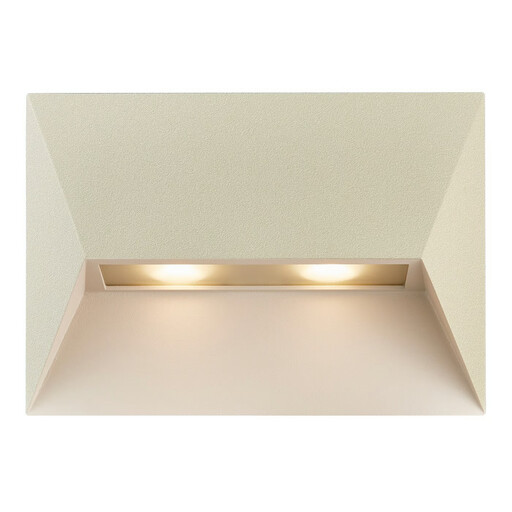
Why this choice suits this profile: Its wall-mounted format and two GU10 sockets meet the needs of an entrance, a passageway or a facade that requires clearly visible directional light.
The IP54 rating is clearly stated and the light accepts two GU10 bulbs. It is therefore impossible to mistake it for a simple decorative light with a single source.
Painted aluminium, two GU10 holders accepting up to 25 W each, dimmable with compatible bulbs and a space provided to display a house number.
We have put together a comprehensive, real-time updated selection of products that meet these strict criteria as well as European safety requirements.
For a sheltered area, IP44 may be sufficient if the light is not very exposed to splashes. IP54 offers enhanced protection against dust and splashes. The position of the light, the presence of an awning and the quality of the installation are all just as important as the stated rating.
It is mainly suitable for marking, decoration and creating ambient light. To properly illuminate steps, a door or a walkway, a mains-connected wall light or a more powerful outdoor bollard will generally be more suitable. Look at the stated lumens, the battery life and the actual exposure of the solar panel.
It all depends on the wattage of the light, how long it is used and your electricity tariff. LEDs generally consume less than an equivalent, more energy-hungry light source, but the comparison only makes sense at the same wattage and usage duration. To reduce the bill, programme the time slots, activate a sensor when the product allows it, and avoid leaving the lighting on all night.