
Livraison le jour même ou le lendemain

Qualité garantie

Débloquez vos offres de bienvenue: Livraison GRATUITE | Jusqu'à -80 % | 30 jours d'essai gratuits à JoyPlus
Téléchargez l'application
Decorating a balcony, terrace, or pergola with cascading greenery is an appealing idea. But faced with the time and maintenance that real plants demand, many give up. Outdoor artificial hanging flowers have emerged as the ideal alternative. Be careful, however: a poor choice can quickly turn this dream into a costly disappointment. Too many products fail to deliver on their promises, ending up as faded, brittle plastic after just one summer.
Before you start, here are the 3 most common traps to avoid so you don't regret your purchase:
This guide gives you the keys to sidestep these traps by teaching you to read between the lines on product descriptions and focus on the criteria that truly matter: quality and durability.
To make the right choice, forget the marketing and focus on three technical points. These are the true guarantors of your artificial plant's quality and longevity.
This is THE number one criterion for outdoor use. A simple "UV-resistant" mention on the packaging is not enough. Demand specifics about the composition.
To avoid falling into the "sparse" effect trap, you need to learn to decipher product descriptions beyond the photos.
Being able to shape your plants is essential to adapt them perfectly to their support, whether it's a planter, a hanging basket, or a trellis.
To help you visualise how these criteria apply, here are a few options that meet specific needs while avoiding common pitfalls.
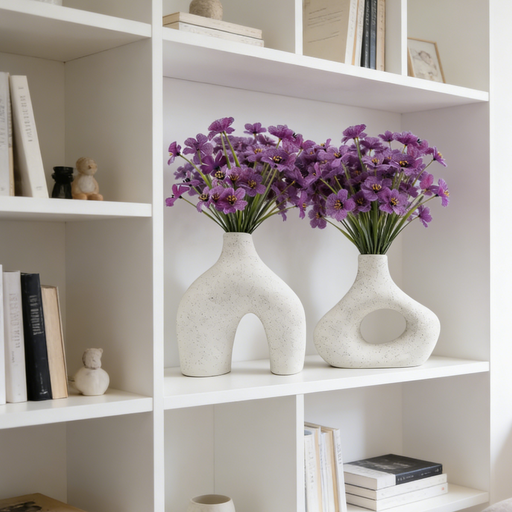
Why we chose it: Ideal for decorating several small planters or a window sill on a controlled budget. The 4-pack format offers an excellent quantity-to-price ratio to get started.
The product description specifies that the materials (PE plastic and fabric) are UV and fade-resistant treated, which eliminates the risk of colours fading in the sun.
The set of 4 bouquets totals 20 flexible branches, enough to achieve a very decent density by grouping them in a large planter, or by distributing them across several small pots.
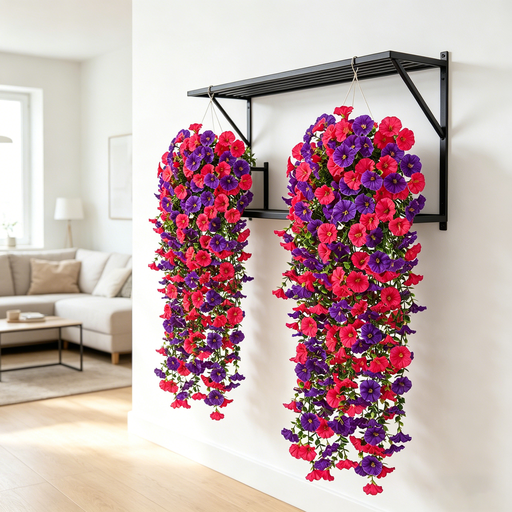
Why we chose it: Perfect for maximum visual impact. Ideal for filling large hanging baskets or tall planters to create a spectacular "waterfall" effect.
This model avoids the "sparse" effect trap by being upfront: 4 bouquets, 16 branches in total, and nearly 128 flowers. Such density guarantees a lush and generous look that lives up to the photos.
Its long length (76 cm) and very dense design create impressive volume with just one set. This allows you to achieve a lush result without multiple purchases.
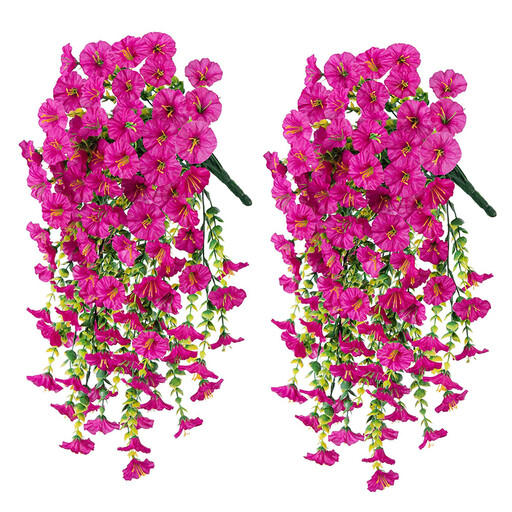
Why we chose it: The perfect option for creative projects. Its flexibility is a major asset for adorning structures like an arch, a railing, a green wall, or a pergola.
This model sidesteps the fragility trap: made of waterproof fabric and plastic, it's designed to withstand both rain and wind. This makes it perfectly suited for a durable outdoor installation.
Its vine-like structure, much more flexible than a classic bouquet, offers impressive versatility. The long stems can be bent, wrapped, and hung at will to adapt to any decor project.
Find our complete selection of products that meet our quality criteria for outdoor decor that truly lasts.
It all depends on the quality. A low-end model without UV treatment will lose its colour in less than a summer. Conversely, quality artificial hanging plants, made of PE plastic or treated fabric, can remain impeccable for several years, even when exposed to the elements. To prolong their vibrancy, a simple cleaning with clear water from time to time is enough to remove dust.
A few simple tricks can make all the difference. First, after unpacking, take the time to "fluff" and shape each stem and leaf to give them a natural movement. Next, mix several types of plants (e.g., flowers with artificial ivy or ferns) in the same planter to add texture and depth. Finally, place them in real containers (pots, planters) and add a bit of soil or decorative moss on the surface for a perfect illusion.
Yes, for the most part. Good quality plastic models (especially polyethylene) are designed to withstand freezing temperatures without cracking. They retain their flexibility even in cold weather. Be aware, however, that a deep, prolonged frost or the weight of a thick layer of snow can weaken the structures. For fabric models, it is wiser to bring them inside or place them in a sheltered area (under an awning) during harsh winters to preserve their appearance.