
Livraison le jour même ou le lendemain

Qualité garantie

Débloquez vos offres de bienvenue: Livraison GRATUITE | Jusqu'à -80 % | 30 jours d'essai gratuits à JoyPlus
Téléchargez l'application
An organiser can quickly free up space in a flat, office or wardrobe. But some purchases turn out to be disappointing after just a few weeks: wrong dimensions, flimsy materials or a stated capacity with no real-world context. To avoid nasty surprises, start by looking at the actual use, the available space and how often you'll handle it.
A 84-litre box may look spacious, but it can become difficult to move once it's full. Conversely, a small storage basket can be far more practical for accessories you use every day. So you need to weigh the capacity against the weight of the contents, where you plan to put it and whether it has handles.
A piece of furniture or an organiser might look compact in a photo, then end up sticking out from your shelf or worktop. For office storage, check the width, depth and height you actually have available. A4 documents in particular need enough room so that folders don't get bent.
A collapsible storage box is handy when you need to store it between seasons or carry it around. But its panels, seams and handles must be suited to what you put inside. A non-woven fabric box simply isn't the same as a rigid chest or a metal shelf.
Start by measuring the available space, leaving a few centimetres of clearance to open a drawer or pull out a tray. For paperwork, an A4 storage tray or a wall-mounted document holder needs to be big enough for the sheets, folders and ring binders you actually use.
Access matters just as much:
Metal works well for documents, stationery or coffee capsules when you need a stable structure. Easy to clean, plastic can serve as a compact desk organiser. Lightweight and foldable, non-woven fabric is a good choice for clothes and linen, as long as you stick to the recommended load.
For cleaning, use a soft, slightly damp cloth. Woven paper fibres should be kept away from moisture, while a metal frame needs to be dried quickly after contact with water.
A tall or hanging product needs to be properly balanced. Check the fixing, whether it has non-slip feet and how the weight is distributed. For a hanging shelf, the wardrobe rail must be able to support the total load. On a desk, a multi-function organiser with a stable base reduces the risk of tipping over when you open the compartments.
Weight capacity figures aren't always directly comparable from one product to another. When a value is given, treat it as a usage limit, not an invitation to fill every space to the maximum.
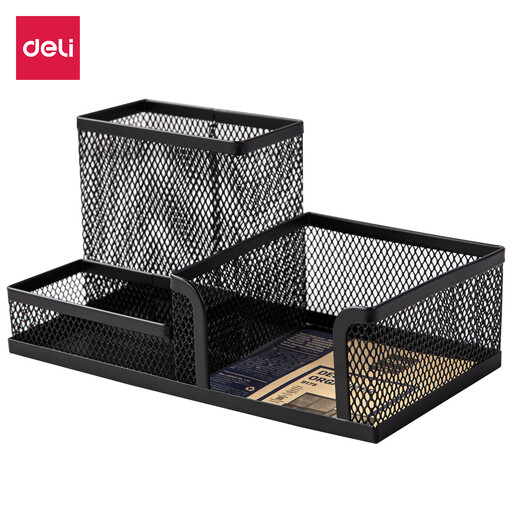
Why this choice suits this profile: Its many compartments let you start organising your desk without installing bulky furniture. It holds pens, scissors, sticky notes and small accessories.
Its compact size keeps clutter to a minimum, and the compartments keep contents visible, rather than letting stationery pile up in a single drawer.
Plastic construction, multiple storage compartments and easy cleaning with a soft cloth.
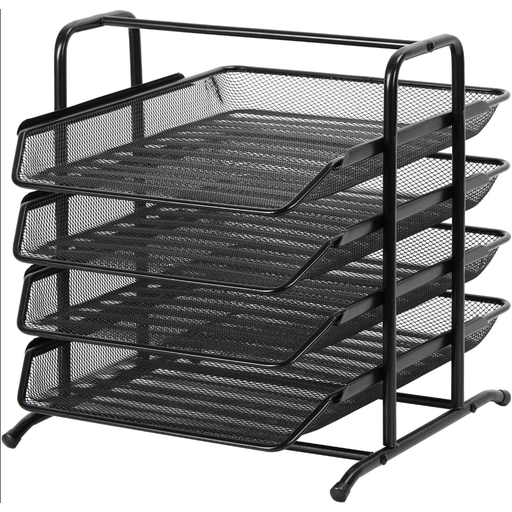
Why this choice suits this profile: Its black metal finish and four tiers fit naturally into a home office or professional workspace where you want to keep a spotless appearance.
The four rubber feet help protect your desk, while the sliding trays make it easy to access A4 documents.
Metal, four tiers, dimensions 35.5 × 29.5 × 32 cm and pull-out trays.
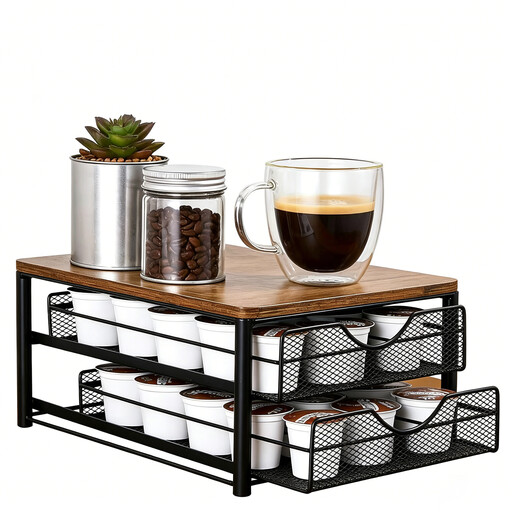
Why this choice suits this profile: In a kitchen or break area where pods are used heavily, it lets you sort them by brand or variety while keeping them within easy reach.
Its open design means you don't have to rummage through an opaque box. The non-slip base improves stability on a flat, dry surface.
Carbon steel with a matt black finish, two tiers and protective feet.
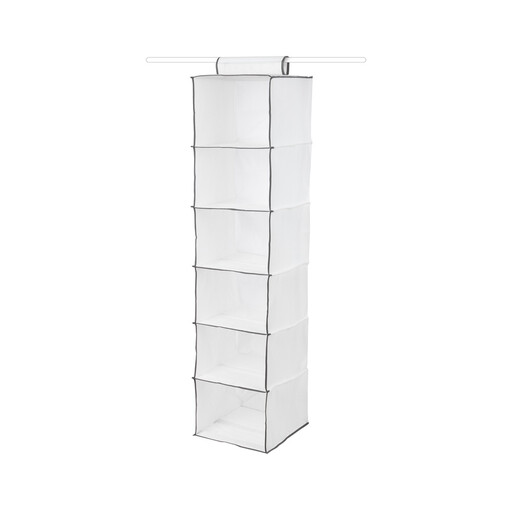
Why this choice suits this profile: This hanging shelf makes use of the height in your wardrobe to store jumpers, t-shirts, accessories or small shoes, without adding any floor-standing furniture.
The hook-and-loop fastening requires no tools to install, while the foldable structure is easy to store away when not in use.
Six compartments of 30 × 30 cm, height of 128 cm and non-woven polypropylene fabric.
A model with multiple compartments or a stacked A4 tray lets you make use of height rather than desk depth. Still, measure the space around your monitor and check that the drawers remain easy to access.
Choose a surface that can support the expected weight, then use screws and wall plugs suited to the wall type. Distribute the documents across the different levels and check the fixing regularly. On a hollow partition, you may need specialist wall plugs.
Its lifespan depends on the load, how often it's moved and where it's stored. Keep it away from moisture, don't exceed the stated weight limit and only fold the box when it's empty. If it's handled frequently, pay particular attention to the condition of the handles and seams.