For a late-afternoon snack, or when a guest wants to limit their caffeine intake, start by looking for organic ground coffee explicitly labelled ‘decaffeinated’. If caffeine isn’t your main concern, an organic Arabica described as mild may suit your taste better. In either case, check that the product you choose is certified organic and has a grind suitable for your coffee maker.
Who is this choice for?
Older people mindful of caffeine at snack time
If an afternoon coffee could affect your sleep, look for a product explicitly labelled decaffeinated. ANSES says caffeine can delay falling asleep and reduce sleep duration and quality; sensitivity varies from person to person.
Fans of a mild flavour
If you’re mainly looking for a less full-bodied taste and don’t need decaffeinated coffee, a product described as mild could help you choose. Carrefour describes its organic ground coffee as 100% Arabica.
Shoppers who look for organic and fair trade products
If these criteria matter to you, check the claims on the specific pack you’re buying. The French Ministry of Agriculture presents the Euro-leaf as a way to identify products that comply with the European Union’s organic regulations.
What should you look for?
For an afternoon snack, first decide whether caffeine is a concern, then check that the product is organic. Taste profile and claims about origin or fair trade can then help you choose between products that meet those initial criteria.
| Criteria |
What to check |
Who is it for? |
| Caffeine |
Look for the word ‘decaffeinated’ on the specific product; ‘organic’ and ‘mild’ are not substitutes. |
For a late-afternoon snack, I want to choose a coffee that takes my sensitivity to caffeine into account. Around 36% of consumers put this precaution first. |
| Organic certification |
Check for the Euro-leaf on the packaging of pre-packed organic products, and for the certification body’s details where these are displayed. |
I want to be able to identify the organic status of the pack I’m buying, rather than rely on the range name alone; this is the top priority for around 29% of consumers. |
| Taste profile |
Compare descriptions such as ‘mild’ and the stated intensity, without treating them as measures of caffeine content. |
If caffeine isn’t my main concern, I’m mainly looking for a cup described as less full-bodied. This preference comes first for around 21% of consumers. |
| Origin and fair trade |
Check the origin and fair trade claims on the product you choose. |
I want to know the stated origin or add a fair trade criterion to my organic choice; around 14% of consumers give these factors top priority. |
Mistakes to avoid
-
Confusing organic with decaffeinated
Coffee grown organically can still contain caffeine. Organic certification alone therefore won’t meet your needs if you want to limit caffeine with a late-afternoon snack.
First look for the word ‘decaffeinated’, then separately check the organic information on the same product.
-
Reading intensity as a measure of caffeine
A stated intensity or the word ‘mild’ describes the coffee’s advertised taste profile, not its caffeine content.
If caffeine determines your choice, look for an explicit ‘decaffeinated’ label rather than relying on the intensity scale.
-
Assuming all older people have the same tolerance
Age alone doesn’t tell you how someone will react to caffeine. ANSES highlights, in particular, its possible effects on sleep.
Ask your guests what they prefer and, if needed, offer a decaffeinated option. If you have a question related to medication or a health condition, ask a healthcare professional for personalised advice.
Brands to consider for these criteria
Malongo
Déca Aqua is an example of organic, decaffeinated ground coffee for anyone also looking for a product described as fair trade.
- According to Malongo, Déca Aqua is 250 g of organic Arabica ground coffee, certified organic by Ecocert France SAS FR-BIO-01 and decaffeinated using water.
- These details apply to Déca Aqua, not to all Malongo coffees.
Carrefour Bio
Worth considering if you prefer organic ground coffee described as mild and don’t necessarily need a decaffeinated option.
- Carrefour describes this 250 g product as 100% organic Arabica, sourced through a fair trade supply chain and roasted in France.
- ‘Mild’ does not mean ‘decaffeinated’.
Carte Noire
The organic, intensity 5 option lets you choose based on the stated taste profile and the pack containing two 250 g bags.
- Carrefour’s product listing describes this ground coffee as 100% organic Arabica.
- Intensity 5 doesn’t quantify its caffeine content.
Bio Village (marque E.Leclerc)
E.Leclerc listings distinguish between organic decaffeinated ground coffee and an organic product whose stated main origin is Peru.
- The decaffeinated coffee listing describes a 250 g pack of ground coffee from organic farming.
- Check availability of the product you’re interested in with your chosen E.Leclerc store.
Organic ground coffee available on Joybuy
These two ground coffees are options to consider if you’re looking for products presented as organic for an afternoon snack. If limiting caffeine is your priority, check that the product is labelled ‘decaffeinated’ before you choose.
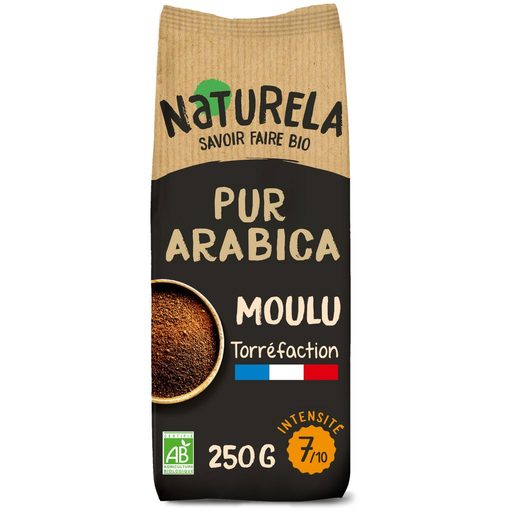 Image unavailable
NATURELA Organic Ground Coffee, 100% Arabica, 250 g
An option for an afternoon snack when you’re looking for organic, 100% Arabica ground coffee.
250 g pack. If you want to limit caffeine, check that the product you buy is labelled ‘decaffeinated’.
View on Joybuy
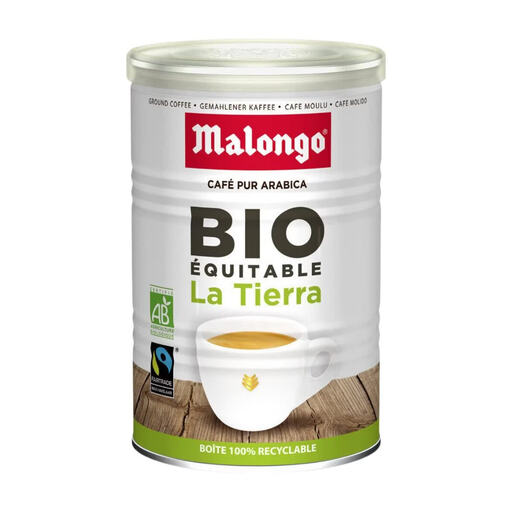 Image unavailable
MALONGO La Tierra Organic Ground Coffee, 250 g
Another 250 g pack of organic ground coffee to consider for an afternoon snack.
La Tierra is a separate Malongo product from Déca Aqua, so don’t assume it has the same decaffeinated qualities. Check the organic and ‘decaffeinated’ claims on the pack to make sure it meets your needs.
View on Joybuy
Frequently asked questions
How can you identify organic ground coffee in France?
For pre-packed organic food, check the pack for the Euro-leaf and certification details. The French Ministry of Agriculture says this European logo identifies products that comply with the European Union’s organic regulations. Check the specific product you’re buying rather than relying on the brand alone.
Will mild organic coffee help you avoid caffeine?
No. ‘Organic’ describes how the coffee is produced, while ‘mild’ describes its stated taste profile; neither means the coffee is decaffeinated. If you want to limit caffeine at snack time, look for a product explicitly labelled ‘decaffeinated’.
Does intensity 5 indicate the amount of caffeine?
No. The intensity 5 shown for the Carte Noire organic product is not a measure of its caffeine content. To tell caffeinated coffee apart from decaffeinated, check the product description rather than its intensity.
How should you store ground coffee after opening?
Seal it tightly after opening. This advice appears on a Joybuy ground coffee product listing; also follow the instructions on the pack you’ve bought.


