People who prioritise organic food
You want to be able to spot the certification on the tin itself and compare sizes before choosing.


To choose organic tinned sweetcorn for a savoury breakfast, first check for the Euro-leaf logo or AB mark on the product you’re buying, then compare the ingredients, salt per 100 g and drained net weight. Organic certification doesn’t mean that a product contains no added sugar or is low in salt. A smaller tin may also be more suitable if you’re preparing smaller portions.
You want to be able to spot the certification on the tin itself and compare sizes before choosing.
You prepare meals or savoury breakfasts and want to compare the amount of salt per 100 g, without assuming that an organic product is low in salt.
You’re looking for an amount that suits smaller recipes, a container that’s easy to handle and fewer leftovers to store once opened.
When shopping for a savoury breakfast, start with the factor that matters most to you, then check the other details on the label of the product you’ve chosen.
| Factor | What to check | Who is it for? |
|---|---|---|
| Organic certification | Look for the Euro-leaf logo or AB mark on the sweetcorn packaging. According to the French Ministry of Agriculture, organic certification is governed by a regulated framework. | I want to see the certification on the tin rather than rely on the name of a product range alone; around 40% of relevant consumers would put this first. |
| Salt | Compare the ‘salt’ figure per 100 g and take your planned portion into account. Auchan Bio’s product information lists 0.46 g per 100 g for its sweetcorn in a jar. | For my savoury breakfast, I want to know how much salt is in the sweetcorn I’ll be serving; this would be the main consideration for around 30% of relevant consumers. |
| Pack size and portion | Check the drained net weight, the type of opening and the storage instructions after opening, especially if you’ll use the contents more than once. | If I’m preparing small amounts, I prefer a manageable container and the option to use up any leftovers; around 20% of relevant consumers would prioritise this. |
| Added sugars | Read the ingredients list and check whether the exact product carries a ‘no added sugars’ claim; this claim tells you nothing about its salt content. | I’m looking for sweetcorn with no added sugar for a savoury recipe; around 10% of relevant consumers would make this their main priority. |
These claims refer to different standards. Bonduelle’s ‘no pesticide residues’ range follows its own protocol; it isn’t a substitute for organic certification.
If organic certification is essential to you, look for the Euro-leaf logo or AB mark on the product you choose.
Organic certification doesn’t determine the amount of salt in a product. Auchan Bio’s product information for its sweetcorn in a jar lists 0.46 g of salt per 100 g.
Compare the nutritional information per 100 g, then work out how much salt you’ll be getting in the portion you plan to serve.
The drained net weight tells you how much sweetcorn is left after draining. Storage instructions after opening vary by product.
Choose a size that suits your portions and follow the instructions on the packaging once it’s open.
A container that’s too large for your recipes may leave you with sweetcorn to use up within the stated timeframe.
These products offer useful comparisons for pack size and labelling. Check the details on the product you choose.
Carrefour France lists, among other products, a multipack of three tins of organic sweetcorn with no added sugars, each with a drained net weight of 140 g, as well as a 230 g drained net weight jar.
Auchan France sells organic sweetcorn in a jar with a drained net weight of 230 g, displaying the Euro-leaf and AB logos and the ‘no added sugars’ claim.
E.Leclerc sells 285 g of organic sweetcorn under the Bio Village brand and also lists an organic product with no added sugars in two 140 g tins.
The organic sweetcorn product listed by Auchan France comes in a carton with a drained net weight of 230 g.
Bonduelle organic sweetcorn products with no added sugars are included in the ranges listed by Carrefour and Auchan. The brand also offers a separate ‘no pesticide residues’ range.
These two sweetcorn products are described as organic and can be used in a savoury recipe. If a certification logo, exact quantity or salt content is important to your purchase, check these details on the packaging of the variant you choose.
 Image unavailable
This sweetcorn comes in two tins, so it may suit you if you’d like to open one tin at a time for your savoury recipes.
The product information describes sweetcorn that’s ready to eat cold or heated, and lists sweetcorn, water and salt as the ingredients. It states that it contains 0.3 g of salt per 100 g and should be kept in the fridge after opening and eaten within two days.
If you’re looking for clearly identifiable organic certification, check for the Euro-leaf logo or AB mark on the packaging. Also check the drained net weight of each tin so you can plan your portions.
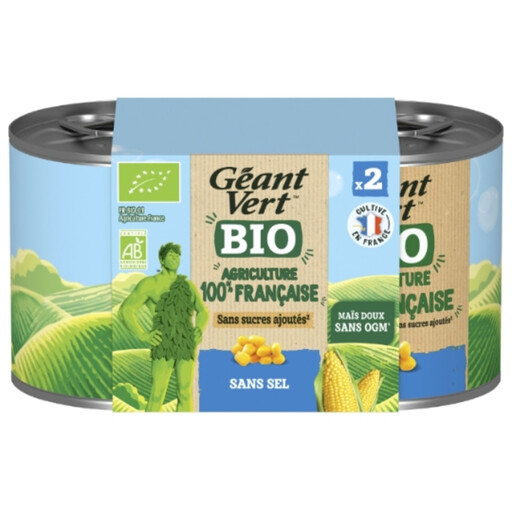 Image unavailable
This sweetcorn is described as ready to eat and suitable for a simple savoury recipe.
The ingredients list includes sweetcorn, water and salt. The title says ‘unsalted’, but the ingredients list includes salt, so don’t rely on the ‘no salt’ claim without checking the label. The quantity details also differ, so check the number of containers and the drained net weight of the variant on offer.
If organic certification is important to you, check for the logo on the packaging. Also read the storage instructions for the product after opening.
Look for the European Euro-leaf logo on the packaging; the AB mark may also be displayed. According to the French Ministry of Agriculture, organic certification is governed by a regulated framework, so check that it applies to the sweetcorn product you’re buying.
No. Organic certification, added sugars and salt content are separate considerations. For example, Auchan France describes its organic sweetcorn in a jar as having ‘no added sugars’, while its nutritional information states that it contains 0.46 g of salt per 100 g.
Yes, it can be used as an ingredient in a savoury breakfast if that fits with the way you like to eat. Follow the instructions for the product you choose: Auchan France, for example, recommends draining and rinsing its organic sweetcorn in a jar before use.
Follow the instructions on the container you’ve chosen. For its organic sweetcorn in a jar, Auchan France recommends storing it in its juice in the fridge and eating it within two days of opening; don’t assume the same timeframe applies to every product.
No, the two claims aren’t equivalent. Bonduelle describes ‘no pesticide residues’ in line with the protocol for its range; if you want certified organic sweetcorn, check separately for the certification logo on the product.