People keeping an eye on fat
You want to check the stated amount per 100 g to compare tins, rather than assuming that ‘organic’ or ‘no added sugar’ tells you anything about the fat content.


When choosing organic tinned sweetcorn while keeping an eye on fat, first compare the nutritional values per 100 g for the product you’re planning to buy. Regulation (EC) No 1924/2006 sets a maximum of 3 g of fat per 100 g for a solid food to carry the claim ‘low fat’. Organic certification is a separate matter, so it doesn’t replace checking the salt, ingredients and pack size.
You want to check the stated amount per 100 g to compare tins, rather than assuming that ‘organic’ or ‘no added sugar’ tells you anything about the fat content.
You’re looking for organic identification on the label and an ingredients list that meets your criteria. Check the nutrition table separately.
You want a usable amount for your meals, to compare salt levels and to know how to store any leftover sweetcorn once opened.
If you’re choosing organic tinned sweetcorn for a diet where you’re keeping an eye on fat, start with the value per 100 g. Then check the certification and ingredients, before choosing a salt level and pack size to suit your meals.
| Criteria | What to check | Who is it for? |
|---|---|---|
| Fat | Check the value per 100 g on the tin. For a solid food carrying the claim ‘low fat’, Regulation (EC) No 1924/2006, published on EUR-Lex, sets a maximum of 3 g per 100 g. | I want to compare tins of different sizes without relying on the word ‘organic’ alone; around 31% of consumers put fat content at the top of their list of criteria. |
| Organic certification and ingredients | Look for the EU organic logo and read the ingredients list for the product you choose. Certification describes how it was produced, not its fat content. | For food I plan to use in my meals, I want to identify its organic status and find out what’s in the tin first; this is the top priority for around 31% of consumers. |
| Salt | Compare the ‘salt’ value per 100 g and check the ingredients, particularly if you’re looking for a recipe with no added salt. | If I’m serving the sweetcorn with other salty foods, I’d rather check its salt content before choosing; around 23% of consumers prioritise this criterion. |
| Pack size and storage | Check the drained weight and the storage instructions for after opening on the packaging you buy. | I want to use an amount that suits my meals without leaving a tin open for too long; pack size and what to do with leftovers come first for around 15% of consumers. |
These claims relate to different criteria: organic certification concerns production, while a nutrition claim depends on the food’s composition.
Check the ‘fat’ value per 100 g, then check the organic identification and ingredients separately.
Bonduelle Organic Sweetcorn with No Added Sugar, in a 285 g drained-weight pack, lists 7.5 g of sugars per 100 g. The claim doesn’t mean that naturally occurring sugars are absent.
If this value matters to you, check the ‘of which sugars’ line in the nutrition table for the product you buy.
The product information for Carrefour Bio, Bonduelle Bio and Auchan Bio lists 0.28 g, 0.30 g and 0.40 g of salt per 100 g respectively for the products reviewed. A lower fat content therefore doesn’t tell you how much salt a product contains.
Compare both nutritional values on the same per-100 g basis.
An opened tin may need to be kept in the fridge and used promptly. The product information for Auchan Bio’s 2 × 140 g pack says to use the product within two days of opening.
Choose an amount to suit the meals you have planned and follow the instructions on the packaging you buy.
These products offer points of comparison for ingredients, nutritional values and pack sizes. The details apply to the products listed, not to every product from each brand.
An organic sweetcorn option sold in a pack of 3 tins, each with a drained weight of 140 g, as described on Carrefour’s product page.
Bonduelle’s Organic Sweetcorn with No Added Sugar has a drained weight of 285 g.
An organic sweetcorn option with no added sugar, listed by Auchan in a 2 × 140 g pack.
An organic sweetcorn option to consider if the ingredients list is important to you.
These tins of sweetcorn are worth considering if you’re choosing based on fat, organic certification and pack size. For the Géant Vert product below, pay particular attention to the organic claims, salt and quantity on the packaging.
 Image unavailable
The two 140 g tins let you open the sweetcorn for two separate meals. If fat content is a priority for you, compare the value per 100 g shown on the packaging for this pack.
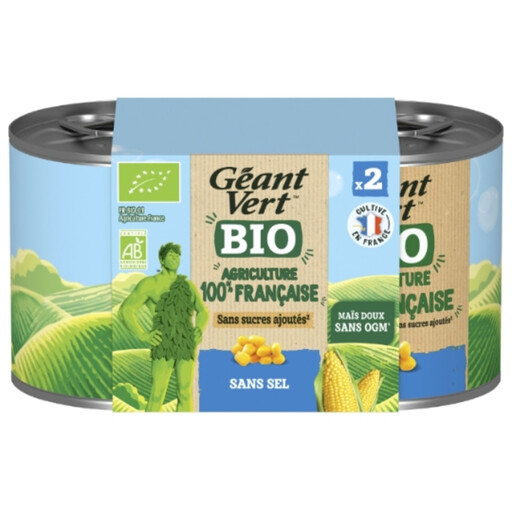 Image unavailable
If you’re looking for organic sweetcorn while keeping an eye on fat, check the certification and value per 100 g on the packaging. Also check the salt content and actual quantity: the information associated with this product doesn’t match on these points.
No. Organic certification relates to production standards, not a guaranteed fat content. For a solid food to carry the claim ‘low fat’, Regulation (EC) No 1924/2006 sets a maximum of 3 g per 100 g. Check the value for the product you buy.
The product information from Carrefour, Bonduelle, Auchan and Carrefour for the Géant Vert product lists 1.2 g, 1.4 g, 1.7 g and 1.7 g of fat per 100 g respectively. These figures apply to the specific products shown in their listings. Check the product and pack size on the packaging before comparing them.
No. Sweetcorn can contain naturally occurring sugars. Bonduelle Organic Sweetcorn with No Added Sugar, with a drained weight of 285 g, lists 7.5 g of sugars per 100 g.
Follow the instructions on the tin you’ve bought. For its organic 2 × 140 g pack, Auchan says to refrigerate the sweetcorn in a suitable container and use it within two days of opening.
Look for the EU organic logo, also known as the Euroleaf, and organic claims on the product label. The French Ministry of the Economy notes that a processed food marketed as organic must, among other things, contain at least 95% agricultural ingredients from organic farming. This status doesn’t tell you how much fat the product contains.