Cyclists looking for an organic spread
You want something to spread on toast at breakfast and compare recipes, particularly their sugar, fat and ingredients per 100 g.


Before choosing an organic spread for breakfast before a bike ride, first check that the organic certification applies to the specific jar you’re buying. Then compare the ingredients, nutritional information per 100 g and allergen advice. The hazelnut content or whether it contains milk may help you choose between two recipes, depending on your needs, but organic certification alone doesn’t tell you about their nutritional composition.
You want something to spread on toast at breakfast and compare recipes, particularly their sugar, fat and ingredients per 100 g.
You’re looking for a variety that’s explicitly milk-free. Check the exact jar and its full allergen information: an organic recipe isn’t necessarily free from milk or soya.
You want to know the hazelnut content and read a short ingredients list. Compare the fat content per 100 g too: a high proportion of hazelnuts doesn’t tell you everything about the product’s nutritional profile.
For a breakfast that’s part of your cycling routine, first confirm that the specific product is organic, then check its ingredients and whether it suits your dietary requirements. The size of the jar also matters if you’ll be using it over time.
| Criteria | What to check | Who is it for? |
|---|---|---|
| Organic certification | Look for an organic certification that applies to the product you’re buying; a claim such as ‘natural’ or ‘palm oil-free’ is not a substitute. | I want the spread on my toast to genuinely meet my organic requirements. Around 33% of consumers rank this certification as their top priority. |
| Nutritional composition | Compare the sugar and fat content per 100 g in particular, then consider how much you’ll use. | Before adding spread to my breakfast, I want to see how it compares with the other foods in my meal. For around 25% of consumers, nutritional composition is the top priority. |
| Ingredients and allergens | Read the information for the exact variety, including declared allergens and possible traces; ‘organic’ and ‘milk-free’ refer to different criteria. | If I need to avoid milk or another ingredient, the range name alone isn’t enough to help me choose a jar. For around 25% of consumers, suitability comes before all other criteria. |
| Size and storage | Check the net weight and storage instructions, particularly after opening. | I prefer a size I can use while following the manufacturer’s instructions. Around 17% of consumers say this is their main priority. |
In France, Nutri-Score is optional, according to the Ministry of the Economy. Its absence alone therefore doesn’t tell you whether an organic spread is a good choice.
Use the nutrition declaration to compare prepacked products; the DGCCRF states that this labelling is compulsory for these foods.
Organic recipes can vary considerably. For example, Rigoni di Asiago lists 51 g of sugar and 32 g of fat per 100 g for Nocciolata L’Originale. A high proportion of hazelnuts doesn’t necessarily mean a low fat content either.
Compare the values per 100 g for the products you’re interested in, then consider how much you’ll use as part of your breakfast overall.
A variety labelled milk-free may still contain hazelnuts or other allergens. Claims about one variety don’t automatically apply to the whole range.
Before choosing, read the ingredients, allergen information and possible traces on the exact jar you’re buying.
Storage instructions and how long a product lasts after opening depend on the specific product. A larger size is only practical if it suits how quickly you’ll use it.
Check the net weight and the instructions on the packaging before choosing a size.
A jar left open beyond the recommended conditions may go to waste.
Always compare a specific product: ingredients, allergens and nutritional values can vary between varieties within the same brand.
The range includes organic cocoa and hazelnut spreads, including L’Originale and L’Intense, which Rigoni di Asiago describes as milk-free.
Carrefour offers an organic hazelnut spread in several sizes.
The Délicieux de noisette variety focuses on hazelnuts rather than a classic cocoa and hazelnut recipe.
Lucien Georgelin offers, among other products, a 400 g organic hazelnut and cocoa spread.
The recipe described by Nutella France is included here only as a comparison for the ingredients in a chocolate and hazelnut spread, not as an organic option.
These organic products suit different kinds of toast: cocoa and hazelnut spreads, a smooth praline spread and a crunchy cereal spread. They’re not ranked by their nutritional suitability for cycling. Compare the variety and the label with your breakfast in mind.
 Image unavailable
Worth considering if you’re looking for a cocoa and hazelnut spread for your toast. Check the variety and its allergen information before buying, particularly if you avoid milk, soya or hazelnuts.
 Image unavailable
This size is worth comparing if you regularly spread hazelnut and cocoa on toast. The recipe is listed as containing milk and hazelnuts; check for other allergen information and the storage instructions on the jar.
 Image unavailable
This variety may suit you if you’re after a smooth praline texture rather than a classic cocoa and hazelnut spread. If avoiding milk is important to you, confirm this on the jar. Check the hazelnut information and exact recipe before choosing too.
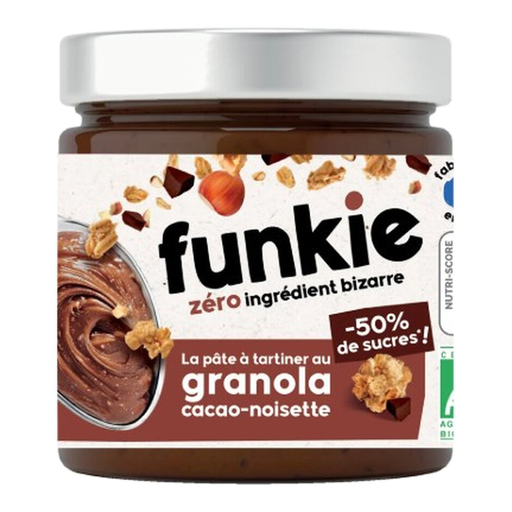 Image unavailable
Worth a look if you prefer a crunchy texture on your toast. The recipe includes oats, rice and hazelnuts, among other ingredients. Check the allergen information and the base ingredients listed on the label before comparing nutritional values.
 Image unavailable
This variety is for anyone who prefers a smooth hazelnut and cocoa spread on their toast. Check which nuts are listed and the units used for the nutritional values on the jar before comparing it with other recipes per 100 g.
No. The French Ministry of the Economy says that displaying Nutri-Score is optional in France. The DGCCRF states that a nutrition declaration is compulsory for prepacked foods. Use its values per 100 g, in particular, to compare two recipes.
No: organic certification relates to the method of production, not the overall nutritional composition of your meal. To choose, check the sugar, fat and allergen information, how much you’ll use and what else you’ll have for breakfast.
Have it as part of a breakfast or snack rather than as your only food. Adjust the amount and the rest of your meal to suit your habits and what you tolerate; an organic label doesn’t predict how a recipe will affect you during a ride.
No. A recipe labelled milk-free may contain hazelnuts or list other allergens and traces. Check the information on the jar for the exact variety you’re considering.
Follow the instructions for the product you’ve bought, as they vary from jar to jar. For its 400 g organic hazelnut and cocoa spread, Lucien Georgelin recommends storing it away from heat and moisture and consuming it within 18 days of opening. This guidance doesn’t apply to other products.