For October half-term breakfasts, first choose a spread with verifiable organic certification, then compare the recipe, nutritional information and allergens to suit your household’s needs. Nutri-Score can help you compare similar products when it is displayed, but Santé publique France says it is optional in France. It does not replace checking the ingredients list or verifying organic certification.
Who is this choice for?
Families planning breakfasts for their stay
Choose a jar size that suits the number of people and breakfasts you have planned. If a child needs to avoid certain ingredients, checking the allergens on the jar you choose is more important than preferring an organic recipe.
People who prefer a hazelnut flavour
The proportion of hazelnuts, and where sugar and oils appear in the ingredients list, can help you tell recipes apart, including organic spreads.
Households managing food exclusions
Milk, hazelnuts and warnings about possible traces vary from one product to another. Check the label on the jar you buy rather than assuming what it contains based on the brand name or organic certification.
What should you check before buying?
Before your stay, start by confirming the organic certification, then compare the recipes that are suitable for everyone who will be sharing the jar.
| Priority |
What to check |
Who it matters to |
| Organic certification |
Look for the Euro-leaf or organic certification on the jar, then read the ingredients list. The DGCCRF says that a processed food must contain at least 95% certified organic agricultural ingredients to be labelled organic. |
When organic certification is the reason I’m buying this for breakfasts during our stay, I want to be able to confirm it on the product rather than relying on a range name alone. Around 42% of consumers put this check first. |
| Recipe and nutrition |
Compare the proportion of hazelnuts, the order of the ingredients and the sugars per 100 g. Use Nutri-Score only if it is displayed, and only to compare similar products. |
If I prefer a hazelnut flavour to a cocoa and hazelnut recipe, the ingredients matter more to my choice than the word “organic” alone. The recipe and nutritional information are the main priority for around 33% of consumers. |
| Allergens and your stay |
Check the allergens and any warnings about traces on the jar. Choose a size that suits your stay and confirm it is available at the shop you plan to visit. |
If someone in my household needs to avoid certain foods, or I’m planning several breakfasts, I need to find a suitable product and size before we set off. These considerations come first for around 25% of consumers. |
Common misunderstandings to avoid
-
Assuming organic means nutritious
Organic certification tells you about a regulated method of production, not how much sugar a spread contains or its nutritional values.
When comparing similar recipes, check the sugars and fat per 100 g, as well as the order of the ingredients.
-
Thinking every jar must display a Nutri-Score
Santé publique France says that displaying it is voluntary in France. Its absence alone is no reason to judge a product’s composition.
If it appears on the packaging, use it alongside the ingredients list and nutritional information.
-
Assuming you know the allergens from an organic or “palm oil-free” claim
Depending on the recipe, products listed by Carrefour, Auchan and E.Leclerc contain hazelnuts or milk, and some warn that they may contain traces of other allergens.
If you need to avoid an ingredient, check the ingredients and any warnings about traces on the jar itself every time you buy.
-
Choosing a product without checking the store has it
A product listed in a retailer’s catalogue may not be available at the store you plan to visit. E.Leclerc specifically asks customers to contact their local store to check whether the Bio Village product is available.
Check with the store that it has the product and size you want before you set off.
Brands to compare
Jardin Bio Étic
Two recipes listed by Carrefour illustrate different options: one spread made mainly with hazelnuts and one hazelnut and chocolate spread.
- According to Carrefour’s product listings, “Délicieux de noisette” contains 80% hazelnuts, compared with 20% in the hazelnut and chocolate variety.
- The first warns that it may contain traces of peanuts, other nuts and sesame; the second contains milk. These details apply to each recipe individually.
Carrefour Bio
Carrefour’s organic hazelnut spread comes in a 350 g jar.
- Carrefour’s product listing states that it contains 13% hazelnuts and lists ingredients including cane sugar, sunflower oil and cocoa.
- It contains skimmed milk powder, so check the label if you need to avoid this ingredient.
Auchan Bio
Auchan’s organic cocoa and hazelnut spread comes in a 400 g jar.
- Auchan’s product listing displays the Euro-leaf and AB logos, and states that the spread contains 13% hazelnuts.
- This recipe contains milk. The product listing recommends storing it in a cool, dry place before opening; also check the jar for storage instructions for the rest of your stay.
Bio Village
E.Leclerc’s Bio Village organic hazelnut spread comes in a 600 g jar.
- E.Leclerc’s product listing states that it contains 13% hazelnuts, which is a useful point of comparison with other hazelnut spreads.
- It contains milk and carries warnings about peanuts, cereals containing gluten and other nuts, among other things. E.Leclerc recommends checking availability with your chosen store.
BIO® (ALDI)
ALDI’s BIO® organic spread comes in a 350 g jar.
- ALDI describes this product as “palm oil-free”.
- To compare it with another recipe or check whether it is suitable for a food exclusion, refer to the ingredients and allergen information on the jar you choose.
Spreads available on Joybuy
These jars are suited to breakfasts during a stay, with cocoa and hazelnut, praline or granola-textured recipes. To compare them, consider the size, ingredients and storage instructions on each jar.
 Image unavailable
RIGONI DI ASIAGO Nocciolata Organic cocoa and hazelnut spread, 250 g
This size is worth considering if only a few people will be sharing the cocoa and hazelnut spread during your stay. The product listing identifies hazelnuts, milk and soya; check the label if these allergens are a concern, and confirm the organic certification on the jar.
View on Joybuy
 Image unavailable
LUCIEN GEORGELIN organic hazelnut and cocoa spread, 400 g
This size could suit several shared breakfasts; check the jar for how long and how to store it after opening. The product listing identifies milk and hazelnuts, and warns that it may contain other nuts.
View on Joybuy
 Image unavailable
FUNKIE smooth organic hazelnut and cocoa spread, 200 g
This small jar is for anyone looking to compare a hazelnut and cocoa recipe that also contains red bean purée. The product listing says to refrigerate after opening, so check that this suits your stay. Hazelnuts are listed as an allergen.
View on Joybuy
 Image unavailable
FUNKIE smooth organic praline spread, 200 g
Worth comparing if you’re looking for a small jar of praline spread: the recipe includes red bean purée. The product listing identifies hazelnuts and says to refrigerate after opening.
View on Joybuy
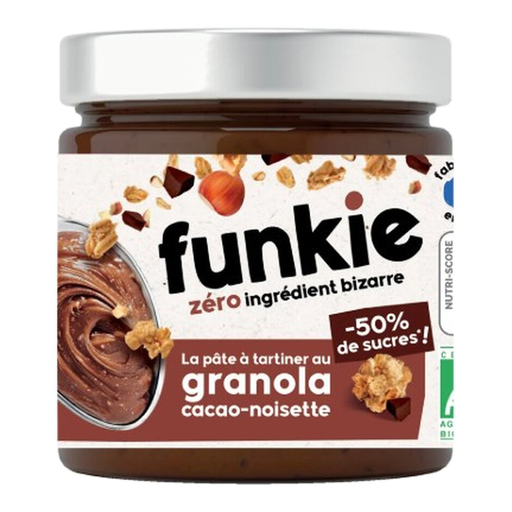 Image unavailable
FUNKIE crunchy organic hazelnut and granola spread, 200 g
If you’re after a crunchy texture rather than a classic cocoa and hazelnut spread, this variety combines cereals with hazelnuts. The product listing identifies gluten and nuts, so check the ingredients and any warnings about traces on the jar.
View on Joybuy
Frequently asked questions
Is Nutri-Score compulsory on spreads in France?
No. Santé publique France says displaying it is voluntary. If it appears on the jar, compare it with similar spreads; if it doesn’t, use the ingredients list and nutritional information rather than drawing conclusions from its absence alone.
How can you check whether a spread is organic?
Look for organic certification on the packaging and check the ingredients list. For processed foods, the DGCCRF says that a product must contain at least 95% certified organic agricultural ingredients to be labelled “organic”.
Does an organic spread necessarily have a favourable Nutri-Score?
No: organic certification and Nutri-Score describe different things. Compare products in the same category by checking their ingredients, nutritional values per 100 g and Nutri-Score, if displayed. Don’t assume you know the composition from the organic label alone.
What should you check before taking a jar on holiday?
Check the allergens and any warnings about traces on the jar, its weight, its best-before date and the storage instructions after opening. If you plan to buy it before setting off, also confirm that it is available at your chosen shop.


