For a meal before or during a flight, choose a spread whose organic certification you can check, then read the ingredients in light of any foods you need to avoid and compare the nutritional values per 100 g. If you plan to take the jar through security, don’t assume it’s allowed based on its weight in grams: at Paris-CDG and Paris-Orly, Paris Aéroport limits liquids, gels and aerosols to 100 ml per container. Nutri-Score is optional in France, so its absence doesn’t prevent you from checking the nutritional information.
Who are these criteria useful for?
Travellers with cabin baggage
You’re planning to eat before or during a flight and want to know what to do with your jar at security. For liquids, gels and aerosols, Paris Aéroport sets a limit of 100 ml per container at Paris-CDG and Paris-Orly. The weight printed on a jar of spread isn’t enough on its own to determine whether it’s allowed.
Shoppers looking to check organic certification
You want to distinguish certified products from those that are simply presented as ‘natural’. For relevant prepacked organic products in the European Union, check for the EU organic logo, the code of the control body and the agricultural origin. The European Commission explains that use of the logo requires, among other things, at least 95% organic ingredients.
Shoppers who pay close attention to ingredients
You need to avoid milk, soya or certain nuts and want to find the exact recipe that meets your needs. A cocoa and hazelnut spread labelled as milk-free may still contain hazelnuts and soya; the information on the specific product you choose is what matters.
What should you check before choosing?
For a meal before or during a flight, check the certification and how you’ll transport the jar before comparing recipes by their ingredients and nutritional values.
| What matters to you |
What to check |
Who is this for? |
| Organic certification |
On the packaging for the product in question, look for the EU organic logo, the control code and the agricultural origin. |
I want to be able to recognise a certified product rather than judge by the look of the jar alone. Around 33% of consumers would put this organic check at the top of their list. |
| Getting through security |
Check your departure airport’s rules and the container’s volume; a weight in g can’t be converted directly into a volume in ml. |
If I’m keeping the jar in my cabin baggage, I want to know whether I can take it through security. Transport would be the top priority for around 27% of consumers. |
| Ingredients and allergens |
Read the ingredients for the exact variant, along with any ‘may contain’ statements, especially for milk, soya and nuts. |
If I need to avoid a specific ingredient, ‘organic’ or ‘palm oil-free’ doesn’t answer my question. Finding a recipe that suits a dietary exclusion would come first for around 20% of consumers. |
| Nutritional values |
Compare sugars, fat, saturates and salt on the same per-100 g basis. |
When choosing between two recipes or jar sizes, I want to compare values based on the same quantity. Around 20% of consumers would make this nutritional comparison their top criterion. |
Common misconceptions to avoid
-
Assuming organic means nutritious
Organic certification relates to production and labelling standards; on its own, it doesn’t tell you how much sugar or fat a spread contains.
Read the ingredients list and compare the nutritional values per 100 g for the recipes you’re interested in.
-
Assuming a jar is allowed in the cabin because it’s food
At Paris-CDG and Paris-Orly, Paris Aéroport’s published limit for liquids, gels and aerosols is 100 ml per container. A jar labelled in grams, whether it’s 270 g, 350 g or 400 g, doesn’t prove that it meets this limit.
Before you travel, check the rules that apply at your airport and for your journey. You could also eat the spread before security, pack it in hold luggage if the rules allow, or buy it after security.
Relying on a jar that isn’t allowed through security could mean having to leave it behind.
-
Assuming ‘milk-free’ means ‘allergen-free’
The milk-free Nocciolata listed by Carrefour contains hazelnuts and soya lecithin. Another palm oil-free recipe may contain milk and several types of nuts.
Check the ingredients and any warnings about traces on the specific variant you plan to buy.
-
Thinking Nutri-Score is compulsory
The French Ministry of the Economy says that displaying Nutri-Score is optional in France. Nutritional declarations are required for most prepacked foods, subject to certain exceptions, so the absence of the logo doesn’t mean anything is wrong.
If the product displays Nutri-Score, read it alongside the other information on the label. If not, compare the nutritional values per 100 g, as recommended in the guidance described by the DGCCRF.
Brands to know
These examples show why it’s important to check the recipe and format of the specific product, even when several jars carry an organic label.
Rigoni di Asiago / Nocciolata
The range includes a 270 g milk-free cocoa and hazelnut Nocciolata listed by Carrefour, as well as a recipe containing milk listed by Auchan.
- The milk-free version listed by Carrefour contains 19,5% hazelnut paste and 11% fat-reduced cocoa.
- This version contains hazelnuts and soya. The recipe with milk is a separate product, so the ‘milk-free’ label doesn’t apply to the whole range.
Jean Hervé
La Chocolade is an organic, fair trade palm oil-free spread available in a 350 g jar.
- Jean Hervé states that this recipe contains 31% hazelnuts and 10% full-fat cocoa.
- It contains milk and several types of nuts. Its weight of 350 g doesn’t prove that it can be taken through security in cabin baggage.
Ethiquable
The brand describes its hazelnut spread as organic and fair trade, made with cocoa from the Dominican Republic.
- According to Ethiquable, fair trade ingredients make up 65% of the total weight of this recipe.
- The recipe contains hazelnuts and skimmed milk powder; the brand warns that it may contain traces of other nuts and soya.
Lucien Georgelin
The 400 g organic hazelnut and cocoa product featured on Joybuy lists the proportions of hazelnuts and cocoa.
- The product listing states that this recipe contains 16% hazelnuts and 7% fat-reduced cocoa.
- It contains milk and hazelnuts, and may contain traces of other nuts. The 400 g format doesn’t prove that it’s allowed in cabin baggage.
Spreads available on Joybuy
This selection includes cocoa and hazelnut spreads, a praline spread and a cocoa and peanut recipe to help you prepare a meal before or during a flight. Before choosing a jar, check the organic claims and ingredients that matter to you on its packaging; its weight doesn’t tell you whether it’ll be allowed in the cabin.
 Image unavailable
Rigoni di Asiago Nocciolata organic cocoa and hazelnut spread, 250 g
This cocoa and hazelnut recipe is worth considering if you’re planning a meal before you travel. The jar is listed as 250 g.
If you need to avoid milk or another ingredient, read the label on this 250 g variant rather than assuming it has the same ingredients as another Nocciolata product. Also check the organic certification details on the jar and the applicable rules before packing it in your cabin baggage.
View on Joybuy
 Image unavailable
FUNKIE organic cocoa and hazelnut spread, smooth, 200 g
This 200 g product is a cocoa and hazelnut option for a meal you’ve planned around your journey.
Check the allergens and organic claims on the packaging for this recipe. For a nutritional comparison, use values shown on the same basis; the jar’s weight doesn’t tell you whether it’s allowed through security.
View on Joybuy
 Image unavailable
FUNKIE organic praline spread, smooth, 200 g
This 200 g jar is for anyone looking for a praline-style spread rather than one simply described as cocoa and hazelnut.
The word ‘praline’ doesn’t replace the ingredients list, so check it if you avoid certain nuts. For travel, check the organic claims and cabin baggage rules separately.
View on Joybuy
 Image unavailable
Lucien Georgelin organic hazelnut and cocoa spread, 400 g
This 400 g product lets you explore a cocoa and hazelnut recipe whose listing states that it contains 16% hazelnuts and 7% fat-reduced cocoa.
It contains milk and hazelnuts, and may contain other nuts, so check the allergen information if you need to avoid these ingredients. Check the organic claims on the packaging, and don’t treat the 400 g weight as proof that it meets cabin baggage rules.
View on Joybuy
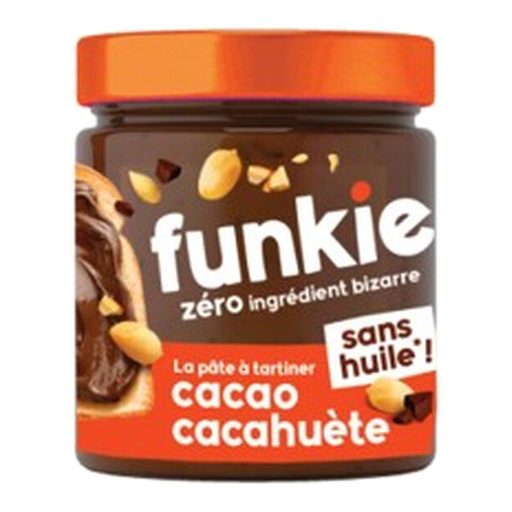 Image unavailable
FUNKIE organic cocoa and peanut spread, smooth, 200 g
This 200 g spread combines cocoa and peanuts, making it a different choice from a cocoa and hazelnut recipe.
It isn’t suitable if you need to avoid peanuts. Check the label for other ingredients and organic certification, and check the security rules before planning to take the jar in your cabin baggage.
View on Joybuy
Frequently asked questions
Is Nutri-Score compulsory on organic spread in France?
No. The French Ministry of the Economy confirms that displaying it is optional in France. To compare two prepacked spreads, check their nutritional values per 100 g; according to the DGCCRF, nutritional declarations are required for most of these foods, subject to certain exceptions.
How can I recognise a certified organic spread?
For relevant prepacked organic products in the European Union, look for the EU organic logo, the code of the control body and the origin of the agricultural raw materials. The European Commission says that use of the logo requires, among other things, at least 95% organic ingredients; check these details on the specific product and size you’re buying.
Can I take a jar of spread in my cabin baggage?
Don’t assume a standard jar will be allowed through without checking the rules for your departure airport. At Paris-CDG and Paris-Orly, Paris Aéroport limits liquids, gels and aerosols to 100 ml per container, carried in a single sealed transparent bag with a maximum capacity of one litre; the jar’s weight in grams doesn’t establish its volume or determine the decision made at security. Check with your departure airport and airline, or plan to pack the jar in hold luggage if permitted.
Is organic milk-free spread suitable if I need to avoid other allergens?
Not necessarily. The milk-free Nocciolata listed by Carrefour contains hazelnut paste and soya lecithin. Check the full ingredients list, stated allergens and any warnings about traces for the exact variant.


