Who is this choice for?

People keeping an eye on the calories they serve

If you’re looking for an organic option for drinks and nibbles, compare the kcal per 100 g, then consider how much you’ll actually put in the bowl. A small pack doesn’t necessarily mean a small portion.

People keeping an eye on salt

If you want to compare organic savoury biscuits on this basis, check the ‘salt’ line per 100 g alongside the energy value. Manger Bouger, the Santé publique France website, lists savoury biscuits among the products it recommends limiting when they are high in salt.

Guests with dietary exclusions

If an ingredient needs to be avoided, check the ingredients list and any ‘may contain’ warnings for the exact product. Being organic or lower in calories doesn’t, by itself, tell you anything about allergens.

Which criteria should you check?

When choosing organic savoury biscuits, start by comparing products per 100 g, then check how your intended portion affects the figures.

Criteria What to check Who is it for?
Calories served Compare the kcal per 100 g for biscuits intended for the same purpose, then consider the amount planned per person. If I want to reduce the calories in my nibbles, the amount I put in the bowl matters just as much as the value shown per 100 g. Around 37% of consumers prioritise the calories in their portion.
Salt and Nutri-Score Check the salt content in g per 100 g. If a Nutri-Score is shown, compare it across similar products. A lower-calorie recipe won’t meet my needs if its salt content is less suitable for me. Salt and nutritional information come first for around 36% of consumers.
Organic status and ingredients Check the organic details on the packaging, then look at the ingredients, allergens and any ‘may contain’ warnings. To serve biscuits that are suitable for my guests, I need to check the specific product, even if the packaging says it’s organic. Around 27% of consumers put organic status and ingredient suitability at the heart of their choice.

Mistakes to avoid

  • Assuming ‘organic’ means ‘low in calories’

    The organic label relates to the method of production, not the energy content. Auchan’s product pages for three organic savoury biscuits list 423, 464 and 473 kcal per 100 g respectively.

    Use organic status as your starting point, then compare the kcal per 100 g and the portion you plan to serve.

  • Expecting every pack to have a Nutri-Score

    According to the French Ministry of the Economy, displaying the Nutri-Score is optional in France. Its absence therefore doesn’t mean you can rank one biscuit against another.

    If it appears on the packaging, use it to compare similar products; also check their nutritional values per 100 g.

  • Checking calories but not salt

    On Auchan’s product pages, Aglina P'tit snack tomato & basil has 423 kcal and 2.47 g of salt per 100 g, compared with 464 kcal and 1.2 g of salt per 100 g for Bjorg Crousti'pois chiche et curry.

    Compare both figures before you choose, then take the amount you’ll serve into account.

  • Assuming the organic label means there are no allergens

    Organic recipes can contain allergenic ingredients or carry ‘may contain’ warnings. A ‘gluten-free’ claim doesn’t tell you whether other ingredients you need to avoid are present.

    Read the ingredients list and warnings on the exact product before serving it.

Brands to know

Carrefour Bio

Carrefour offers, among other products, organic gouda savoury biscuits under this brand.

  • Carrefour’s product page lists 130 kcal per 25 g serving.
  • This figure is based on a 25 g serving; also check the ingredients if you need to avoid wheat or milk.

Bio Village

E.Leclerc’s Bio Village range includes mini pumpkin seed and cheese crackers, as well as organic pretzels.

  • These products let you compare several types of savoury biscuits within the range.
  • Check the nutritional values and, if displayed, the Nutri-Score for each product rather than judging the whole brand at once.

Bjorg

Organic Crousti'pois chiche et curry is worth comparing if fibre and salt are among your criteria.

  • Auchan’s product page lists 464 kcal, 10 g of fibre and 1.2 g of salt per 100 g.
  • This isn’t the lowest-calorie option of the three biscuits compared in this article.

Jardin Bio Étic

The brand offers, among other products, Crousti Apéro puffed biscuits with onion and herbs.

  • Auchan’s product page lists 473 kcal and 1.53 g of salt per 100 g, two useful figures for comparing this recipe.
  • The product page warns that it may contain traces of peanuts, tree nuts and celery.

Aglina

P'tit snack tomato & basil is described as organic and gluten-free on its product page.

  • Auchan’s product page lists 423 kcal per 100 g, the lowest energy value of the three products compared here.
  • It also lists 2.47 g of salt per 100 g; check for ‘may contain’ warnings if you need to avoid other ingredients.

A product to consider on Joybuy

For drinks and nibbles featuring savoury shortbread biscuits, this parmesan and chia seed option is worth considering in light of your portion, salt and organic labelling criteria.
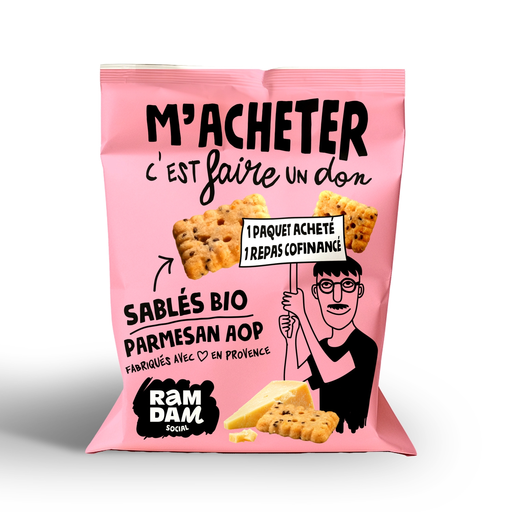
RAMDAM SOCIAL savoury parmesan and chia seed shortbread biscuits, 100 g pack

RAMDAM SOCIAL Organic, savoury parmesan and chia shortbread biscuits, 100 g

These savoury shortbread biscuits could be an option for drinks and nibbles if you want to compare the amount served with other biscuits. The pack contains 100 g. If organic status is important to you, check the certification details on the packaging for this product before buying.

View on Joybuy

Frequently asked questions

Is the Nutri-Score compulsory on savoury biscuits in France?

No. According to the French Ministry of the Economy, the Nutri-Score is optional in France. The DGCCRF states that the nutrition declaration on the relevant prepacked foods includes values per 100 g or 100 ml, among other details. If the logo isn’t displayed, these figures remain the basis for comparison.

How can I check whether a savoury biscuit is organic?

For a prepacked food of European origin that meets the requirements for using the logo, look for the EU organic logo and check the certification and origin details on the packaging. Agence BIO says the logo applies to foods containing at least 95% organic ingredients, excluding water and salt; it doesn’t tell you how many calories the product contains.

Should I compare calories per portion or per 100 g?

Start with the kcal per 100 g to compare biscuits intended for the same purpose, then work out how much you’ll actually serve. A figure given per 25 g portion is only relevant to your nibbles if the portion you serve is about that size.

Does a lower-calorie organic biscuit always contain less salt?

No. On Auchan’s product pages, Aglina P'tit snack tomato & basil has 423 kcal and 2.47 g of salt per 100 g, while Bjorg Crousti'pois chiche et curry has 464 kcal and 1.2 g of salt per 100 g. Compare both figures according to what matters most to you.

Are the organic label or a ‘gluten-free’ claim enough for guests with dietary exclusions?

No. Check the ingredients list and any ‘may contain’ warnings on the specific pack you’re going to serve. A gluten-related claim doesn’t, by itself, tell you whether other ingredients you need to avoid are present.