Organic shoppers keeping an eye on sugar
If you’re looking for an organic product and want to distinguish added sugars from naturally occurring sugars, check both the ingredients list and the ‘of which sugars’ figure in the nutritional information.


If you’re looking for organic porridge while keeping an eye on sugar, plain oats let you choose what to add yourself, as long as you check that the product you buy is certified organic. Ready-to-cook organic porridge meets a different need. If you prefer a fruit mix, compare the ‘of which sugars’ figure per 100 g: ‘no added sugars’ doesn’t mean ‘sugar-free’.
If you’re looking for an organic product and want to distinguish added sugars from naturally occurring sugars, check both the ingredients list and the ‘of which sugars’ figure in the nutritional information.
Plain oats let you choose the liquid and toppings, rather than buying a recipe that already includes fruit. The ingredients in Quaker Oats, as listed by Quaker France, are an example of this oats-only format; you’ll still need to check that the product you choose is organic.
Organic status alone doesn’t tell you whether a product contains wheat, spelt or other ingredients you need to avoid. Anses recommends checking the ingredients list when this information matters to your choice.
To compare the different formats, start with your top priority, then check the other details on the packaging of the exact product you plan to buy.
| What matters to you | What to check | Who this matters to |
|---|---|---|
| Total sugars | Compare the ‘of which sugars’ figure per 100 g and look for fruit or other sweetening ingredients in the ingredients list. | If I’m keeping an eye on the sugar in my porridge, the words ‘no added sugars’ aren’t enough to help me choose between a plain recipe and a fruity one. Around 42% of consumers would put total sugars first. |
| Organic status | Check for the organic label and certification details on the packaging of the exact product. | When shopping for organic food, I want to be able to confirm the status of the pack I’m buying, rather than relying on the brand or the word ‘oats’ alone. Organic status would be the top priority for around 33% of consumers. |
| Ingredients and allergens | Read the ingredients list, declared allergens and any ‘may contain’ statements. | When certain cereals or allergens matter to my choice, I need to be able to check the recipe and any warnings about traces. Around 25% of consumers would put suitability first. |
A fruit mix can carry this claim and still contain naturally occurring sugars. Carrefour’s listing for Bjorg three-grain porridge and Auchan’s listing for Bjorg fruit muesli, for example, describe two different recipes.
To compare them, look at the ‘of which sugars’ figure per 100 g, not just the claim on the front of the pack.
Auchan’s listing for Bjorg three-grain porridge mentions wheat and spelt; Quaker France says its Quaker Oats may contain barley and wheat.
Check the ingredients and any warnings about traces on every pack, even if you’re already familiar with the product.
With fruity muesli, the fruit is already part of the mix, so you can’t choose each topping separately.
If having that freedom matters more to you than the convenience of a ready-made recipe, start with plain oats and add the ingredients you want.
A product listing doesn’t guarantee that the exact pack will be available at your chosen store or through your preferred collection option.
Check that the product is available before travelling or placing your order.
The brand offers, among other products, organic three-grain porridge and organic fruit mueslis listed by French retailers.
Quaker Oats, as presented by Quaker France, are wholegrain rolled oats to prepare your own way.
An option if you’d like organic fruit muesli rather than plain oats or ready-to-cook porridge.
The range presented by E.Leclerc includes organic cereal products such as oat bran and muesli.
You can check your local store’s organic range, but don’t assume that a particular porridge will meet all your requirements.
These two products suit different needs: organic rolled oats for making your own porridge, and organic porridge with chia and fruit. If you’re choosing based on sugar or allergens, be sure to check the information on the pack too.
 Image unavailable
A good option if you want to make your own porridge and choose the toppings separately. The pack is described as 500 g of organic rolled oats; check its nutritional information and allergen statements against your requirements.
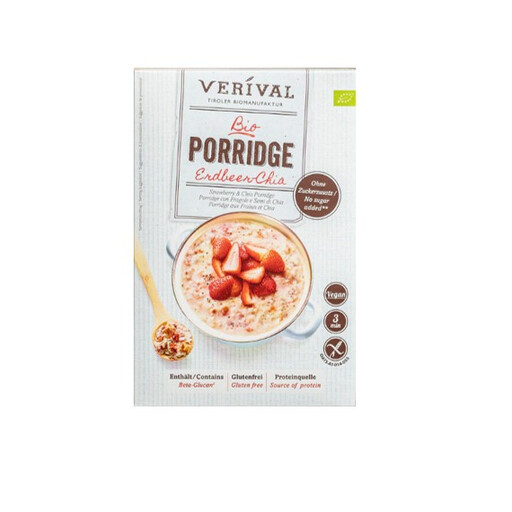 Image unavailable
A good option if you prefer porridge with chia and fruit already mixed in. The pack is described as 350 g of organic porridge; if no added sugars is important to you, confirm this claim on the packaging and check the ‘of which sugars’ figure.
No. As Carrefour explains in its listing for Bjorg three-grain porridge, this claim doesn’t rule out naturally occurring sugars. To choose between a plain recipe and one with fruit, compare the ‘of which sugars’ figure per 100 g.
Check the organic claim and certification details for the exact product, rather than relying on the brand or its main cereal. In the European Union, Regulation (EU) 2018/848 governs the production and labelling of organic products.
No. Check the ingredients and statements on the product you choose. Auchan’s listing for Bjorg three-grain porridge includes wheat and spelt, while Quaker France says its Quaker Oats may contain barley and wheat.
Start with the ingredients list, declared allergens and nutritional information, especially the ‘of which sugars’ figure per 100 g. Anses highlights the value of checking the ingredients list if you need to keep an eye on particular components.