People who make their porridge from scratch
If you add your own toppings, oats with a simple ingredient list give you a clear starting point. Carrefour and E.Leclerc each list an organic option made from wholegrain oats.


To make your own organic porridge, choose plain oats so you can check the ingredients and organic labelling on the pack. A large bag is suitable for regular use if you can keep it dry; buying loose lets you get a more precise quantity, while a ready-to-make mix is ideal when you fancy a recipe that’s already been put together. None of these formats guarantees a metal tin, so check the packaging before planning how to store it.
If you add your own toppings, oats with a simple ingredient list give you a clear starting point. Carrefour and E.Leclerc each list an organic option made from wholegrain oats.
A 900 g bag may suit frequent use, provided you can reseal it and keep it dry. Auchan lists this size for an organic Bjorg product, for example.
Organic labelling alone doesn’t meet this requirement. Check the exact product for a ‘gluten-free’ label and allergen warnings: the Carrefour Bio product listing, for example, warns that it may contain traces of other cereals containing gluten.
| What to consider | What to check | Who is it for? |
|---|---|---|
| Organic labelling and ingredients | Look for the EU organic logo, the code of the control body and the origin of the raw ingredients on the pack, then read the ingredients list. Agence Bio explains what the European logo and origin statement mean. | I want plain oats as a base so I can make my own porridge, without mistaking plain flakes for a mix. Around 42% of consumers would put checking organic credentials and ingredients at the heart of their choice. |
| Quantity and storage | Choose a quantity that suits how much you use and check how to reseal the pack; keep the oats dry. | If I make porridge often, I want enough oats in the cupboard without leaving a bag open to damp. Pack size and storage would be the priority for around 33% of consumers. |
| Texture or gluten-free labelling | Check the type of oats to get the texture you want. If needed, look for a ‘gluten-free’ label on the exact product and check its allergen information again. | To get a particular texture or meet a gluten-free requirement, I need to choose a specific product rather than rely on organic labelling alone. Around 25% of consumers would prioritise one of these product features. |
Organic oats may carry a warning about traces of other cereals containing gluten, as shown on the Carrefour Bio product listing.
If gluten-free is essential, look for this label on the product you choose and check the pack’s allergen information again, even if you’re only switching to a different size.
A large pack doesn’t mean its contents will be protected from damp once it’s been opened.
Choose a quantity you’ll use and follow the product’s storage instructions. If the bag doesn’t seal properly, use a clean, dry, airtight food container.
The organic five-cereal mix by Bjorg described by Auchan contains wheat, oats, barley, rye and maize, among other ingredients. It isn’t a base made from oats alone.
Read the ingredients and choose plain oats if you want to make your own porridge; opt for a mix if its recipe is what you’re looking for.
Carrefour lists plain organic wholegrain oats in a 500 g bag, which can be used as a base for porridge.
The range includes several different products, such as organic jumbo oats, a 900 g organic pack and organic oats labelled ‘gluten-free’.
E.Leclerc lists Bio Village organic wholegrain oats in a 500 g bag.
Auchan lists a 500 g pack of Auchan Bio oats in its oats category.
These two products suit different needs: oats for making a plain recipe and a chocolate and peanut porridge mix that’s ready to prepare. Neither size should be mistaken for a bulk storage tin.
 Image unavailable
Worth considering if you want to make your own porridge using oats. This product comes in a 500 g pack, rather than a large size; reseal it and keep it dry after opening. It isn’t labelled gluten-free. To confirm the organic labelling for this product, check the EU organic logo, control code and origin of the raw ingredients on the packaging.
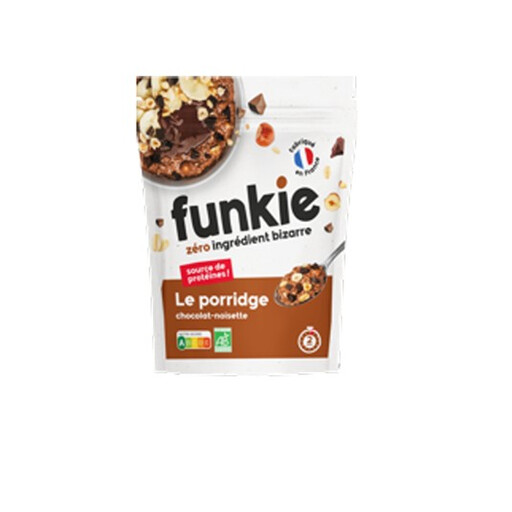 Image unavailable
Worth considering if you’re after a chocolate and peanut mix to prepare, rather than plain oats. It comes in a 280 g pack and contains peanuts and gluten. Check the packaging for the full ingredients list, what the organic labelling covers and storage instructions after opening.
Look for the EU organic logo, the control body’s code, the origin of the agricultural raw ingredients and the ingredients list. Agence Bio says the European organic logo certifies compliance with the applicable European regulation and is accompanied by a statement of the origin of the raw ingredients. Organic labelling alone doesn’t tell you whether the product contains oats and nothing else.
No. The Carrefour Bio oats listing warns that traces of other cereals containing gluten may be present. If you need a gluten-free product, choose one that is explicitly labelled as such and check the label on the pack you buy.
Keep the oats dry and reseal the bag carefully, following the storage instructions on the Bjorg product listings checked at Auchan. If the closure doesn’t suit your storage needs, use a clean, dry, airtight food container rather than assuming the bag is a storage tin.