If you’re looking for organic pasta and want to compare its fibre content, start by looking at wholemeal or semi-wholemeal options: organic certification alone doesn’t tell you whether pasta is wholemeal. To choose between these and classic organic pasta, compare the nutritional values on the same basis, then consider the amount you cook and what you serve it with. None of these labels guarantees an effect on weight.
Who are these options for?
People looking to prioritise fibre
You want to keep pasta in your meals while comparing the fibre content of organic options. Wholemeal and semi-wholemeal pasta are worth considering: Manger Bouger recommends choosing wholemeal or semi-wholemeal starchy foods.
People mindful of portion size
You want to assess the whole meal, rather than just the packet of pasta. Check what quantity the nutritional values refer to, then consider the portion you prepare, the sauce and the other ingredients.
People new to wholemeal pasta
If you’re less familiar with the texture of wholemeal pasta, semi-wholemeal could be another option to compare. Check the fibre content on the packet: the term “semi-wholemeal” alone doesn’t give you an exact figure.
What should you check before buying?
First decide what matters most for your meal — fibre, organic certification, portion size or texture — then check the relevant details for the exact product. Classic organic pasta and wholemeal organic pasta won’t necessarily meet the same priority.
| Criteria |
What to check |
Who is it for? |
| Fibre |
The “wholemeal” or “semi-wholemeal” label and the fibre listed per 100 g, using the same basis for comparison. |
I want to compare organic pasta by its fibre content, rather than relying on the product range name alone. Around 33% of consumers prioritise this factor. |
| Organic certification |
The Euro-leaf and, if it appears on the packet, the AB logo; check separately whether the pasta is wholemeal. |
My first priority is finding a certified organic product, and I’ll check its fibre content afterwards. This is the priority for around 27% of consumers. |
| Meal served |
The basis used for the nutritional values, the amount of pasta prepared and the ingredients in the sauce or topping. |
I want to consider everything on my plate, rather than attributing my choice to the packet alone. The overall composition of the meal comes first for around 27% of consumers. |
| Texture |
The difference between classic, semi-wholemeal and wholemeal pasta, as well as the ingredients in the product you choose. |
I may not enjoy the texture of wholemeal pasta, so I’d rather compare a semi-wholemeal option too. Around 13% of consumers put ease of choice first. |
Common mix-ups to avoid
-
Assuming “organic” means “wholemeal”
Organic certification and fibre content answer two different questions. Barilla France lists 3 g of fibre per 100 g for its Organic Spaghetti, while Auchan lists 11 g per 100 g for its Wholemeal Organic Spaghetti. These figures apply to these specific products.
Look for certification marks, then check for a “wholemeal” or “semi-wholemeal” label and the fibre content on the packet you plan to buy.
-
Comparing a label with a plate without checking quantities
A nutritional value given per 100 g doesn’t necessarily describe the amount of pasta served. A comparison can also be misleading if it mixes figures for dry and cooked pasta.
Check the basis given on each packet and compare equivalent quantities. Also take the sauce and toppings into account.
-
Choosing wholemeal without considering the texture
The texture of wholemeal pasta can matter just as much as its fibre content. Manger Bouger also includes semi-wholemeal starchy foods among the options to choose.
If you’re torn between two textures, compare a semi-wholemeal product with a wholemeal one, then check the fibre content of each.
-
Assuming “organic” tells you about allergens
Organic pasta made with wheat still contains wheat. Depending on the product, other ingredients or possible traces may also be listed.
If allergens affect your purchase, read the ingredients list and warnings on the packaging of the exact product.
Brands to consider
Auchan Bio
Wholemeal Organic Spaghetti is a specific product to consider if you’re comparing wholemeal organic pasta.
- Auchan lists 11 g of fibre and 336 kcal per 100 g for this product.
- Check the ingredients and allergen information on the packet you choose, rather than assuming they apply across the range.
Panzani
Its organic wholemeal wheat products, including Fusilli, give you another pasta shape to compare.
- Carrefour’s product listing for the Fusilli states that they’re made with durum wheat semolina from organic farming.
- Check the nutritional values and allergens for the shape and packet you choose; the ingredients in the Fusilli don’t apply to every Panzani product.
Barilla
Organic Spaghetti and Wholemeal Wheat Spaghetti are two distinct products to compare without confusing their features.
- Barilla France lists 3 g of fibre per 100 g for its Organic Spaghetti and 6.5 g per 100 g for its Wholemeal Wheat Spaghetti.
- The Wholemeal Wheat Spaghetti listing cited here doesn’t describe it as organic. Check the exact product if you’re looking for both features.
Carrefour Bio
The range lets you look at classic organic pasta and organic wholemeal wheat Fusilli separately.
- Carrefour states that its organic wholemeal wheat Fusilli are made with organic wholemeal durum wheat semolina.
- To compare this product with classic pasta, read the nutritional values on each packet using the same basis.
Bio Village (E.Leclerc)
The E.Leclerc range includes Bio Village wholemeal pasta shapes and Organic Spaghetti.
- Organic Wholemeal Twists and Farfalle are among the products listed by E.Leclerc.
- The pasta shape and “wholemeal” label don’t replace checking the nutritional table for the product you choose.
Pasta to compare on Joybuy
These two JARDIN BIO ETIC spaghetti products let you compare recipes with different ingredients. If you’re looking for semi-wholemeal organic pasta, check the certification, ingredients and nutritional values on each packet before comparing them with a wholemeal or classic product.
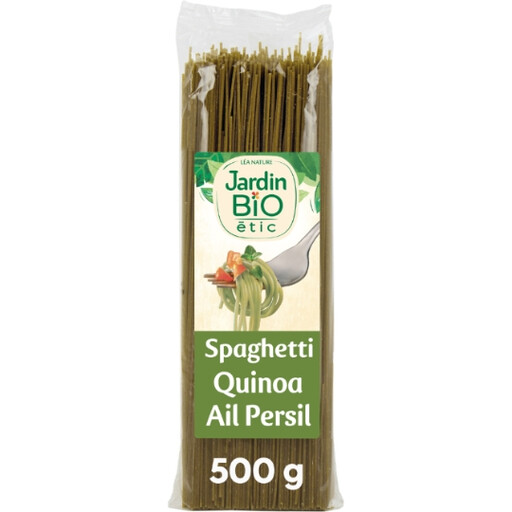 Image unavailable
JARDIN BIO ETIC colourful spaghetti with quinoa, parsley and garlic, 500 g
Worth considering if you’re looking for spaghetti made with quinoa, parsley and garlic. This product comes in a 500 g pack. Before comparing it with other options, check for a semi-wholemeal label, organic certification marks, allergen information and the basis used for the nutritional values.
View on Joybuy
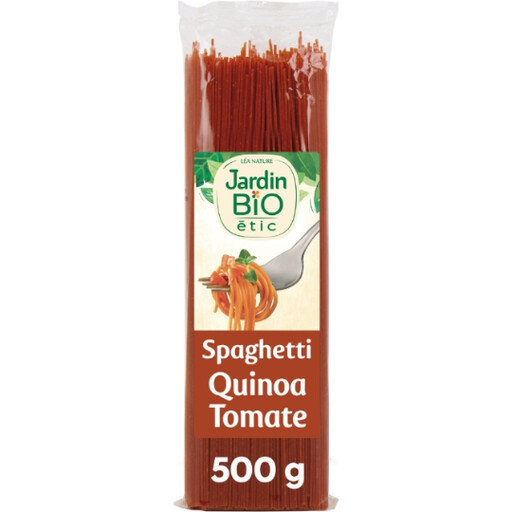 Image unavailable
JARDIN BIO ETIC colourful spaghetti with quinoa and tomato, 500 g
Worth considering if you’d rather compare a recipe featuring quinoa and tomato. Assess this 500 g pack based on its own packaging: check the ingredients, semi-wholemeal label, organic certification, allergen information and the basis used for the nutritional values.
View on Joybuy
Frequently asked questions
How can you identify organic pasta on the packet?
Look for certification marks on the product you’re buying. The French National Institute of Origin and Quality says that the Euro-leaf and AB mark are indicators of an organic product. Then check separately whether the pasta is wholemeal or semi-wholemeal.
Is “organic” enough to help you choose pasta as part of a weight-management plan?
No. “Organic” tells you about how the food is produced, not how much you’ll serve or what else is in the meal. If fibre is important to you, also compare the values listed for the specific products, using the same basis.
Should you choose wholemeal rather than semi-wholemeal pasta?
Your choice depends in part on the texture you prefer and the fibre content listed on each packet. Manger Bouger recommends choosing wholemeal or semi-wholemeal starchy foods. Neither label alone tells you the nutritional value of a specific recipe.
Is organic wheat pasta gluten-free?
No. Organic certification doesn’t remove the gluten from wheat. If you need to avoid an ingredient or allergen, check the ingredients list and information on the exact packaging.
What does the date on a packet of dried pasta mean?
Read the wording next to the date and follow the instructions for that packet. Barilla France recommends using its products before the date preceded by “Best before”. Store the product you choose according to the instructions on its packaging.


