People preparing meals to take away
If you cook pasta in advance, the number of portions, the instructions for after opening and how you transport the dish matter just as much as the sauce recipe.


To prepare pasta to take away, choose a sauce with clearly identifiable organic certification, then check that its recipe, allergens and pack size suit the portions you have in mind. A ready-made sauce needs less preparation than a tomato base you season yourself, but whichever you choose, you must follow the storage instructions after opening and keep the dish chilled when required.
If you cook pasta in advance, the number of portions, the instructions for after opening and how you transport the dish matter just as much as the sauce recipe.
If certification and ingredients guide your purchase, check the organic information first, then read the ingredients and allergens for the exact product.
A ready-made sauce is a good choice if you want to keep preparation to a minimum. A tomato base lets you choose which ingredients and seasonings to add.
For a meal to take away, first check the certification and ingredients of the exact product, then make sure its pack size and storage instructions suit how you plan to prepare it.
| Criteria | What to check | Who it matters to |
|---|---|---|
| Certification and ingredients | Look for an organic farming label on the product, then read its ingredients and allergen information. The French Ministry of Agriculture explains that organic production is governed by European regulations. | I want to choose an organic sauce without relying on a recipe simply sounding ‘natural’, and make sure its ingredients are suitable for the meal I have planned. Around 43% of shoppers put this need first. |
| Meal storage | Read the instructions for after opening and plan how to transport the prepared dish. Anses recommends using an insulated bag to transport chilled food. | If I prepare the pasta before heading out, I need to be able to store it properly until it’s time to eat. Around 29% of shoppers put this need first. |
| Pack size and recipe | Compare the net weight with the portions you’re planning and decide whether you’d prefer a ready-made sauce or a tomato base to customise. | I’m looking for an amount that suits my portions, without ending up with an opened jar I can’t use in time. Around 28% of shoppers prioritise pack size and customisation. |
Organic certification doesn’t replace storage instructions. For its 200 g organic tomato and basil sauce, Auchan advises refrigerating it at between 0 and 4 °C and consuming it within 48 h of opening.
Follow the instructions on your jar and plan to transport it in a way that keeps the dish chilled if it needs to stay refrigerated.
Carrefour Bio’s Provençal tomato sauce contains wheat and may contain traces of celery, milk, mustard and sesame. Another recipe in the same range may have different ingredients.
Check the ingredients and allergen information on the product you buy, especially if the meal is for someone who needs to avoid certain ingredients.
The products featured by the brands and retailers mentioned here range in size from 190 g to 400 g. Once opened, a jar must be used in line with its storage instructions.
Work out how much you’ll need for your portions before you buy, and check that you’ll be able to use the rest within the time stated on the label.
Availability may vary by store. E.Leclerc, for example, directs shoppers to check the local availability of its Bio Village basil tomato sauce.
If your menu depends on a particular recipe, check whether it’s available at the store or through the collection service you plan to use.
These products offer points of comparison for recipes, pack sizes and labels; ingredients and instructions vary from product to product.
Panzani’s range includes a 400 g Organic Cooked Tomato Sauce, designed for meals made with a ready-made sauce.
Barilla offers a range of organic tomato sauces, with recipes to compare individually.
Carrefour Bio’s range includes a 190 g Provençal tomato sauce and a 350 g basil sauce.
Bio Village offers a 350 g organic basil tomato sauce, made in France according to E.Leclerc’s product information.
Auchan Bio offers a 200 g tomato and basil sauce, made in France according to its product information.
Lidl may be worth checking if you’re looking for organic products at your usual supermarket.
This organic tomato purée is a good choice for a pasta sauce you want to season yourself, rather than a ready-to-use recipe. Allow time to prepare it and check the storage requirements for the dish you plan to take away.
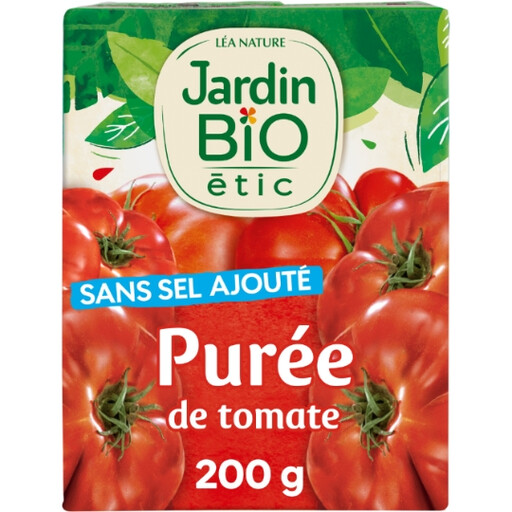 Image unavailable
Choose this if you’d like to prepare and season your own pasta sauce.
200 g pack: this is tomato purée, not a ready-made sauce. Check that the quantity is right for the portions you have planned.
Look for an explicit organic farming label on the sauce packaging or product information, then check that it applies to the exact product you’re buying. The French Ministry of Agriculture explains that organic production, including the production of processed foods, is governed by European regulations.
No. The fact that a sauce is organic doesn’t mean you can ignore the storage requirements for the prepared dish. Follow the instructions for after opening and, if the meal needs to stay refrigerated, keep it chilled during transport. Anses recommends using an insulated bag for chilled food.
Not necessarily: check the ingredients and allergens for the exact product. Carrefour Bio’s Provençal tomato sauce contains wheat and also lists possible traces of other allergens, so check the product label when you buy it.