What should you check before buying?
Start with the type of recipe your child enjoys, then compare the labels of products that suit your meal. Always check the exact product for any allergen-related requirements.
| Criteria |
What to check |
Who is it for? |
| A familiar recipe |
The type of sauce and its ingredients, particularly any vegetables, herbs or meat your child likes or refuses. |
If my child happily eats tomato but picks out certain ingredients, I first look for a recipe whose ingredients I can anticipate; around 36% of consumers in this group would make this their top priority. |
| Sugars and salt |
The values per 100 g for sauces of the same type, followed by the amount actually served. |
For a meal I make regularly, I want to be able to compare sugars and salt rather than relying on the organic logo alone. Around 29% of consumers in this group would put this first. |
| Organic certification |
The certification details on the packaging, then the ingredients list separately. |
If my purchase is primarily guided by a preference for organic production, I need to be able to identify the certification on the jar; around 21% of consumers in this group would rank it first. |
| Allergens and school |
Allergens, warnings about possible traces and, if needed, a ‘gluten-free’ statement on the product you buy. |
If my child has a dietary requirement, or one that affects their school meal, I need to check the exact product before choosing it. Around 14% of consumers in this group would make this their top priority. |
Brands and ranges to know
These products offer useful points of comparison for recipes and labels. The details mentioned don’t apply to every sauce from each brand.
Panzani
Panzani offers an organic cooked tomato sauce in a 400 g jar, among other products.
- The brand says this product complies with organic regulations.
- Check the ingredients and allergens on the jar you buy: the organic label doesn’t mean it’s gluten-free.
Barilla
Barilla offers a range of organic sauces and, separately, a Cooked Tomato Sauce labelled ‘gluten-free’.
- Barilla says its organic range is made with ingredients from organic farming.
- The ‘gluten-free’ label on the Cooked Tomato Sauce doesn’t automatically apply to every sauce in the organic range. If you need both features, check that they’re stated on the same jar.
Jardin BiO étic chez Carrefour
Carrefour lists a 200 g jar of organic Jardin BiO étic tomato sauce for spaghetti.
- The product listing states that it contains 73% tomatoes, as well as onions and carrots.
- The listing warns that it may contain traces of celery, which is important to consider if this allergen is a concern at mealtimes.
Bio Village (E.Leclerc)
The range includes a 350 g jar of organic Provençal tomato sauce.
- The E.Leclerc product listing shows the ingredients and nutritional values per 100 g.
- E.Leclerc says the Nutri-Score on the packaging uses the previous calculation method. Check the recipe and nutritional values too.
Auchan Bio
Auchan offers a 200 g jar of organic Bolognese tomato sauce for meals where a meat-based recipe is suitable.
- The product listing states that it contains 14% pre-cooked beef.
- It warns that the sauce may contain traces of celery, milk and mustard. Check the packaging if any of these allergens need to be avoided.
A tomato sauce base to prepare, available on Joybuy
This tomato purée can be used as a base for a sauce if your child already likes tomato. It needs to be prepared, so it isn’t a ready-to-serve pasta sauce.
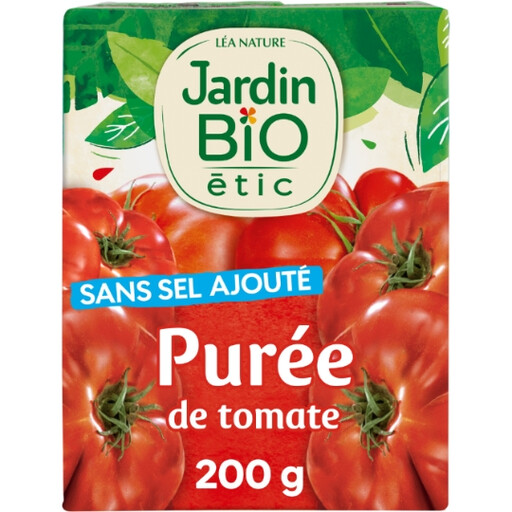 Image unavailable
JARDIN BIO ETIC organic tomato purée, 200 g
If your child already likes tomato, this purée can be used as a base for a sauce you prepare. It isn’t ready to serve as a pasta sauce.
If these factors affect your choice, check the organic details and allergens on the exact product packaging.
View on Joybuy
Frequently asked questions
How can you tell if a pasta sauce is organic?
Look for organic certification details, such as the European organic leaf logo, on the product you buy. The French Ministry of Agriculture explains that organic production is governed by European regulations. However, certification doesn’t replace checking the ingredients and allergens.
Does an organic sauce always contain gluten?
No. Being organic doesn’t tell you whether a product contains gluten. Barilla labels its Cooked Tomato Sauce ‘gluten-free’. If you need this feature, check the specific product you’re buying rather than assuming it applies to the whole range.
What should you check for a sauce intended for a school meal?
If your child has a specific dietary requirement, check the allergens and warnings about possible traces on the packaging, then confirm the arrangements for them with the school. The French Ministry of National Education says that an individual care plan can set out adjustments to their education.
Is Nutri-Score enough to compare two sauces?
No. Also compare the ingredients, sugars and salt per 100 g in sauces of the same type. For its Bio Village Provençal sauce, E.Leclerc says that the Nutri-Score printed on the packaging uses the previous calculation method.
How long can you keep sauce after opening?
Follow the instructions on the jar you buy, as they vary by product. For example, Auchan’s product listing for Jardin BiO étic tomato sauce for spaghetti says to keep it chilled and use it within three days of opening.


