People keeping an eye on carbohydrates per serving
You compare the carbohydrates and sugars per 100 g, then work out how they relate to the amount of sauce you actually serve with your pasta.


When choosing an organic pasta sauce as part of shopping with diabetes in mind, check its certification, then compare the carbohydrates, sugars and salt per 100 g, taking your serving size into account. Tomato purée that you season yourself lets you control what you add, while a ready-made sauce saves you the preparation. Organic certification alone does not tell you whether a recipe suits your dietary needs.
You compare the carbohydrates and sugars per 100 g, then work out how they relate to the amount of sauce you actually serve with your pasta.
You’re looking for an organic tomato base to season yourself, particularly if you want to choose how much salt and fat to add.
You want to spend less time preparing your meal while still comparing recipes and checking storage instructions after opening.
France’s national health insurance service (Assurance Maladie) advises comparing the nutritional information per 100 g, then relating it to the amount you eat. For a sauce, this goes hand in hand with checking the ingredients and the instructions on the jar.
| Criteria | What to check | Who it matters to |
|---|---|---|
| Carbohydrates and serving size | Carbohydrates and sugars per 100 g, then the amount of sauce served. | If I’m keeping an eye on what’s in my meal, I want to know what my serving of sauce adds to my pasta; around 38% of consumers put this need first. |
| Salt | Salt per 100 g and how the rest of the dish will be seasoned. | When a sauce is already seasoned, I’d rather avoid adding salt without thinking; for around 25% of consumers, this is their main consideration. |
| Certification and ingredients | The organic logo on the packaging and the recipe’s ingredients list. | I want to confirm that it’s organic and see what has been added to the tomatoes; around 25% of consumers put this first. |
| Preparation and storage | The jar size and instructions for storing it after opening. | If I want to make pasta quickly without leaving unused sauce, I look for a size that suits my meals; around 12% of consumers prioritise this aspect. |
According to France’s Ministry of Agriculture, organic certification sets standards for how food is produced. It doesn’t replace the nutritional information: a recipe may also contain sugar, salt or oil.
If organic matters to you, check for the logo, then read the ingredients and nutritional information for the sauce you’re considering.
Sauces can also differ in their carbohydrate and salt content, as well as their ingredients. A figure per 100 g won’t necessarily reflect the amount you put on your plate.
Compare like-for-like amounts on the labels, then relate the figures to your serving of sauce and the rest of your meal.
A ready-made sauce may already contain salt, on top of what you use when cooking or add when serving.
Check the salt per 100 g and taste the dish before adjusting the seasoning.
Storage times depend on the product: the product pages for Auchan Bio basil and Barilla Bio basil give different time limits.
Choose an amount that suits your meals and follow the refrigeration and use-by instructions on the jar.
Panzani offers a 400 g jar of cooked organic tomato sauce, with the AB logo shown on its product page.
The range includes a 200 g jar of organic tomato and basil sauce.
The organic tomato and basil sauce and the Neapolitan sauce are available in 200 g jars.
Bio Village offers organic tomato purée to season yourself, as well as ready-made organic tomato sauces.
Carrefour Bio offers, among other products, a 350 g jar of tomato and basil sauce.
This tomato purée is for anyone who wants to season a base themselves to make pasta sauce, rather than choose a ready-to-serve sauce.
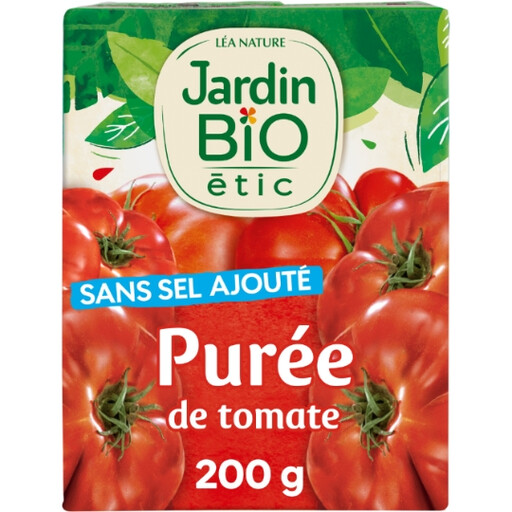 Image unavailable
A base to prepare if you want to control the seasoning in your pasta sauce. If organic certification is important to your choice, check for the logo on the packaging.
No. Organic certification relates to how food is produced, not its carbohydrate, sugar or salt content. To choose between sauces, check their nutritional information and take into account how much you’ll use.
Compare the same amounts, usually per 100 g, for carbohydrates, sugars and salt, as well as fat and fibre if listed. France’s national health insurance service (Assurance Maladie) then recommends relating these figures to the amount you actually eat.
Look for the European organic leaf logo on the packaging and, where applicable, the AB logo. According to France’s Ministry of Agriculture, organic production is governed by a European framework; however, the logo doesn’t replace checking the recipe and nutritional information.
Follow the instructions for the product you’ve bought, as storage times vary between sauces. The Auchan Bio basil product page says to keep it between 0 and 4 °C and use it within 48 hours; the Barilla Bio basil page says to keep it in the fridge and use it within five days of opening.