Shoppers looking for both organic and wholemeal pasta
You want to identify organic pasta and check that it’s made with wholemeal wheat, without assuming that meeting both criteria automatically makes it suitable for your dietary needs.


When choosing organic pasta as part of your diabetes-related shopping, first check the organic certification and the ingredients for the specific product: organic pasta is not necessarily wholemeal. Then compare the carbohydrate and fibre content per 100 g, and work out what these values mean for the amount you eat. Neither an organic label nor wholemeal ingredients alone determine a portion that’s right for you.
You want to identify organic pasta and check that it’s made with wholemeal wheat, without assuming that meeting both criteria automatically makes it suitable for your dietary needs.
You compare the nutrition information on several packets before relating it to the amount you plan to eat. France’s Assurance Maladie recommends checking carbohydrates and fibre in particular.
You’d like to stick with a familiar pasta shape while checking whether your chosen product is wholemeal, semi-wholemeal and organic. The name of a range is no substitute for checking the specific packet.
For this kind of shop, make three separate decisions: confirm that the pasta is organic, choose between wholemeal, semi-wholemeal or standard ingredients, then compare the nutrition information on an equal-weight basis. Standard organic pasta meets the organic criterion, but it shouldn’t be confused with wholemeal pasta.
| Criterion | What to check | Who it’s for |
|---|---|---|
| Organic and wholemeal wheat | Look for the organic certification on the packet, then check that the ingredients specify organic wholemeal durum wheat. | I want both criteria in the same product, rather than assuming that ‘organic’ means ‘wholemeal’. Around 36% of consumers would put this combination first. |
| Carbohydrates, fibre and portion size | Compare the carbohydrate and fibre content per 100 g, then relate it to the amount you actually eat. | When putting together my meal, I need to compare labels without confusing the per-100 g figures with what’s on my plate. Around 29% of consumers would make this their priority. |
| Ingredients and shape | Tell wholemeal and semi-wholemeal apart; also check the shape, cooking time and allergens. | If the taste of wholemeal pasta or its shape matters for the meals I usually make, I’m looking for a product I’ll actually want to use. Around 21% of consumers would prioritise this choice of ingredients and shape. |
| In-store choice | Check the pack size and label of the products available at your usual shop. | If a particular product isn’t available where I shop, I want to be able to compare the other organic packets on offer. Around 14% of consumers would put this first. |
Organic describes how a product is produced, while ‘wholemeal’ describes the grain ingredients. Barilla Organic Spaghetti and Auchan Bio Organic Wholemeal Wheat Spaghetti illustrate the difference between specific products.
Check the organic certification and ingredients list separately, then compare the fibre and carbohydrate information on each packet.
A Nutri-Score or a prominent claim is no substitute for the nutrition information and ingredients list. France’s Assurance Maladie recommends checking carbohydrates and fibre in particular.
Read the table per 100 g and take the amount you’ll serve into account. Use the Nutri-Score, if it appears on the packet, as an additional guide.
Durum wheat pasta contains gluten. The Auchan Bio, Carrefour Bio and Lustucru product information mentioned here also notes that some products may contain traces of other allergens.
If you have an allergy, check the ingredients and trace warnings on the packet you buy, particularly for eggs, soya, mustard, lupin or celery, depending on the product.
These products are examples for comparing specific ingredients: their inclusion here doesn’t mean that every pasta from each brand is organic or wholemeal.
According to the Auchan product information, the 500 g Organic Wholemeal Wheat Spaghetti is made with organic wholemeal durum wheat semolina and carries the Euro-leaf and AB labels.
BIO Wholemeal Penne is a short pasta shape, described by Lustucru as being made with whole durum wheat semolina.
Carrefour describes its 500 g Organic Semi-Wholemeal Spaghetti as being made with organic semi-wholemeal durum wheat semolina.
Organic Spaghetti 500 g is made with organic durum wheat semolina and should be distinguished from wholemeal wheat pasta.
Panzani describes its Complètement Bon! range as wholemeal wheat pasta, including penne, macaroni and twists.
These two JARDIN BIO ETIC products are coloured quinoa spaghetti: one combines parsley and garlic, while the other has tomato. If you’re looking for organic pasta, check the certification on the packaging before choosing either one. Also compare the ingredients and nutrition information for the portion you plan to eat.
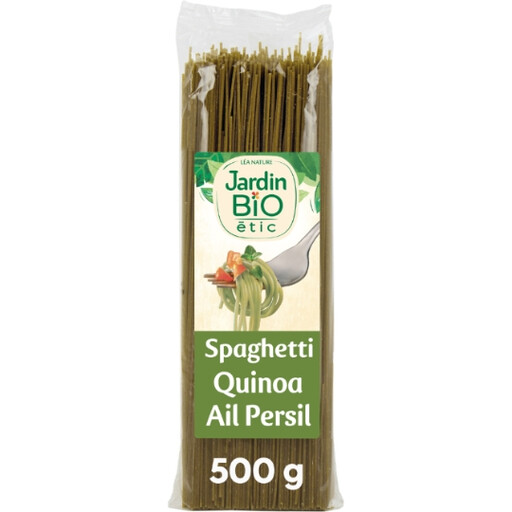 Image unavailable
An option to consider if you’re looking for coloured quinoa spaghetti with parsley and garlic. To check that it meets your organic and semi-wholemeal criteria, read the packaging carefully. Also check the carbohydrate and fibre content and allergens for this product.
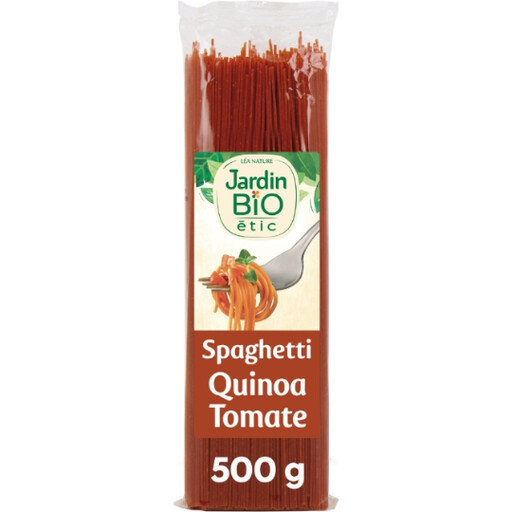 Image unavailable
An option to consider if you prefer coloured quinoa spaghetti with tomato. Check the packet for the organic certification and ingredients you’re looking for, then check the carbohydrate and fibre content and allergens. Remember to take the amount you eat into account.
No: organic status tells you how the pasta was produced, not what portion is right for you. France’s Assurance Maladie recommends checking carbohydrates and fibre in particular. Relate the per-100 g figures to the amount you eat and follow the advice given as part of your care.
Look for the European Euro-leaf logo and, if it appears on the packaging, the AB label, then read the ingredients list. France’s Ministry of Agriculture presents these labels as part of organic certification; the word ‘wholemeal’ alone doesn’t confirm that a product is organic.
The difference is in the grain ingredients: the Auchan Bio spaghetti mentioned here is made with organic wholemeal durum wheat semolina, while the Carrefour Bio spaghetti mentioned here uses organic semi-wholemeal semolina. Compare the nutrition information on the specific packets rather than assuming they have the same values.
First check for wheat and gluten, then look for warnings specific to the product you’re buying. Depending on the product, the Auchan Bio, Carrefour Bio and Lustucru product information mentioned in this article warns of possible traces of eggs, soya, mustard, lupin or celery.