To choose organic muesli that’s quick to serve, first check the certification on the packaging, then look at the ingredients, allergens and nutritional values per 100 g. A plain recipe is a good choice if you want to add your own toppings; a fruit muesli saves you that step, while crunchy muesli is ideal if you prefer a crispier texture. In every case, the word ‘organic’ alone tells you nothing about the sugar or fat content.
Who is this choice for?
If you want a simple organic recipe
If you pour your muesli straight into milk or yoghurt, a recipe based on flakes gives you the freedom to choose your own accompaniments. Still, read the ingredients and any warnings about traces of allergens: a plain recipe isn’t necessarily free from them.
If you’re comparing sugar content
A fruit muesli labelled ‘no added sugars’ may still contain sugars naturally present in dried fruit. To compare two packs, also check the ‘of which sugars’ figure per 100 g.
If you’re looking at protein and fibre
Some recipes combine cereals and pulses. If that appeals to you, compare the nutritional values per 100 g and check which gluten-containing cereals and nuts are in the product you’re considering.
What should you check first?
For a quick breakfast, start with what matters most to you, then check that the recipe and its label meet your needs. According to Agence Bio, the Euro-leaf on the label indicates that the product meets EU organic farming rules; the DGCCRF says allergens must be highlighted in the ingredients list.
| What to consider |
What to check |
Who it’s for |
| Certification and ingredients |
Look for the Euro-leaf and read the ingredients list, including the allergen information. |
I want to confirm that it’s organic and find out what’s in my bowl before choosing a recipe. Around 36% of consumers say this is their top priority. |
| Sugars and nutritional values |
Distinguish ‘no added sugars’ from ‘of which sugars’; compare the values per 100 g. |
If I choose fruit or crunchy muesli, I want to compare the sugar content rather than relying on the recipe name alone. This is the top priority for around 29% of consumers. |
| Protein and fibre |
Compare the protein and fibre per 100 g, then check the recipe’s allergens. |
I’m interested in a recipe that combines cereals and pulses, but I need to be able to check its nutritional profile and ingredients. Around 21% of consumers look for this information first. |
| Serving and texture |
Check the preparation instructions and how to store the product once opened. |
In the morning, I want to serve muesli without cooking and choose a texture I enjoy. For around 14% of consumers, convenience comes first. |
Mistakes to avoid
-
Assuming ‘organic’ means ‘low in sugar’
Organic certification relates to how a product is made, not to a consistent sugar content across all recipes. Crunchy muesli, for example, may contain cane sugar or syrups.
Read the ingredients and compare ‘of which sugars’ and fat per 100 g, even if the pack carries the Euro-leaf.
-
Relying on the recipe name to check for allergens
Depending on the product, it may contain gluten, nuts, sesame, soya, milk or peanuts, or warn that traces may be present. The muesli’s name won’t tell you which applies.
If you have an allergy, check the information on the exact pack before eating it, even if you’re familiar with an older version of the product.
-
Forgetting how to store it once opened
A pack that isn’t sealed properly can let moisture in and affect the muesli’s texture, particularly if it’s crunchy.
Follow the storage instructions on the pack and choose a size that suits how often you eat muesli.
Brands to compare
Carrefour Bio
Carrefour offers a plain five-cereal muesli and a fruit recipe labelled ‘no added sugars’.
- The plain recipe combines oat, wheat, rye, barley and rice flakes.
- Check the allergens and any warnings about traces on the specific product, even if it’s a plain recipe.
Bjorg
Two different recipes let you compare organic fruit muesli with no added sugars and organic muesli combining cereals and pulses.
- The recipe with pulses is worth considering if you’re comparing the protein and fibre figures on the packs.
- Ingredients and allergens vary by recipe, so don’t assume the information on one pack applies to another.
Jordans
Jordans Organic Nut & Seed Muesli combines cereals, seeds and nuts for anyone looking for this kind of mix.
- Check the ingredients list to see whether it contains the nuts and seeds you’re looking for.
- This product isn’t suitable if you need to avoid gluten-containing cereals or nuts.
Auchan Bio
Auchan Bio’s crunchy dried-fruit muesli is for anyone who prefers this texture and wants a no-cook breakfast.
- The product information says it can be served with milk or yoghurt.
- The recipe includes cane sugar, oils and syrups, among other ingredients, so compare its label with a non-crunchy muesli.
Bio Village
Bio Village is the organic range offered by E.Leclerc DRIVE. To choose a muesli, start with the product available at your local store.
- You can check the local product while doing the rest of your shopping.
- Before comparing, check the ingredients, allergens and nutritional information on the exact pack.
A product to consider on Joybuy
This product is worth considering if you’re looking for fruit muesli that’s quick to serve. Before choosing it for its organic certification, check the logos and claims on the exact pack.
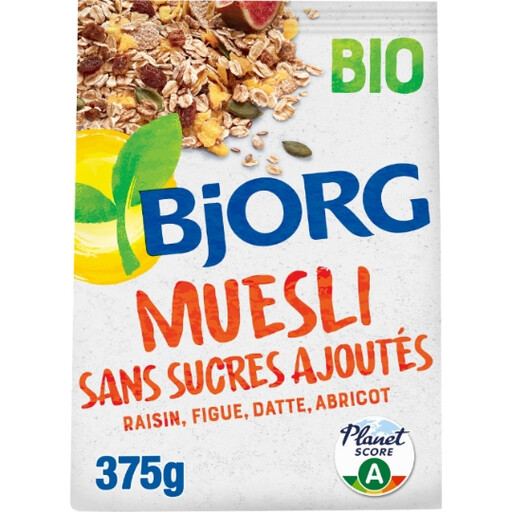 Image unavailable
BJORG Organic Muesli 375 g
Worth considering if you’re looking for fruit muesli that can be served without cooking. Joybuy describes this product as containing 23% fruit and carrying a ‘no added sugars’ claim; this doesn’t mean it contains no sugars. Check the organic certification and allergen information on the pack you receive.
View on Joybuy
Frequently asked questions
How can you tell if muesli is certified organic?
Look for the Euro-leaf on the packaging: according to Agence Bio, its presence on the label indicates that the product meets EU organic farming rules. Also check the certification details for the specific product.
Does ‘no added sugars’ mean ‘sugar-free’?
No. Muesli containing dried fruit may have sugars that occur naturally in its ingredients. Check the ‘of which sugars’ figure per 100 g to compare recipes.
Which allergens should you check in organic muesli?
Check for gluten-containing cereals, nuts and any other allergen or trace warnings on the product you’re buying. The DGCCRF says allergenic ingredients must be highlighted in the ingredients list on pre-packed foods.
How can you quickly compare two mueslis?
Start with the ingredients and allergens, then compare the nutritional values per 100 g, especially sugars, fat, fibre and protein. The DGCCRF says that presenting values per 100 g provides a common basis for comparison.
How do you keep crunchy muesli crisp after opening?
Reseal the pack and follow its storage instructions, particularly those relating to moisture. Also check the best-before date on the packaging.


