What should you check before buying?
Start by confirming that the muesli is organic. Then check the dietary requirements of everyone in your group before choosing the recipe and pack size to suit the length of your stay.
| Criteria |
What to check |
Who is this important for? |
| Organic certification |
Look for the EU organic logo or another clearly identifiable organic certification on the pack. |
If I’m mainly looking for organic muesli, a ‘natural-looking’ pack isn’t enough. Around 38% of consumers prioritise checking for this certification. |
| Gluten and allergens |
If gluten needs to be avoided, look for the relevant claim; also check the ingredients, allergens and any possible traces. |
If someone in my group has a dietary restriction, I need to choose a suitable recipe before thinking about its texture. Around 37% of consumers prioritise dietary suitability. |
| Pack size and storage |
Compare the net weight with the number of breakfasts planned, and follow the storage instructions after opening. |
For a short stay or a pack shared between people, I want a size the group can use and store properly. This is the priority for around 25% of consumers. |
The French Ministry of Agriculture explains that organic farming is governed by European regulations. For dietary restrictions, the DGCCRF says allergenic ingredients must be emphasised on labels. Organic certification and checking allergens therefore answer two different questions.
Brands to consider
These examples relate to specific recipes, not every product from each brand. Always compare the label of the version you’re thinking of buying.
Carrefour Bio
The Organic 5-Grain Plain Muesli comes in a 500 g pack. According to Carrefour, it’s made with oats, wheat, rye, barley and rice flakes.
- A five-grain recipe with no fruit listed in its ingredients.
- Wheat, rye and barley contain gluten; the product listing also mentions possible traces of other allergens.
BJORG
The products reviewed meet two different needs: organic fruit muesli with no added sugars, and organic muesli labelled ‘gluten-free’.
- According to Carrefour’s listing, the 375 g Raisin, Date and Fig recipe contains 23% fruit and is labelled ‘no added sugars’.
- This fruit recipe contains wheat and spelt, among other ingredients. Don’t confuse it with the Multi-Fruit Gluten-Free Organic version.
Terres & Céréales Bio
The organic gluten-free mueslis reviewed include a crunchy Oat and Almond recipe and a fruit recipe in a 900 g pack.
- Carrefour’s listings describe these products as made with gluten-free oats.
- The Oat and Almond recipe contains almonds, cane sugar and rice syrup. Check the exact recipe against your group’s dietary requirements.
Auchan Bio
The product reviewed is a 500 g pack of crunchy organic muesli with dried fruit.
- Auchan’s product listing gives useful storage advice if the pack will be open during your stay.
- This recipe contains wheat, almonds and hazelnuts, among other ingredients. Check the ingredients and nutritional information before sharing it.
Bio Village (E.Leclerc)
The 500 g organic flaked muesli with dried fruit is another recipe to consider if you prefer flakes to a crunchy texture.
- E.Leclerc’s listing mentions raisins, dried figs and several seeds.
- The recipe contains oats and wheat-spelt. Also check how the shop or collection service you’ve chosen sells the product.
A selection of muesli on Joybuy
For a holiday rental, this selection features a 375 g pack of BJORG organic fruit muesli, which is worth considering if you’re looking for a recipe with no added sugars. Check the pack label to confirm the organic certification and allergens before serving it.
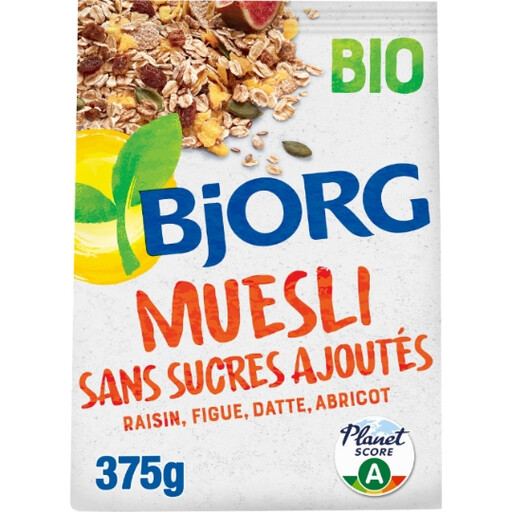 Image unavailable
BJORG Organic Muesli 375 g
The 375 g pack may be a good fit if you’re planning just a few breakfasts during your stay. Joybuy’s listing describes this fruit muesli as having no added sugars and containing 23% fruit; that doesn’t mean it’s sugar-free. If someone needs to avoid gluten or another allergen, check the label on the exact pack before sharing it.
View on Joybuy
Frequently asked questions
How can you identify organic muesli in France?
Look for clearly identifiable organic certification on the packaging, such as the EU organic logo, rather than relying on the word ‘natural’. The French Ministry of Agriculture explains that organic farming is governed by European regulations.
Is organic muesli always gluten-free?
No. Carrefour’s listing for BJORG Organic Raisin, Date and Fig Muesli says it contains wheat and spelt, among other ingredients. If gluten needs to be avoided, look for a product labelled ‘gluten-free’ and check the pack for details of any other allergens.
Does ‘no added sugars’ mean ‘sugar-free’?
No. Ingredients such as raisins, dates and figs contain naturally occurring sugars. To compare two recipes, check the ‘sugars’ line in the nutritional information per 100 g as well as the ingredients list.
What should you check before leaving a pack in your holiday rental?
Choose a net weight that suits the breakfasts planned and read the product’s storage instructions. For its crunchy organic muesli with dried fruit, Auchan recommends keeping the pack away from heat and moisture, then sealing it tightly after opening.
Which label details should you check before serving muesli?
Check the ingredients list, highlighted allergens, net quantity, nutritional information and date shown on the pack. The DGCCRF lists these among the labelling information required for prepacked foods. They help you check that the recipe you’ve chosen is suitable for everyone present.


