When shopping with diabetes in mind, choose muesli whose organic status can be verified on the packaging. Compare the carbohydrates, including sugars, and fibre per 100 g, then work out what those figures mean for the portion you serve, as recommended by French National Health Insurance when reading nutrition information. ANSES reminds consumers that ‘no added sugars’ does not mean there are no naturally occurring sugars. The recipe and allergens should also inform your choice.
Who are these criteria for?
People keeping track of breakfast carbohydrates
You compare the carbohydrates and sugars per 100 g, then work out how they relate to the amount you actually serve. This is the approach to reading food labels recommended by French National Health Insurance.
People looking for fibre and wholegrains
You want a recipe with clearly listed fibre and ingredients, while still keeping an eye on the carbohydrates in the portion you eat.
People checking organic credentials and dietary restrictions
You want to recognise organic certification on the packaging and check the cereals, nuts and other declared allergens in the variant you choose.
What should you check before buying?
| What matters |
What to check |
Who is it for? |
| Carbohydrates and portion size |
Compare ‘carbohydrates’ and ‘of which sugars’ per 100 g, then calculate the figures for the portion you serve. |
If I have muesli for breakfast, I want to know what’s in my bowl rather than rely on the figures on the pack alone; around 36% of consumers prioritise keeping track of carbohydrates and portion size. |
| Fibre and wholegrains |
Check the fibre per 100 g and the ingredients in the specific variant. |
When choosing between two recipes, I look at their fibre and wholegrains first; this is the main consideration for around 29% of consumers. |
| Organic certification and ingredients |
Look for the EU organic logo (Euro-leaf) on the label, then check the ingredients list and nutrition information separately. According to the French Agency for Organic Farming, this logo confirms compliance with the European regulations on organic farming. |
I want to be able to confirm that a product is organic without assuming anything about its sugar content; around 21% of consumers put certification and ingredients first. |
| Allergens and recipe |
Check the allergens and ‘may contain’ statements on the exact pack you’re buying. |
If some ingredients aren’t suitable for me, the list of cereals, nuts and possible traces determines my choice; this check comes first for around 14% of consumers. |
Common misconceptions to avoid
-
Assuming ‘organic’ tells you about sugar content
According to the French Agency for Organic Farming, the EU organic logo tells you about the production method. It does not show how much carbohydrate or sugar the muesli contains.
Check the organic status on the packaging, then read the nutrition table separately.
-
Confusing ‘no added sugars’ with ‘sugar-free’
ANSES reminds consumers that a product with no added sugars can still contain sugars naturally present in its ingredients, such as the dried fruit in muesli.
Check the ‘of which sugars’ line per 100 g and the ingredients list.
-
Forgetting how much you actually serve
Figures per 100 g make it easier to compare products, but they may not reflect what’s in your bowl. French National Health Insurance recommends calculating the figures for the amount you eat.
Measure your usual portion and take account of any foods you add to it.
-
Overlooking allergens in a particular variant
Depending on the recipe, these mixes may contain cereals with gluten or nuts, and may carry warnings about traces of other allergens.
Read the ingredients and warnings on the pack for the size you choose.
Organic muesli brands to know
Bjorg
The range includes several organic muesli recipes, with distinct nutritional profiles.
- Bjorg lists 15 g of fibre and 9.3 g of sugars per 100 g for its Muesli Fibres, compared with 10 g of fibre and 14 g of sugars per 100 g for its 750 g Muesli without added sugars.
- Cereals and allergen statements vary by recipe, so check the exact pack.
Carrefour Bio
The 375 g Organic Fruit Muesli with No Added Sugars combines wholegrains, dried fruit and seeds.
- Carrefour lists, among other ingredients, 44% wholegrain oat flakes and 15% wholegrain rye flakes in this recipe.
- To compare this muesli with others, also check its carbohydrates, sugars and fibre on the pack you choose.
Favrichon
The brand offers organic mueslis made with wholegrains and dried fruit, with ingredients that vary between recipes.
- Favrichon describes a traditional Fruit Muesli and a Raisin, Hazelnut & Almond recipe.
- Check the declared sugars and nuts in the variant you choose.
Happy Bio
The 375 g Muesli with No Added Sugars provides figures you can use to compare this recipe with others per 100 g.
- Auchan’s product information lists 63 g of carbohydrates, including 11 g of sugars, and 8.8 g of fibre per 100 g.
- The amount you eat still matters: figures per 100 g alone don’t tell you what’s in a portion.
Jordans
The organic Fruit and Nut Muesli with No Added Sugars is for people looking for a recipe with raisins and hazelnuts.
- Auchan’s product information lists 18.9 g of sugars and 8.5 g of fibre per 100 g for this product.
- It contains wheat, oats and hazelnuts, among other ingredients. ‘No added sugars’ is no substitute for checking the nutrition information and allergens.
A muesli option on Joybuy
This Bjorg product gives you the chance to check a 375 g muesli against its declared carbohydrates, sugars and fibre. If certified organic status is essential to you, check the label on the pack before choosing.
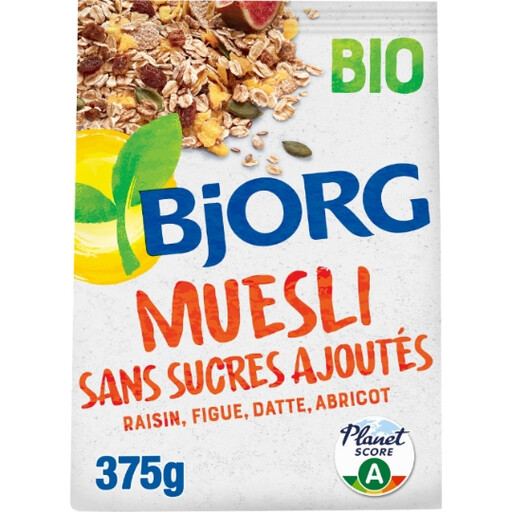 Image unavailable
BJORG Organic Muesli 375 g
Worth considering if you want to compare the nutrition information for muesli per 100 g before calculating the figures for your portion. Joybuy lists 59 g of carbohydrates, including 14 g of sugars, and 10 g of fibre per 100 g. Check the organic certification and allergens on the packaging for this variant.
View on Joybuy
Frequently asked questions
Is organic muesli automatically suitable when shopping with diabetes in mind?
No. The organic logo relates to the production method, not the carbohydrate or sugar content. According to the French Agency for Organic Farming, the EU organic logo confirms compliance with European regulations on organic farming. To choose a recipe and portion size, check its nutrition information and ingredients list too.
Does ‘no added sugars’ mean ‘sugar-free’?
No. ANSES explains that sugars can be naturally present in a product with no added sugars. For muesli with dried fruit, check the ‘of which sugars’ line rather than relying on the claim on the front of the pack alone.
How can you compare two organic mueslis?
Compare their carbohydrates, including sugars, and their fibre on the same per-100 g basis, then check the ingredients and allergens in each variant. French National Health Insurance recommends calculating the nutrition information for the amount you actually eat.
Should you look for muesli labelled ‘specially for people with diabetes’?
The claim is no substitute for checking the product itself. French National Health Insurance highlights the importance of your overall diet and portions that suit your needs. Compare the label and portion size, and follow any individual dietary advice you’ve been given.


