For mornings when you want to customise your bowl
A plain muesli with a short ingredients list leaves you free to choose what to add. Still, check which cereals it contains: even a simple recipe may include wheat, rye or barley.


For a weekday breakfast, first choose between a plain base you can customise, a recipe that’s already fruity or one containing nuts, depending on what you want to prepare in the morning. Then compare the ingredients, nutritional values per 100 g and allergens. The organic label tells you about how the product is made, not its nutritional composition or whether it’s suitable for your dietary requirements.
A plain muesli with a short ingredients list leaves you free to choose what to add. Still, check which cereals it contains: even a simple recipe may include wheat, rye or barley.
Dried fruit means you don’t have to add an extra ingredient to your bowl every time. If the product information says ‘no added sugars’, check the sugars per 100 g too, as fruit contains naturally occurring sugars.
Ingredients and ‘may contain’ warnings should take priority over flavour. According to the DGCCRF, allergens must be highlighted in the ingredients list on pre-packed foods. Check the specific pack you’re buying.
To compare organic mueslis, start with how you plan to use them at breakfast, then compare the recipes and their nutritional information per 100 g.
| What to consider | What to check | Who is it for? |
|---|---|---|
| Customisable plain base | The cereals and other ingredients listed, as well as any allergens. | If I want to add my own fruit or another topping, a plain recipe gives me that flexibility. Around 33% of consumers put this simplicity first. |
| Fruit and ‘no added sugars’ claim | The proportion of fruit, if stated, and the ‘of which sugars’ figure per 100 g. | For a bowl that’s already fruity, I look for a recipe carrying this claim without assuming it contains no sugar at all. This is the top priority for around 27% of consumers. |
| Allergens and dietary requirements | Highlighted ingredients and ‘may contain’ warnings on the exact pack. | If I need to avoid certain ingredients, I check the pack is suitable first, whatever the recipe. This is the top priority for around 27% of consumers. |
| A more specific nutritional profile | Fibre, protein, fat and sugars per 100 g, as well as the ingredients. | If the texture of nuts or specific nutritional values influence my purchase, I compare labels on an equal, per-100 g basis. Around 13% of consumers prioritise this type of recipe. |
The French Ministry of Agriculture describes organic certification as relating to how a product is made. It doesn’t tell you how much sugar a muesli contains. A fruit recipe labelled ‘no added sugars’ may still contain naturally occurring sugars.
Read the ingredients and compare the ‘of which sugars’ figure per 100 g, as shown in the nutritional declaration described by the DGCCRF.
Nuts may be part of the recipe, while other allergens may appear in ‘may contain’ warnings. Organic certification doesn’t tell you whether a product is suitable for you.
If you need to avoid an allergen, check the ingredients and ‘may contain’ warnings on the exact pack, even when buying the same muesli again.
A nut recipe changes both the texture and the nutritional composition of your bowl. On Carrefour’s product pages for the products compared here, Charles Vignon 5 Nuts muesli contains 433 kcal and 17 g of fat per 100 g, compared with 334 kcal and 3.2 g for Carrefour Bio 5 Cereals Plain.
Choose according to the ingredients you actually want in your bowl, then compare the nutritional information on the same per-100 g basis.
The range includes a 500 g Organic 5 Cereals Plain Muesli that you can use as a base and customise.
The Superfruits recipe is an organic muesli made with wholegrains and fruit.
The 500 g Organic Fruit and Nut Muesli combines cereals, fruit and seeds.
The 500 g organic flaked muesli with dried fruit combines flakes, dried fruit and seeds.
The range includes a 375 g muesli made with oats, rye, dried fruit and seeds.
This selection features a 375 g BJORG muesli to consider for weekday breakfasts. Check the pack for the organic certification and ingredients that matter to you.
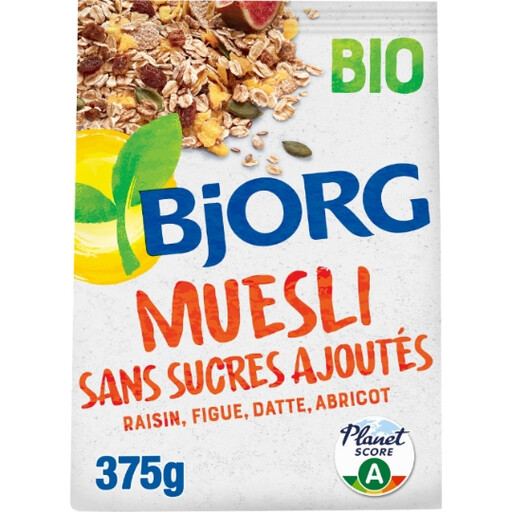 Image unavailable
Before choosing this muesli for weekday mornings, check the recipe on the pack. The product name indicates a 375 g pack; also check the organic logo, ingredients and allergens before deciding if it’s right for you.
Look for the European organic logo on the pack. The French Ministry of Agriculture explains that organic certification relates to regulated production methods; it doesn’t tell you how much sugar the product contains or whether it includes allergens.
No. Auchan’s product page for Bjorg Superfruits carries the ‘no added sugars’ claim, states that it contains naturally occurring sugars and lists 13 g of sugars per 100 g. Check the ‘of which sugars’ figure to compare recipes.
Compare the ingredients and nutritional information on the same per-100 g basis, particularly sugars, fat and protein. The DGCCRF states that the nutritional declaration for pre-packed foods is given per 100 g or 100 ml.
No. Carrefour Bio 5 Cereals Plain contains wheat, rye and barley, among other ingredients, while some fruit recipes include almonds or hazelnuts. Check the ingredients and ‘may contain’ warnings on the exact pack.
Reseal the pack and follow the storage instructions on the packaging you’ve bought. Bjorg and Jordans product pages recommend storing their muesli in a dry place, away from moisture.