Those who like to customise their breakfast
You want to mix matcha into milk, yoghurt or a smoothie, or use it in a recipe to enjoy with your toast. Pure powder lets you choose how much to add, unlike a ready-made blend.


To enjoy with toast and jam, choose an organic matcha powder that lets you control the quantity when making a latte, adding it to yoghurt or using it in a recipe. Check the ingredients and organic certification details on the packaging: tea containing matcha or an instant mix won’t give you the same control as pure powder. If you also plan to drink your matcha on its own, look at the tasting notes, but don’t treat them as a guarantee of flavour.
You want to mix matcha into milk, yoghurt or a smoothie, or use it in a recipe to enjoy with your toast. Pure powder lets you choose how much to add, unlike a ready-made blend.
You want to tell the difference between organic certification and packaging that simply suggests a natural product. Check the organic certification details, product name and ingredients on the packaging.
You mainly use matcha at breakfast, but sometimes want to drink it without milk or anything else added. Compare the suggested ways to use the powder, but don’t assume that the word “ceremonial” alone predicts whether you’ll enjoy the flavour.
For breakfast with jam, first decide whether you want to measure out pure powder or make a drink from a blend. Then check the organic certification details and choose a pack size to suit how often you’ll use it.
| What to consider | What to check | Who it matters to |
|---|---|---|
| Using it in a blend | Read the ingredients to tell pure powder apart from matcha tea or a matcha mix; check whether it’s recommended for lattes and recipes. | I want to add matcha myself to a drink or yoghurt served with my toast, rather than relying on a ready-made blend; around 42% of consumers prioritise this flexibility. |
| Certification and ingredients | Look for the EU organic logo and, where shown on the product, the AB mark; check the ingredients and stated origin separately. | “Natural” on the packaging isn’t enough for me: I want to check the organic details and know what the product contains. Around 33% of consumers would prioritise this check. |
| Taste and pack size | Compare the suggested uses for drinking it on its own and using it in recipes, the pack size and storage instructions; consider its caffeine content depending on when you plan to drink it. | If I sometimes drink matcha on its own but don’t use much in cooking, I’d rather choose an amount I can store according to the label; around 25% of consumers prioritise this balance between use and pack size. |
Auchan’s product listing for Pukka green tea states that it contains 2% matcha in a blend of green teas. So it won’t let you measure out matcha in the same way as a powder made entirely from matcha.
If you want to control how much you add to your breakfast, read the ingredients rather than relying on the name on the front of the pack.
Organic certification alone doesn’t tell you whether a powder comes from Japan or what it will taste like in a drink on its own.
Check the organic certification details, stated origin and suggested uses for cooking or drinking separately.
A 100 g pack will take more uses to get through than a smaller one if you only prepare matcha occasionally. Auchan’s product listing for 110 Graines matcha advises keeping the powder away from heat, light and moisture.
Choose an amount that suits how often you’ll use it, and follow the product’s storage instructions once opened.
Matcha is a type of tea and contains caffeine. ANSES says caffeine can delay falling asleep and reduce sleep duration or quality, although its effects vary from person to person.
If you’re sensitive to caffeine, consider when you drink matcha and how much other caffeine you consume.
Aromandise’s range includes organic matcha powders for recipes, as well as powders presented for drinking on their own.
Kusmi Tea offers organic matcha from Japan in 30 g and 100 g packs. The brand says it can be used in a drink on its own, in a latte or in baking.
Auchan’s product listing for 110 Graines matcha describes a 100 g powder for drinks and sweet or savoury recipes.
This matcha powder could be an option for making a drink or a recipe to enjoy alongside toast and jam. The word “ceremonial” on its own doesn’t tell you how it will taste, so check the organic labelling and ingredients too.
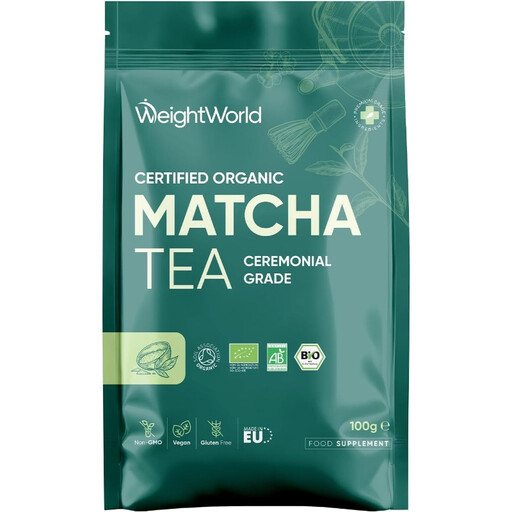 Image unavailable
Worth considering if you want to measure matcha into a latte or breakfast recipe: the product listing also mentions smoothies and baking.
The stated pack size is 100 g. Before buying, check the organic certification details, ingredients and stated origin on the packaging; the word “ceremonial” doesn’t tell you how the powder will taste.
The listing states that it contains caffeine, which is worth bearing in mind depending on your sensitivity and when you plan to drink it.
Check the organic certification details on the packaging, including the EU organic logo and the AB mark, if present, then read the product name and ingredients. The French Ministry of Agriculture says that processed agricultural products intended for food may be certified organic; this doesn’t mean that an organic product contains only matcha.
Not if you want to measure the matcha powder yourself and add it to milk or yoghurt. Auchan’s product listing for Pukka green tea states that it contains 2% matcha in a blend, so check the ingredients and the proportion of matcha before choosing.
A powder described as suitable for lattes or cooking is a good fit. Aromandise offers powders for these uses; still, check the ingredients and add as much matcha as you need to get the flavour you’re after.
Follow the instructions on the packaging. For its 110 Graines matcha, Auchan’s product listing recommends keeping it away from heat, light and moisture. Consider how often you’ll use it before choosing a pack size.
Yes, if you’re sensitive to caffeine or also drink other caffeinated beverages. ANSES says caffeine can make it harder to fall asleep and disrupt sleep, although its effects vary from person to person. Bear your sensitivity in mind when deciding when to drink matcha.