Conscious shoppers looking for organic products
You’re looking for organic instant coffee for breakfast and comparing jar sizes before you choose.


When choosing organic instant coffee for a quick breakfast, check the certification logos and ingredients first, rather than relying on the word “natural” alone. Then compare jar sizes and any guidance on flavour or intensity: organic certification doesn’t predict how the coffee will taste.
You’re looking for organic instant coffee for breakfast and comparing jar sizes before you choose.
You want to make a cup without a machine and are looking for organic coffee that specifies its bean type or flavour profile.
You want to know where the coffee comes from and distinguish a brand’s fair trade claims from the product’s organic certification.
First, check whether you’re buying pure instant coffee or a coffee and chicory blend, then look at the details for each product. The stated intensity alone isn’t enough to predict how it will taste in your cup.
| Criteria | What to check | Who it matters to |
|---|---|---|
| Organic certification | Look for the Euroleaf and, where applicable, the AB logo. Check the ingredients too, to distinguish pure coffee from a blend. | If organic certification guides my choice, simply describing a product as natural isn’t enough. Around 42% of consumers would put this check at the top of their list. |
| Packaging | Compare the net weight of the jars, especially when choosing between 90 g and 100 g sizes. | For my breakfasts, I want to choose a size that suits how much coffee I usually drink. This would be a priority for around 33% of consumers. |
| Flavour and preparation | Check the type of coffee, the stated flavour notes and intensity, and the preparation instructions for the product. | Without a machine, I’m looking for an easy-to-make coffee and some guidance on its flavour before I choose. Around 25% of consumers would prioritise this cup profile above all else. |
The word “natural” is no substitute for the certification marks that help identify a product presented as organic.
Look for the logos on the packaging and check the product description and ingredients.
Two instant coffees sold in 90 g and 100 g jars don’t contain the same amount of product.
Check the net weight and, if provided, the recommended amount of coffee per cup.
The stated intensity of a product doesn’t, by itself, tell you how bitter it is, what its flavours are or whether you’ll like it.
Read it alongside the other product details, including the type of coffee and recommended amount.
A product listed in an online catalogue may not be available at the shop or for the collection option you’ve chosen.
Select your shop before finalising your choice.
Carrefour France lists two organic instant coffees in 100 g jars: a 100% Arabica and an espresso.
Auchan lists a freeze-dried organic 100% Arabica instant coffee in a 100 g jar.
NESCAFÉ describes its Spécial Filtre BIO as a 100% Arabica instant coffee in a 90 g jar.
Alter Eco lists pure Arabica instant coffee from Colombia.
This product is for making a cup of instant coffee without a machine. If organic certification is important to you, check the logos on the packaging before choosing.
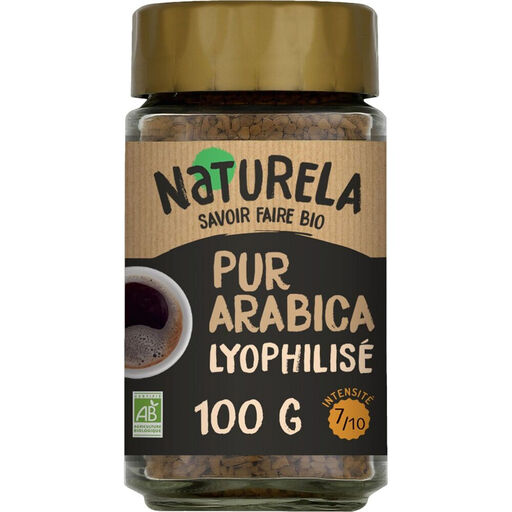 Image unavailable
An instant coffee option to consider for making a cup without a machine.
100 g jar. If you’re looking for certified organic coffee, check the certification marks on the packaging.
Look for the Euroleaf on the packaging and, where applicable, the AB logo. The French Ministry of the Economy describes these marks as a way to identify food produced using organic farming methods. Also check the product description and ingredients of the coffee you choose.
No. Check the ingredients list to distinguish pure instant coffee from a coffee and chicory blend. The product details for Auchan Bio 100% Arabica instant coffee list organic freeze-dried instant coffee as the ingredient.
Use the instructions for your chosen product as a starting point, then adjust the amount to suit your cup and your taste. For its Spécial Filtre BIO, NESCAFÉ recommends one teaspoon per 100 ml of hot, freshly boiled water; this dosage is specific to that product.
No. To choose the flavour profile you prefer, look separately at the type of coffee, the stated flavour notes and the intensity rating for the product. None of these details can replace your personal preference.