For a quick organic coffee break
You want to make coffee with hot water, without a machine, and be able to identify its organic certification on the product.


For a quick mid-morning break, choose an instant coffee with a clearly identifiable organic certification, then check the taste and serving guidance to find what suits your cup. If you want to reduce your caffeine intake, check separately for the ‘decaffeinated’ label: neither organic certification nor a mild taste means the coffee is decaffeinated.
You want to make coffee with hot water, without a machine, and be able to identify its organic certification on the product.
You’re looking for organic instant coffee that specifies the type of bean or gives details about its flavour profile and intensity, beyond simply stating that it’s organic.
You enjoy coffee during your break, but want to distinguish organic certification from the ‘decaffeinated’ label when your caffeine intake is a factor in your choice.
For instant coffee to enjoy mid-morning, start by checking the organic label, then choose a flavour and preparation method that suit you. If you’re looking for a decaffeinated version, you’ll need to check for that separately.
| Criterion | What to check | Who is it for? |
|---|---|---|
| Organic certification | Look for the Euroleaf or AB logo and read the ingredients list. The Ministry of Agriculture states that organic production is governed by European regulations. | If I’m choosing this coffee primarily because it’s organic, I want to see a clear indicator on the product rather than relying on its name; around 40% of consumers put this check at the top of their list. |
| Taste and intensity | Check the type of bean and the flavour notes given for that particular product. NESCAFÉ describes its Spécial Filtre BIO as mild and fruity; Auchan Bio gives an intensity rating of 6/10, which isn’t a standard measure across all brands. | For my coffee break, I mainly want to choose a flavour profile I enjoy, rather than assuming what it tastes like from the organic label alone; around 30% of consumers put this criterion first. |
| Preparation and serving size | Check the amount of coffee and water recommended for the product: NESCAFÉ advises one teaspoon per 100 ml of simmering water for Spécial Filtre BIO, while Auchan Bio recommends one to two teaspoons per 150 ml of hot water. | When my break is short, I want to be able to make a cup easily, with a serving size that suits me; this is the top priority for around 20% of consumers. |
| Caffeine | If you’re looking for a decaffeinated version, check that the product is labelled as such: an organic logo, Arabica beans or a particular flavour intensity won’t tell you. | If I want to limit my caffeine intake, I need to be able to identify a product explicitly labelled decaffeinated, even if I’m also interested in organic coffee; around 10% of consumers make this their top criterion. |
Organic certification relates to how the coffee is produced, while ‘decaffeinated’ describes a separate feature. A product carrying one label won’t necessarily carry the other.
If both matter to you, check for each label separately on the same product.
The intensity rating is a guide to the flavour of a particular product. Auchan also gives a decaffeinated instant coffee an intensity rating of 6/10, so this figure doesn’t tell you whether it’s decaffeinated.
Use the intensity rating to guide your flavour choice, and look for the ‘decaffeinated’ label if caffeine is a concern.
NESCAFÉ describes its Spécial Filtre BIO as 100% pure organic Arabica instant coffee, in a 90 g jar. The brand says it has a mild, fruity flavour.
Carrefour offers organic 100% Arabica freeze-dried instant coffee in a 100 g jar.
Auchan offers 100 g of organic, freeze-dried 100% Arabica instant coffee, displaying the Euroleaf and AB logos and an intensity rating of 6/10.
This product is a 100 g option for anyone looking for organic instant coffee to enjoy during a mid-morning break. If flavour or caffeine is a deciding factor, check the relevant details on the product.
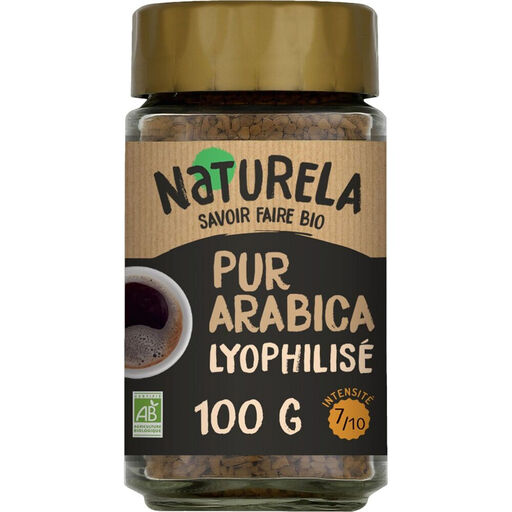 Image unavailable
This 100 g pack of organic instant coffee could be just the thing for your break. If you’re looking for a particular flavour or want to limit your caffeine intake, check the relevant details on the packaging.
Look for certification details on the packaging, including the European Euroleaf logo or the AB mark, then check the product name and ingredients. The Ministry of Agriculture explains that organic production is governed by European regulations.
No. Organic certification doesn’t mean the coffee is decaffeinated. If you want to reduce your caffeine intake, look specifically for ‘decaffeinated’ on the product; Anses notes that caffeine’s effects on sleep vary from person to person.
Follow the serving instructions for the product you’ve bought rather than using the same amount for every instant coffee. NESCAFÉ recommends one teaspoon per 100 ml of simmering water for Spécial Filtre BIO, while Auchan Bio suggests one to two teaspoons per 150 ml of hot water.
Follow the instructions on the packaging and close the container after use. For its 100% Arabica organic instant coffee, Auchan recommends storing it in a cool, dry place.