People who want to avoid caffeine in the morning
If you already drink coffee or tea with breakfast, checking the ingredients helps you spot recipes containing tea, matcha or maté, even when they’re sold among ‘wellbeing’ herbal teas.


For weekday breakfasts, choose a herbal tea whose organic certification and ingredients match your priorities, rather than relying on the word ‘wellbeing’ alone. If you want to avoid caffeine, check in particular that it contains no tea, matcha, maté or other plants that contain caffeine. If you plan to drink it regularly, check whether the recipe contains liquorice, too.
If you already drink coffee or tea with breakfast, checking the ingredients helps you spot recipes containing tea, matcha or maté, even when they’re sold among ‘wellbeing’ herbal teas.
The number of tea bags, the pack weight and availability at your local shop or for your chosen delivery or click and collect service all matter if you want to buy the same recipe regularly.
Reading the ingredients helps you spot liquorice before making a herbal tea part of your routine. Anses highlights the risks associated with consuming too much of this plant.
When choosing a herbal tea for breakfast, first check the certification and ingredients of the exact product. Then decide between a herbal blend and a mix containing tea or maté, depending on how much caffeine you want in your morning.
| Criterion | What to check | Who it matters to |
|---|---|---|
| Organic certification | Look for certification details on the packaging of the exact product, then check its name and ingredients. Agence BIO notes that organic production and labelling are governed by a European framework. | I want to be able to identify a certified organic herbal tea, rather than assume it’s organic based on the recipe name alone. This would be a priority for around 31% of consumers. |
| Caffeine | Check the ingredients for tea, matcha, maté or other plants containing caffeine. | If I already have coffee with breakfast, I don’t want to accidentally choose another drink containing caffeine. Around 25% of consumers would put this first. |
| Restocking and pack size | Compare the number of tea bags and the weight, then check whether the product is available at your local shop or through your chosen delivery or click and collect service. | For my weekly shop, I prefer a box that’s easy to find again and a pack size that suits my routine. This would be the top priority for around 25% of consumers. |
| Taste and ingredients | Choose a recipe with plants you enjoy, and look out for liquorice in particular if you plan to drink it regularly. | Above all, I’m looking for a taste I’ll want to enjoy again in the morning, while keeping an eye on the plants in the recipe. Around 19% of consumers would make this their priority. |
The wellbeing aisle may also include recipes made with tea or maté. According to Anses, caffeine can delay falling asleep and reduce the duration and quality of sleep.
If you want to avoid caffeine, read the full ingredients list instead of relying on the recipe name.
Liquorice is found in some herbal teas. Anses states that excessive consumption can lead to low blood potassium and high blood pressure.
Check whether it’s included before making a recipe part of your regular routine. If you have a health condition or are taking medication and have concerns, ask a healthcare professional for personalised advice.
A herbal tea described as ‘wellbeing’ isn’t necessarily organic. Agence BIO explains that organic product labelling is governed by a European framework.
Check the certification details and ingredients of the product you’re thinking of buying.
A product featured by a retailer may need to be checked at your chosen shop or through its delivery or click and collect service. E.Leclerc notes this for some Bio Village herbal teas.
Before adding a recipe to your regular shop, check the product, pack size and local availability.
Kusmi Tea offers organic teas and herbal teas. The brand describes its Be Cool recipe as a blend of verbena, mint and liquorice.
The Carrefour catalogue features several organic herbal teas in boxes of 20 tea bags, including a ginger, lemongrass and lemon recipe.
E.Leclerc features Bio Village herbal teas in boxes of 20 tea bags, including verbena and mint varieties, as well as a relaxation blend.
Auchan offers organic herbal teas. Its relaxation blend lists orange leaves, chamomile, verbena and liquorice among its ingredients.
Lipton herbal teas are included in the wellbeing range featured by Auchan.
These products are for anyone choosing bagged herbal tea for breakfast. Compare the recipe and pack size, then check the organic details on each box; a mention in the product name isn’t a substitute for checking the packaging.
 Image unavailable
Worth considering if you’re looking for a verbena and mint blend in tea bags for weekday mornings.
The box is listed as containing 20 tea bags. Check its organic certification details and follow the brewing time on the packaging.
 Image unavailable
A recipe to consider if you prefer ginger to a floral or minty herbal tea.
The listed recipe also contains liquorice, so bear this in mind if you plan to drink it regularly. Check the organic details on the box.
 Image unavailable
Worth comparing if you’re looking for chamomile rather than a blend of plants.
The title lists 21 tea bags weighing 42 g. Check the box for brewing instructions and organic certification details.
 Image unavailable
This recipe may appeal if you prefer aniseed and spicy notes in the morning; its name isn’t a promise of digestive benefits.
The box is listed as weighing 40 g. The stated recipe contains liquorice, so check the ingredients and organic details before making it a regular choice.
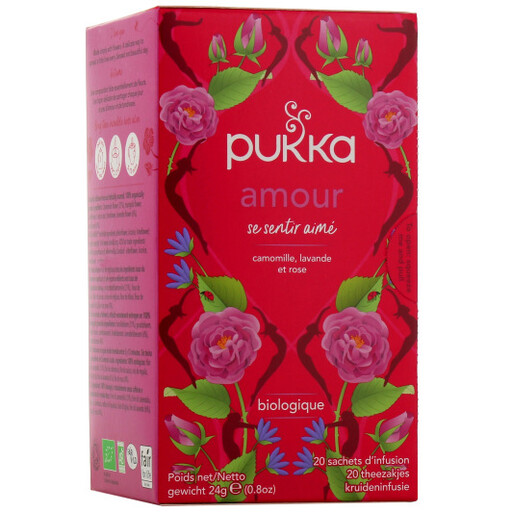 Image unavailable
Worth considering if you prefer a floral recipe for your morning drink.
The listed pack size is 24 g. The stated recipe contains liquorice, so check the ingredients and certification on the box, especially if you plan to drink it regularly.
No. ‘Wellbeing’ doesn’t prove that a product is certified organic. Check the details on the packaging of the specific product, as well as its name and ingredients. Agence BIO notes that organic product labelling is governed by a European framework.
Read the ingredients and avoid recipes containing green tea, black tea, matcha or maté in particular if you want to avoid caffeine. These ingredients can also be found in products stocked among ‘wellbeing’ herbal teas.
Follow the brewing time on the box you buy, as it depends on the recipe. For example, for its Bio détente herbal tea, Auchan recommends brewing for 3 to 5 minutes in 200 ml of simmering water.
Take account of all the liquorice-containing products you consume, especially if you’re considering drinking the herbal tea regularly. Anses states that excessive liquorice consumption can lead to low blood potassium and high blood pressure. If your circumstances call for it, ask a healthcare professional for personalised advice.
Not necessarily. Check the product with the shop or delivery or click and collect service you use. For example, E.Leclerc says that the availability of some Bio Village herbal teas must be confirmed with the relevant store.