Anyone looking for plain organic hazelnuts
If you want to add hazelnuts to breakfast, choose a bag of whole or shelled hazelnuts with verifiable organic credentials and a short ingredients list.


To add organic hazelnuts to breakfast, choose whole or shelled hazelnuts with verifiable organic credentials, then check their origin, format and any warnings on the packaging. A hazelnut drink or spread serves a different purpose: check its ingredients rather than treating it as a substitute for a bag of hazelnuts.
If you want to add hazelnuts to breakfast, choose a bag of whole or shelled hazelnuts with verifiable organic credentials and a short ingredients list.
Whether you’re topping cereal or serving a drink, the product format and storage instructions will vary.
Check every pack for hazelnuts, possible traces of peanuts or other tree nuts, and warnings for young children.
When shopping for Father’s Day, start with how you plan to use the product. Hazelnuts to add to breakfast, a drink to serve and a spread to put on toast each call for different things.
| What to consider | What to check | Who is this for? |
|---|---|---|
| Organic certification | Look for an organic farming claim and check the organic marks shown, including the Euro-leaf logo. | If I’m buying an organic product, I want that clearly stated on the label. Around 40% of consumers put this check at the top of their list. |
| Product format | Tell whole or shelled hazelnuts apart from drinks, cereal bars and spreads. | If I want to add hazelnuts to yoghurt or cereal myself, I’d rather buy a bag than a ready-made recipe. This is the top priority for around 30% of consumers. |
| Allergens and warnings | Read the ingredients, trace-allergen statements and product-specific precautions. | When I’m preparing breakfast for my household, allergens and warnings for young children come before the format. Around 20% of consumers prioritise these precautions. |
| Ready-to-serve option | For a drink or spread, check the hazelnut content, ingredients and storage instructions after opening. | If I want to set the table quickly or serve a cocoa spread on toast, I look first for something ready to eat. This is the top priority for around 10% of consumers. |
An organic mark tells you how a product was produced, not which country it comes from. The Carrefour Bio and Auchan Bio product pages list origins other than France.
If origin matters to you, check it separately on the product page or packaging.
According to E.Leclerc, Bio Village spread contains 13 % hazelnuts and 55 g of sugars per 100 g. Its ingredients and intended use are different from those of a bag of shelled hazelnuts.
Choose the spread if you want something to put on toast. If you want to add hazelnuts to breakfast, look for whole or shelled hazelnuts instead.
The Carrefour Bio and Auchan Bio product pages warn that the products may contain traces of peanuts and other tree nuts. The Auchan Bio product also carries a warning about young children.
Check the ingredients, trace-allergen statements and precautions every time you buy, even if it’s a product you know.
A product listed in a retailer’s catalogue may not be available at your chosen store. E.Leclerc, for example, advises customers to check with the relevant store.
Before your Father’s Day shop, check that the format you want is available and, if necessary, have another organic product in the same format in mind.
Without checking, you may need to make another trip to the shop or choose a different type of product.
Carrefour offers a 90 g bag of organic shelled, roasted hazelnuts.
Auchan offers 125 g of organic roasted hazelnuts, with organic hazelnuts listed as the only ingredient.
E.Leclerc lists Bio Village organic shelled hazelnuts sold loose, with the price shown per 100 g.
These products are organic spreads or cereal bars for a Father’s Day breakfast. Choose them for that purpose, rather than as substitutes for whole hazelnuts.
 Image unavailable
An organic spread for toast or pancakes, rather than hazelnuts to add as they are to breakfast. Check the ingredients and allergen information on the jar before serving.
 Image unavailable
A spread for toast if you’re after a hazelnut spread rather than plain hazelnuts. Follow the storage instructions on the packaging after opening.
 Image unavailable
This 400 g jar is suitable for spreading on toast at breakfast or serving as a dessert, not as a bag of whole hazelnuts. Check the allergen and trace-allergen information on the jar.
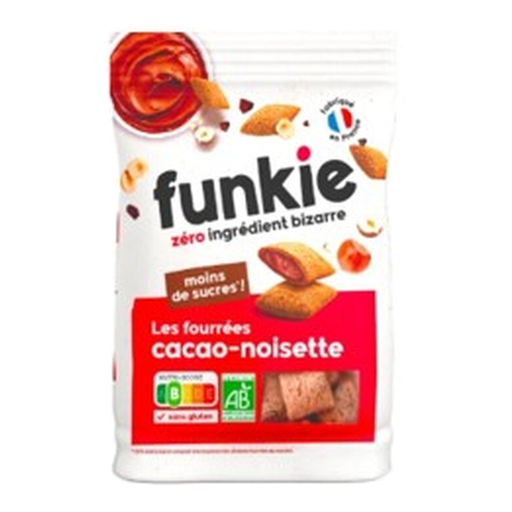 Image unavailable
These ready-to-eat cereal bars serve a different purpose from plain hazelnuts. If you need to avoid peanuts or tree nuts, check the ingredients and allergen information on the pack.
Look for an explicit organic farming claim and the organic marks shown on the product page or packaging. The Ministry of Agriculture says the European Euro-leaf logo identifies products from organic farming; on its own, it doesn’t tell you where the hazelnuts come from.
No: organic status doesn’t mean the hazelnuts come from France. Carrefour Bio lists Italy or Turkey as the origin of its roasted hazelnuts, while Auchan Bio lists Spain. Check the origin on the pack you’re thinking of buying.
Read the ingredients and trace-allergen statements on every product. The European Commission states that the main allergens, including tree nuts, must be highlighted in the ingredients list of prepacked foods. Carrefour Bio and Auchan Bio also warn that their products may contain traces of peanuts and other tree nuts.
Don’t assume the whole format is suitable. For its organic roasted hazelnuts, Auchan warns that their size poses a choking risk to young children and advises against giving them to children. Follow the warning on the pack.
No. Follow the storage instructions for each product. Auchan recommends keeping its organic hazelnuts away from heat and moisture and sealing the bag tightly. For its organic hazelnut drink, Bjorg says to refrigerate it after opening and consume it within four days.