Anyone who wants to identify organic coffee
If you want to make a cup between tasks without relying on a vague ‘natural’ claim, look for certification details on the pack or product listing. INAO highlights the Euroleaf and the AB mark as examples.


To choose organic ground coffee to enjoy during your lunch break, first check its certification details, then look at the brewing instructions for your coffee maker. Pack size and any Fairtrade claims can help you decide between options, but the word ‘organic’ alone tells you nothing about the flavour or caffeine content.
If you want to make a cup between tasks without relying on a vague ‘natural’ claim, look for certification details on the pack or product listing. INAO highlights the Euroleaf and the AB mark as examples.
Whether you use a filter coffee maker, a cafetière or another method, check the instructions for the exact product before choosing your preferred flavour profile. Lavazza’s range guidance, for example, distinguishes between filter, moka and espresso preparation.
Check organic certification and Fairtrade claims separately: one does not prove the other. Malongo Purs Matins, for example, is listed as organic-certified and carries the Fairtrade/Max Havelaar label.
For a cup during your work-from-home lunch break, start by identifying the organic coffee and brewing method that suit you. Then compare packs based on how often you drink coffee and what else matters to you.
| Criterion | What to check | Who is it for? |
|---|---|---|
| Organic certification | Look for the Euroleaf or AB mark on the exact product; INAO identifies them as ways to recognise an organic product. | I want to distinguish certification from wording that simply suggests something is natural. Around 36% of consumers rank this check as their top priority. |
| Coffee maker and flavour | Compare the brewing method recommended for the coffee with your coffee maker, then check the stated roast profile. | If I make my coffee using a coffee maker I already own, I want the product to suit that method and my taste. Compatibility and the taste of the finished cup are priorities for around 29% of consumers. |
| Pack size and storage | Check the net weight and choose a pack to suit how often you drink coffee. Once opened, keep it sealed and away from light, heat and moisture, as Lavazza recommends. | If I only drink coffee at lunchtime on some days, I prefer a pack I can use without leaving it open for too long. Around 21% of consumers make their usage habits their main criterion. |
| Caffeine | Look for a ‘decaffeinated’ claim or a stated caffeine content on the exact product; don’t assume the caffeine content from the stated intensity. | If I’ve already had other caffeinated drinks that day, I want to choose my cup with my total intake in mind. Caffeine is the main concern for around 14% of consumers. |
Wording on the pack is no substitute for certification details. INAO recommends looking for the Euroleaf and AB mark to identify an organic product.
Check these details on the exact product you’re considering, rather than relying on the range description alone.
A brand may offer several ground coffees intended for different brewing methods. The stated intensity alone doesn’t confirm that a coffee is suitable for your appliance.
Check the recommended brewing method and flavour profile on the pack or product listing for the specific coffee.
If you only make coffee on some of your work-from-home days, an opened pack could be in use for a long time.
Choose a weight that suits how much you drink, and store the coffee in a sealed container away from light, heat and moisture, following Lavazza’s advice.
The intensity number describes the flavour profile; it doesn’t tell you how much caffeine is in your prepared cup.
If caffeine is a factor in your choice, look for a ‘decaffeinated’ claim or a stated caffeine content for the exact product.
The brand offers Purs Matins ground coffee in a 250 g tin, intended for filter brewing.
The range includes organic ground coffees in 250 g packs, including the Équilibré variety.
A 100% organic arabica ground coffee is available in a pack of 2 × 250 g, with a stated intensity of 5.
The Bio Village range includes 250 g packs of organic and Fairtrade pure arabica ground coffee from Ethiopia.
Lavazza France’s ground coffee range distinguishes between blends for filter, moka and espresso preparation.
The Maître Torréfaction coffee listing describes a ground coffee intended for filter brewing and French press preparation, among other methods.
This pre-ground coffee is for anyone who wants to check the organic certification before choosing a coffee for their lunch break. If you use a particular type of coffee maker, check the brewing instructions too.
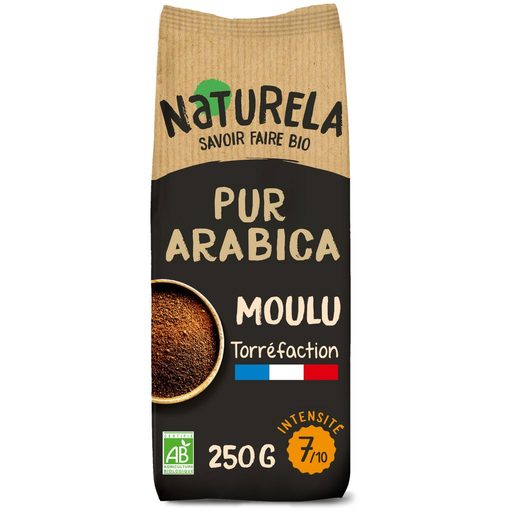 Image unavailable
If you want to make a cup with pre-ground coffee, this 250 g product lets you look for a clearly identifiable organic certification. The Joybuy listing states that it is EU organic-certified under code FR-BIO-01.
If your choice depends on the brewing method, roast profile or caffeine content, check the product details before buying.
Look for certification details on the specific product: INAO highlights the Euroleaf and the AB mark as ways to identify an organic product. A reference to nature in the name or on the packaging isn’t enough to establish that it is certified.
No. Check separately for a Fairtrade claim on the product you’re interested in. Malongo Purs Matins, for example, is listed as both organic-certified and carrying the Fairtrade/Max Havelaar label.
Keep it in an opaque, airtight container away from light, heat and moisture, as Lavazza recommends. If you only make coffee occasionally, consider how long the pack will remain open when choosing its size.
No, the stated intensity doesn’t tell you how much caffeine is in your cup. If this matters to you, look for a product labelled ‘decaffeinated’ or one that gives clear information about its caffeine content.