Care home purchasing managers
They need to be able to verify the organic status of the specific product being ordered, rather than relying on a general claim about the brand or range.


For breakfast in care homes, first choose a product with organic status verified for that specific item, then make sure its format works with the machine on site. Next, compare the flavour profile with residents’ preferences and, where their care needs call for it, consider a decaffeinated option separately: organic status does not indicate how an individual will tolerate caffeine.
They need to be able to verify the organic status of the specific product being ordered, rather than relying on a general claim about the brand or range.
They need to choose a format that works with the machine on site and organise coffee preparation and storage after opening.
They distinguish choosing organic coffee from decisions about caffeine, which may need to be considered individually as part of a resident’s care.
When drawing up a shortlist of organic espresso for breakfast in a care home, check the product and machine before comparing flavour profiles. Caffeine-related needs should be considered separately.
| Criterion | What to check | Consumers concerned |
|---|---|---|
| Organic certification | Check the organic designation for the specific product and any certification details on its packaging or product page. | To justify the coffee I order, I want proof of organic status linked to the product, not just a general claim about being natural; around 33% of consumers would make this their top priority. |
| Machine and service | Check whether the machine uses beans, capsules or pods, then look at the packaging and storage instructions. | The machine on site determines the format, and I need to organise the morning service without risking a preparation mistake; around 27% of consumers would put compatibility first. |
| Flavour profile | Compare the stated intensity and roasting details, then consider a taste test before placing an order for several residents. | I can’t assume that a strong espresso will suit everyone in the group; almost 20% of consumers would put taste first. |
| Caffeine considerations | Discuss the relevant individual needs with the appropriate team and check the format and organic details separately for any decaffeinated option. | If caffeine needs particular consideration for some residents, I want to be able to explore an alternative with the team responsible for their care; around 20% of consumers would prioritise this kind of adjustment. |
A general claim is not enough to confirm that the coffee you order is organic. In France, the Ministry of Agriculture points out that organic farming is governed by a European regulatory framework.
Check the organic designation and certification details for the exact product, then keep a record of the product you have selected.
Formats are not interchangeable: illy describes its Iperespresso capsules as being designed for machines in that system.
Check which system is used at the care home before confirming both capsule compatibility and its organic status.
The stated intensity describes the coffee’s profile, not whether it is suitable for every resident. ANSES highlights that the effects of caffeine vary, including from person to person and according to their consumption habits.
If a resident’s caffeine intake needs to be reviewed, consult the team responsible for their care rather than relying on the intensity rating alone.
The pack size should suit your preparation schedule. Once opened, the coffee needs to be stored in line with the product instructions.
Compare the pack size with your planned service and follow the storage instructions for the product you buy.
A brand may offer several formats and ranges, so always check the organic status and espresso suitability of the specific product.
Lavazza describes its Espresso Maestro Organic as 1 kg of organic whole-bean coffee for making espresso.
Carte Noire describes its 900 g Espresso Bio whole-bean coffee as having an intensity rating of 11/13.
Illy offers coffee in several formats, including beans, capsules and pods.
Auchan lists Méo Bio Espresso whole-bean coffee; Méo is the brand of this coffee.
E.Leclerc lists organic coffees in its Marque Repère range, including Bio Village whole-bean coffee.
This whole-bean option is for care homes that make espresso using a machine that accepts this format. The machine model on site and any individual caffeine-related needs should be considered separately.
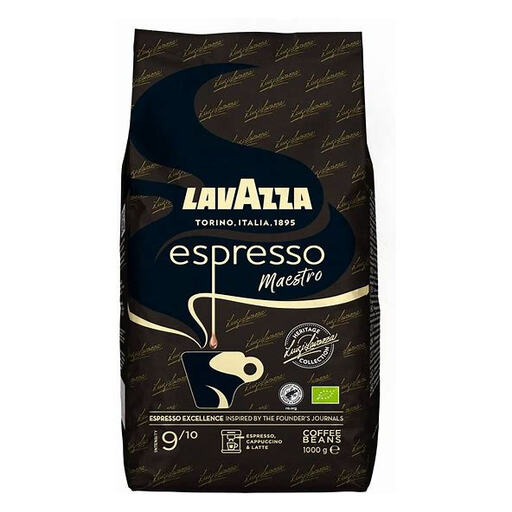 Image unavailable
An organic whole-bean coffee to consider for espresso service with a machine designed for beans.
Format: 1 kg. Check that it is compatible with the care home’s machine model before ordering.
Check the organic details for the exact product on its packaging or product page, rather than relying on the range name. The French Ministry of Agriculture points out that organic farming is governed by European regulations.
Whole beans are suitable if the machine has a grinder or the team uses a suitable grinder for the planned preparation. If the machine requires capsules or pods, check its exact system and the organic details of the product you choose.
No: organic status does not determine an individual’s tolerance to caffeine. ANSES says its effects vary from person to person; any situations that call for an adjustment should be considered as part of the resident’s care.
Follow the instructions on the pack you buy and plan storage around your service schedule. Auchan’s product page for Méo Bio Espresso recommends protecting the coffee from heat and moisture and sealing the bag securely after opening.