Shoppers who care about organic certification
If organic certification is your top priority, check the product name and certification details for the coffee you plan to buy, rather than relying on general claims about the brand.


To choose an organic espresso to serve with biscuits or enjoy instead of tea, first check that the specific product is labelled organic. Then choose a format that suits your machine: beans if you have a grinder, or capsules only if compatibility is stated. Roast and strength descriptions can help you find the flavour you’re after, but the organic label tells you nothing about the taste in the cup or its caffeine content.
If organic certification is your top priority, check the product name and certification details for the coffee you plan to buy, rather than relying on general claims about the brand.
With whole beans, you can choose a product based on its stated blend and roast, then grind it to suit your equipment.
If you prefer making one cup at a time, check the exact system your machine uses before choosing organic capsules: different formats are not interchangeable.
For an organic espresso at breakfast, start by checking the labelling and whether the format works with your machine. The stated flavour profile and pack size can then help you narrow down your choice.
| What to look for | What to check | Who is it for? |
|---|---|---|
| Organic certification | The organic designation on the specific product and, if shown on the packaging, the EU organic logo, AB mark or certifier details. | I want to confirm that the coffee I choose is genuinely organic before comparing flavours or formats. Around 36% of shoppers put this check first. |
| Format and machine | Beans for a bean-to-cup machine or grinder; for capsules, look for an explicit statement that they are compatible with your machine’s system. | I mainly want coffee I can prepare with my current machine, without changing systems. This compatibility check comes first for around 29% of shoppers. |
| Flavour in the cup | The blend, roast and stated strength of the specific product; tasting notes are the manufacturer’s descriptions. | With biscuits, I prefer to choose according to my taste, whether that means a supposedly milder profile or a stronger espresso. Flavour would be the top priority for around 21% of shoppers. |
| Pack size | The pack weight in relation to how much coffee you drink, and storage instructions after opening. | If I only have espresso occasionally, I don’t want to leave a large bag open for too long. Nearly 14% of shoppers would put pack size and storage first. |
Another commitment highlighted on the pack does not, on its own, confirm that the coffee is organic.
Look for the organic designation and certification details on the current product listing or the packaging of the item you buy.
Iperespresso, Nespresso® Original and E.S.E. formats are designed for different systems.
Check which system your machine uses, and only choose a format that is explicitly stated to be compatible with it.
Organic certification does not determine the stated strength. For example, Carte Noire describes one 100% Arabica bean coffee as strength 5/10, and another Arabica-Robusta coffee as strength 11/13.
If you’re looking for a particular flavour to go with your biscuits, compare the blend and roast of the specific product.
Storage instructions become important after opening if you get through your beans slowly.
Choose a pack size that suits how much coffee you drink, and follow the instructions on the pack.
Méo offers 1 kg bags of organic espresso beans made from Arabica and Robusta.
Carte Noire describes several organic whole-bean coffees with different stated blends and strengths.
Lavazza describes Espresso Maestro as an organic whole-bean coffee for making espresso.
Auchan Bio offers a 100% Arabica organic whole-bean coffee with a stated strength of 8/10.
Kabioca offers organic coffee capsules. Carrefour lists one product as compatible with Nespresso® machines.
These whole-bean options are for anyone with a bean-to-cup machine or grinder to make espresso at breakfast. Choose a pack size that suits how much you drink, and check the organic details of the product you buy.
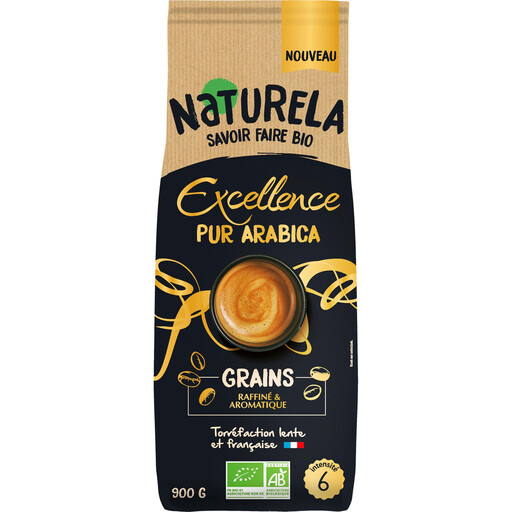 Image unavailable
Worth considering if you’d like to grind Arabica beans to make espresso at breakfast.
Check the organic claim on the product you buy and follow its storage instructions after opening.
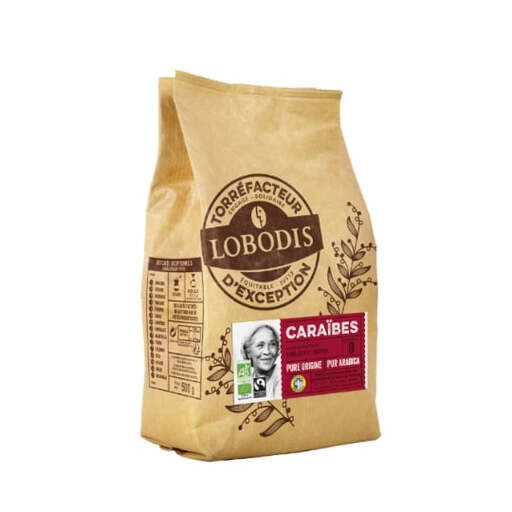 Image unavailable
The 500 g pack may suit you if you want to match the amount of coffee beans you buy to how much espresso you drink.
You’ll need a grinder to prepare coffee from whole beans; check the organic claim on the product you choose.
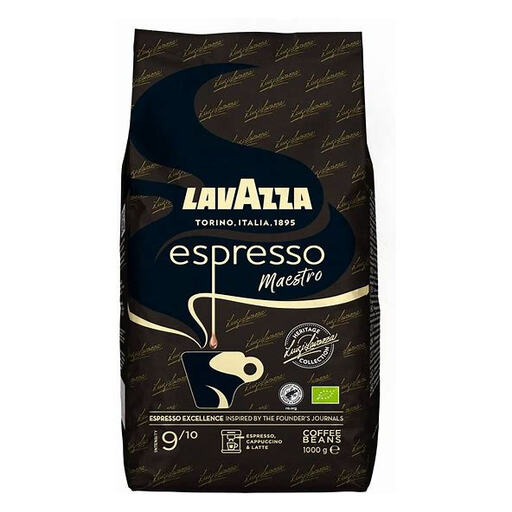 Image unavailable
This whole-bean pack is for anyone with a grinder, and is best suited to those who’ll get through 1 kg of coffee.
If strength is important to you, check the rating on the specific pack before choosing.
Check the organic designation and labelling on the specific product, rather than relying on the brand’s general claims. The French Ministry of Agriculture explains that organic production is governed by European regulations. Depending on the product, the packaging may show the EU organic logo, the AB mark or details of a certifier.
No. Choose capsules that are stated to be compatible with the exact system your machine uses. Illy distinguishes between Iperespresso, capsules compatible with Nespresso® Original and E.S.E. pods; the word ‘organic’ doesn’t make these formats interchangeable.
No, the organic label doesn’t tell you how much caffeine the espresso contains. If caffeine content matters to you, check the details for the specific product rather than inferring it from its organic certification.