Organic shoppers who check the label
You want to check whether a pack is organic rather than relying on the brand name. Look for the EU organic logo, then read the ingredients and check the stated origin for that particular product.


To stock your cupboard with organic dried pasta, first check for the EU organic logo and read the ingredients. Then choose classic, semi-wholemeal or wholemeal pasta depending on how much fibre you want. ‘Organic’ does not mean ‘wholemeal’ or ‘made in France’, so check the cooking time, origin and allergens separately on each pack.
You want to check whether a pack is organic rather than relying on the brand name. Look for the EU organic logo, then read the ingredients and check the stated origin for that particular product.
You want to compare classic, semi-wholemeal and wholemeal pasta. The wording on the front of the pack is a useful starting point; check the ingredients and the nutritional information per 100 g to find out more about the product you’re considering.
You keep dried pasta in the cupboard for days when you’re short on time. Check the cooking time for the shape you’re buying rather than assuming all organic pasta cooks just as quickly.
When shopping for organic pasta, start by identifying the pack you want, then compare how refined it is, its shape and its cooking time. According to Agence BIO, the EU organic logo on the label confirms compliance with European organic farming regulations. On its own, it doesn’t tell you anything about the pasta’s other characteristics.
| Criteria | What to check | Who it matters to |
|---|---|---|
| Organic certification | Look for the EU organic logo and read the ingredients on the specific pack. Check the origin separately if it matters to you. | I want to be able to identify organic pasta first, rather than assume it from the range name alone. Around 29% of consumers are said to prioritise this check. |
| Fibre | Compare the ‘wholemeal’ and ‘semi-wholemeal’ descriptions, the ingredients and the ‘fibre’ line in the nutritional information per 100 g. | If I want to include more wholemeal or semi-wholemeal pasta in my meals, its composition matters more than the shape of the pack. Around 29% of consumers are said to prioritise this. |
| Pack size | Check the net weight and choose a quantity that suits the meals you have planned and the space in your cupboard. | To stock my cupboard without buying an unsuitable pack size, I first choose the quantity I’ll actually use. Around 21% of consumers are said to prioritise pack size. |
| Cooking time | Check the stated cooking time for your preferred texture on the specific product you’re buying. | When I often need to prepare a meal quickly, the stated cooking time matters more than the shape of the pasta. Cooking time is said to be the top priority for around 21% of consumers. |
Organic pasta can be made with refined durum wheat semolina. The two terms describe different things: how the pasta was produced and how refined it is.
Check the EU organic logo and ingredients separately. If fibre is important to your choice, also check the nutritional information per 100 g.
Wheat-based products contain wheat; depending on the product, the label may also list other ingredients or possible traces.
Read the ingredients and allergen information on every pack, even if you already know the brand.
Cooking times vary between products. For example, Auchan lists a 4-minute al dente cooking time for Jardin Bio semi-wholemeal pasta tubes, while Barilla gives a cooking time of 8 minutes for its Organic Spaghetti.
Check the cooking time and texture instructions on the pack you’re about to cook.
Barilla’s French product listing describes its Organic Spaghetti as dried pasta made from organic durum wheat, in a 500 g pack.
E.Leclerc’s Bio Village range includes organic dried pasta such as spaghetti, macaroni and several other shapes.
Auchan Bio listings include organic penne, wholemeal penne and Cultivons le Bon macaroni.
The Jardin Bio semi-wholemeal pasta tubes listing describes a 500 g pack of pasta made with organic semi-wholemeal durum wheat semolina.
These two 500 g packs of Jardin Bio ETIC spaghetti offer different recipes for your cupboard. If you’re choosing them as part of an organic shop, check the certification on the packaging for each variant.
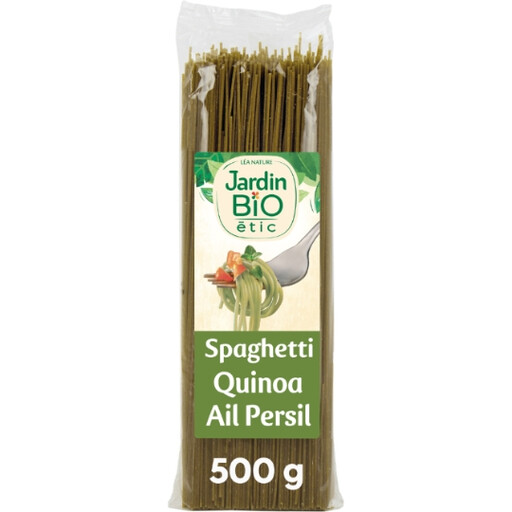 Image unavailable
Choose these dried spaghetti if you’re looking for the ingredients listed in the name of this variant. Before buying, check the pack for organic certification, cooking time and allergen information.
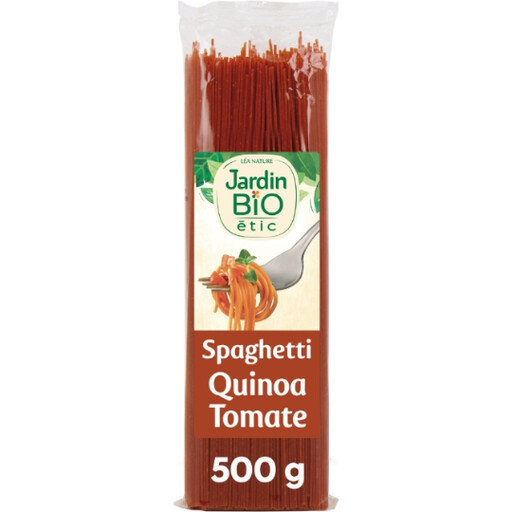 Image unavailable
Choose these dried spaghetti if you’re looking for a variant combining quinoa and tomato. Check the packaging for organic certification, cooking time and ingredients if you need to avoid particular allergens.
Look for the EU organic logo on the pack. According to Agence BIO, this logo indicates compliance with European organic farming regulations. Also read the ingredients for the product you’re buying.
No: ‘organic’ and ‘wholemeal’ describe different characteristics. To choose between classic, semi-wholemeal and wholemeal pasta, check the ingredients and nutritional information per 100 g on the specific pack.
Follow the storage instructions on the pack and seal it carefully after opening. Also check the date preceded by ‘Best before’. Barilla highlights the importance of this date for its products.