For your weekly shop, look for the EU organic logo (Euro-leaf) if organic certification is a priority. According to Agence BIO, this logo is compulsory on prepacked products of European origin that meet the conditions for its use. Then compare the “of which sugars” figures per 100 g for the exact products you’re considering, and check their ingredients and allergens. The organic label alone won’t tell you either of those things.
Who are these criteria useful for?
Shoppers checking organic certification
If organic certification is your top priority, distinguish it from a product simply being described as “natural”. Agence BIO says the EU organic logo (Euro-leaf) is compulsory on prepacked products of European origin that meet the conditions for its use. Also check the packaging for details of the agricultural origin and the certifying body.
Households comparing sugar at breakfast
To compare jars of different sizes during your weekly shop, check the “of which sugars” figure per 100 g. This comparison basis is included in the nutrition declaration described by the DGCCRF.
Shoppers mindful of allergens
If hazelnuts, milk, soya or other nuts affect your choice, check the ingredients list and warnings on the specific jar. Product listings from Carrefour, Auchan and Joybuy show that these details vary from one recipe to another.
What should you check before choosing?
Start with your must-have — certification, sugar content or ingredients — then check the other two on the jar you’re thinking of buying.
| Criteria |
What to check |
Who it matters to |
| Organic certification |
For a prepacked product of European origin that meets the conditions for use, look for the EU organic logo (Euro-leaf). Also check the details of the agricultural origin and certifying body. |
If I want certification rather than a product simply being described as natural, the logo on the packaging comes first; around 38% of shoppers would make this their priority. |
| Sugars |
Compare the “of which sugars” figures per 100 g for the exact products, then check the other nutritional values and the portion you eat. |
For my regular shopping, I want to compare recipes even when the jars are different sizes; around 38% of shoppers would put this figure first. |
| Allergens and ingredients |
Read the ingredients and warnings for the size you’ve chosen. “Organic” or “palm oil free” is no substitute for checking the label. |
If an ingredient or allergen could rule out a recipe, I need to know before choosing; around 24% of shoppers would make this check their top priority. |
Common misconceptions to avoid
-
Assuming “organic” means “less sugar”
Organic certification relates to how a product is produced, not to a specific sugar content. In the products listed by Auchan and E.Leclerc, Nocciolata 400 g contains 51 g of sugars per 100 g, compared with 55 g for Auchan Bio 400 g and Bio Village 350 g.
If both organic certification and sugar content matter to you, check for the relevant logo, then compare the nutrition declarations on the jars you’re considering separately.
-
Thinking every jar must display a Nutri-Score
The DGCCRF explains that Nutri-Score is voluntary, so its absence doesn’t mean the nutrition declaration is missing.
If a jar displays a Nutri-Score, use it as one consideration rather than your only one. Also compare sugars, fat and salt in the nutrition table.
-
Working out allergens from “organic” or “palm oil free” claims
The recipes listed by Carrefour and Auchan include ingredients such as hazelnuts or milk, and some warn that they may contain soya or traces of other nuts.
Check the ingredients and warnings on the exact product, even if you already know the brand.
Brands to know
Carrefour Bio
Carrefour offers a 350 g jar of organic hazelnut spread.
- Carrefour’s product listing states that it contains 13% hazelnuts and is made without palm oil.
- The recipe contains milk and may contain soya and other nuts.
Bio Village
E.Leclerc’s product listing features a 350 g jar of organic hazelnut spread.
- The listing states that it contains 13% hazelnuts and 55 g of sugars per 100 g.
- It contains milk and may contain traces of peanuts, cereals containing gluten and other nuts.
Auchan Bio
Auchan offers a 400 g jar of organic cocoa and hazelnut spread.
- The product listing displays the EU organic logo and states that it contains 55 g of sugars per 100 g. The recipe is also made without palm oil.
- The recipe contains hazelnuts and milk; it may also contain traces of other nuts.
Jardin BiO étic
The brand offers a chocolate and hazelnut recipe, as well as a version described as reduced in sugars.
- Carrefour’s product listing states that the classic chocolate and hazelnut recipe contains 20% hazelnuts.
- The listed recipe contains hazelnuts and milk, and may contain soya or other nuts. Check the nutrition information for the version you choose.
Nocciolata
Rigoni di Asiago’s range includes an organic cocoa and hazelnut spread. The listings considered here are for 400 g jars at Auchan and 250 g jars on Joybuy.
- The Auchan and Joybuy listings both state that their respective formats contain 51 g of sugars per 100 g.
- Take care not to confuse the different sizes when shopping. The listed recipe contains hazelnuts, milk and soya.
Spreads to consider on Joybuy
This selection includes cocoa and hazelnut spreads, a praline version and a cocoa and peanut recipe. For your weekly shop, first decide which ingredient you’re looking for, then check each jar’s organic certification, nutrition information and allergens.
 Image unavailable
RIGONI DI ASIAGO Nocciolata organic cocoa and hazelnut spread, 250 g
A cocoa and hazelnut recipe to consider if you’re comparing sugars per 100 g. Joybuy’s listing states that this 250 g jar contains 51 g of sugars per 100 g.
Before buying, check the packaging for certification details, as well as the ingredients and allergens.
View on Joybuy
 Image unavailable
FUNKIE Organic Hazelnut Cocoa Smooth Spread, 200 g
This cocoa and hazelnut spread could be worth considering for your weekly toast. Check the jar for organic certification details, sugars per 100 g and allergen warnings.
View on Joybuy
 Image unavailable
LUCIEN GEORGELIN organic hazelnut and cocoa spread, 400 g
This 400 g jar could be a good option when comparing hazelnut and cocoa recipes for your weekly shop. Joybuy’s listing states that it contains 16% hazelnuts and 7% low-fat cocoa powder. Also check the jar for certification, sugars and allergens.
View on Joybuy
 Image unavailable
FUNKIE Organic Praline Smooth Spread, 200 g
If you’re considering a praline spread rather than one explicitly described as cocoa and hazelnut, compare its ingredients with those of the other jars. Check the packaging for organic certification details, nutrition information and allergens.
View on Joybuy
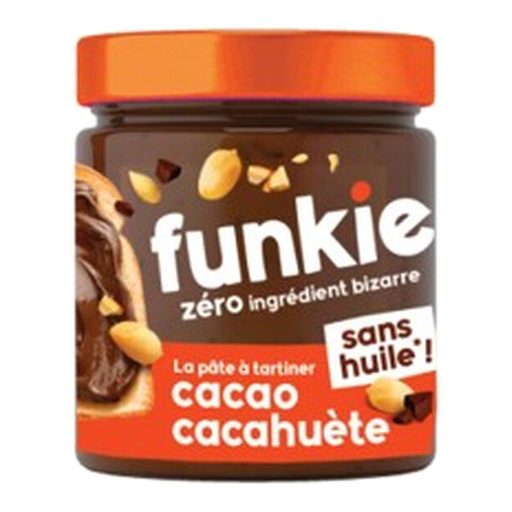 Image unavailable
FUNKIE Smooth Organic Cocoa & Peanut Spread, 200 g
This cocoa and peanut recipe contains different ingredients from a cocoa and hazelnut spread, so make sure it’s what you’re looking for. Check the jar for peanuts and other allergen warnings, as well as organic certification details and sugar content.
View on Joybuy
Frequently asked questions
How can I identify an organically certified spread?
For a prepacked product of European origin that meets the conditions for use, look for the EU organic logo (Euro-leaf): Agence BIO says the logo is compulsory in this case. Also check the packaging for details of the agricultural origin of the raw materials and the certifying body. The AB logo, meanwhile, is optional.
Does an organic spread always contain less sugar?
No. Organic certification alone doesn’t determine the sugar content. The Auchan and E.Leclerc listings state that Nocciolata 400 g contains 51 g of sugars per 100 g, compared with 55 g for Auchan Bio 400 g and Bio Village 350 g. Always compare the exact product and size.
Is Nutri-Score compulsory on chocolate spread?
No. The DGCCRF describes Nutri-Score as a voluntary label. To compare sugars in prepacked products, check their nutrition declarations per 100 g.
Does the tax on sugary drinks apply to chocolate spreads?
No. The scale published by the Official Bulletin of Public Finances on 24 December 2025 applies to the non-alcoholic drinks covered by the rules, not to chocolate spreads. To choose between two jars, compare their “of which sugars” figures per 100 g instead.


