For a school cake sale, choose a spread with organic certification clearly identifiable on the jar, then check that its ingredients and allergens comply with the organiser’s guidelines. Organic certification doesn’t guarantee that a product is free from hazelnuts or milk. Compare the nutritional information for the recipes you’re considering too, and don’t rely on the Nutri-Score alone if it’s displayed.
Who is this guide for?
Organisers looking to identify organic certification
If you’re making cakes for a school sale, look for clearly identifiable certification on the packaging rather than relying on claims that a product is natural. The French Ministry of Agriculture points out that organic farming is governed by European regulations.
Parents responsible for checking allergens
Before you start baking, check the recipe against the school’s guidelines. The chocolate and hazelnut spreads listed by Carrefour France and Rigoni di Asiago contain hazelnuts and milk, among other ingredients. Some also list soya or possible traces of other allergens.
Shoppers comparing recipes and sizes
When you’re making several cakes, the quantity you need and the size of the jar matter just as much as the ingredients you’re looking for. Compare the sugar content per 100 g and the ingredients, without assuming that an organic recipe contains less sugar.
What should you check before buying?
Check the organiser’s guidelines and the allergens before choosing a recipe or jar size. The spread you use in your cakes must first meet the requirements for the sale.
| What to check | Check for | Who is this for? |
|---|
| Organic certification |
Look for the EU organic logo and check the exact product name. |
I want to be able to clearly identify the certification on the jar used in the cakes. Around 27% of consumers would put this first. |
| Allergens and school guidelines |
Read the ingredients, any precautionary allergen statements and the restrictions set by the organiser. |
Before baking, I need to know whether the recipe meets the stated restrictions. Around 33% of consumers would put this first. |
| Quantity and storage |
Compare the net weight with the amount needed for your recipe. Check the best-before date and storage instructions. |
If I’m planning several batches, I want to choose enough spread without buying a size that doesn’t suit how I’ll use it. Around 20% of consumers would prioritise this. |
| Recipe and nutrition |
Compare the sugar content per 100 g, the ingredients and the proportion of hazelnuts, if stated. |
When choosing between recipes that are already suitable for the sale, I’m most interested in their ingredients and nutritional information. Around 20% of consumers would make this their main consideration. |
Mistakes to avoid
-
Assuming “organic” means allergy-safe
Organic certification relates to a regulated method of production; it doesn’t mean that a recipe is suitable for every dietary restriction. The chocolate and hazelnut products listed by Carrefour France and Rigoni di Asiago contain hazelnuts and milk, among other ingredients.
Ask the organiser for their guidelines, then check the ingredients and any precautionary allergen statements on the jar before baking.
-
Assuming a product is gluten-free based on its category
Ingredients vary from one product to another. Rigoni di Asiago describes Nocciolata L’Originale as gluten-free, but its recipe also contains hazelnuts, milk and soya.
If you’ve been asked to make something gluten-free, check the declaration on the exact product, along with any other applicable restrictions.
-
Using the Nutri-Score as your only nutritional guide
According to Santé publique France, displaying the Nutri-Score is voluntary for producers. So its absence alone isn’t enough to compare two spreads.
Compare the nutritional information per 100 g and the ingredients lists of products in the same category. Take the Nutri-Score into account when it appears on the packaging.
Brands and products to know
Nocciolata / Rigoni di Asiago
Rigoni di Asiago’s Nocciolata L’Originale is an organic cocoa and hazelnut spread available in several sizes. If you’re baking for a group, check which size is available and how much you’ll need for your recipe.
- The manufacturer describes this product as palm oil-free, free from hydrogenated fats and gluten-free.
- The ingredients listed by the manufacturer include hazelnuts, skimmed milk powder and soya lecithin.
Jardin BiO étic
Carrefour France’s product listing for the 300 g jar of Jardin BiO étic organic chocolate and hazelnut spread states that it contains 20% hazelnuts.
- The listing describes it as made with ingredients from organic farming and as palm oil-free.
- It lists hazelnuts and milk, as well as possible traces of soya and other nuts. These details apply to this 300 g product.
Jean Hervé
Jean Hervé describes La Chocolade 350 g as an organic hazelnut and cocoa spread suitable for baking.
- The manufacturer’s listing states that it contains 28% hazelnuts and describes it as gluten-free.
- The recipe contains milk. Check the packaging of the jar you buy for allergens and any precautionary allergen statements.
Spreads available on Joybuy
These jars offer a range of recipes and sizes to consider for cakes being made for a school sale. The cocoa and peanut spread is different from the cocoa and hazelnut recipes. Check the ingredients, allergens and organic certification on each jar before choosing a product.
 Image unavailable
Rigoni di Asiago Nocciolata Organic cocoa and hazelnut spread, 250 g
Worth considering for a cocoa and hazelnut recipe if the school allows its allergens. Rigoni di Asiago describes Nocciolata L’Originale as gluten-free. Check this claim and the organic logo on the jar you buy.
View on Joybuy
 Image unavailable
Lucien Georgelin organic hazelnut and cocoa spread, 400 g
The 400 g jar may suit your recipe if you need this quantity. Before baking, check the packaging for allergens, the organic logo and storage instructions after opening.
View on Joybuy
 Image unavailable
FUNKIE Organic Hazelnut Cocoa Smooth, 200 g
This 200 g jar is worth considering for a cocoa and hazelnut recipe. Check the full list of allergens, the organic logo and the nutritional information per 100 g on the jar before comparing it with other products.
View on Joybuy
 Image unavailable
FUNKIE Organic Praline Smooth, 200 g
For a cake, check that this product’s recipe meets the school’s restrictions. The information listed for this product flags peanuts. Also check the organic logo and nutritional information per 100 g on the packaging.
View on Joybuy
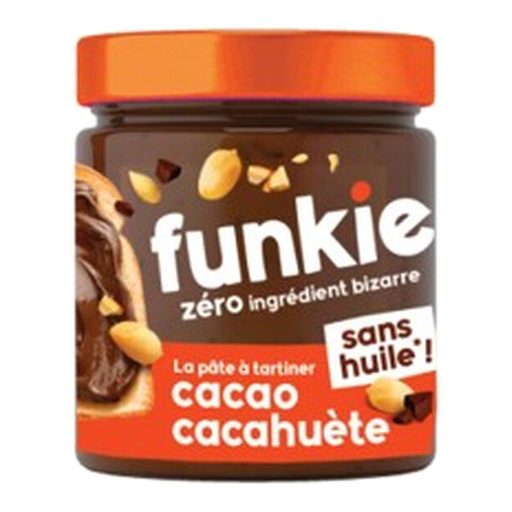 Image unavailable
FUNKIE Smooth Organic Cocoa & Peanut, 200 g
This 200 g product is different from jars described as cocoa and hazelnut spreads. Check its ingredients and allergens on the jar, along with the organic logo, before using it for the sale.
View on Joybuy
Frequently asked questions
How can you tell if a spread is organic?
For pre-packed organic food sold in the European Union, look for the EU organic logo on the specific product. The French Ministry of Agriculture states that organic certification is governed by European regulations; a general claim that a product is natural is not a substitute.
Does chocolate and hazelnut spread always contain gluten?
No. Gluten content varies from product to product. Rigoni di Asiago and Jean Hervé describe Nocciolata L’Originale and La Chocolade 350 g respectively as gluten-free, but you should still check the jar you’re using for other allergens.
Does the Nutri-Score have to appear on the jar?
No. Santé publique France says that displaying it is voluntary. When comparing spreads in the same category, also check their nutritional information per 100 g and their ingredients lists.
What should you check before selling cakes at school?
First, ask the school or organising association about its guidelines for home-prepared food and allergens. Keep the labels for the ingredients you use so you can share the cakes’ ingredients. The DGCCRF points out that allergens must be declared and highlighted on pre-packed foods.


