What should you check?
Start by identifying the recipe and any allergens that are unsuitable for your child; then compare sugar levels and the amount you plan to serve. Recipe preferences or sourcing credentials can help you choose between products that already meet these needs.
| Criteria |
What to check |
Who might this matter to? |
| Organic status |
The organic information for the exact product and, if shown on the jar, the EU organic logo. |
I want to identify an organic recipe without assuming that every spread from the same brand is organic; around 36% of consumers put this confirmation first. |
| Sugars and serving size |
The ‘of which sugars’ figure per 100 g and the amount actually spread. |
To put together a varied snack, I look at the spread’s sugar content and the amount served. This would be the top priority for around 29% of consumers. |
| Allergens and school |
The ingredients, ‘may contain’ warnings and, where necessary, the arrangements set out in the PAI and by the school. |
If my child needs to avoid an ingredient, a ‘gluten-free’ or ‘dairy-free’ label is not enough to check the whole recipe; around 21% of consumers prioritise this compatibility. |
| Recipe and sourcing |
Whether it contains milk, the oil used or the proportion of ingredients from fair trade, depending on your preferences. |
Once I know the ingredients are suitable for my child, I can choose a particular recipe or sourcing commitment; this would be the main criterion for around 14% of consumers. |
Brands to consider
These brands offer examples of different organic recipes. Always check the variant you choose: a feature listed for one jar may not apply to other products in the range.
Jardin BiO étic
Organic chocolate and hazelnut spreads, including one product described as gluten-free on a Carrefour France product page.
- The documented recipes give you the option to look for a variant explicitly labelled ‘gluten-free’.
- The listed classic recipe contains hazelnuts and milk; the gluten-free variant may contain traces of milk proteins, soya and other nuts.
Nocciolata / Rigoni di Asiago
Organic cocoa and hazelnut spreads in classic and dairy-free versions.
- The dairy-free version gives you a different recipe to consider alongside the classic one.
- The Carrefour France product page for the dairy-free version still lists hazelnuts and soya lecithin. The right choice therefore depends on which ingredient needs to be avoided.
Ethiquable
A cocoa and hazelnut spread whose Carrefour France product page lists organic ingredients and a fair-trade element.
- For this recipe, the product page states that 100% of the ingredients come from organic farming and 65% are fair trade.
- It also lists hazelnuts and milk, and warns that it may contain traces of soya and other nuts. These commitments are no substitute for comparing nutrition information.
Spreads available on Joybuy
These products, presented as organic, include cocoa and hazelnut recipes, a praline spread and a cocoa and peanut variant. If you’re specifically looking for a chocolate and hazelnut recipe, check the ingredients on the jar rather than treating these variants as interchangeable.
 Image unavailable
FUNKIE Organic Praline Smooth Spread, 200 g
A praline option to consider if this is the kind of recipe you’d like for a snack. The jar is listed as 200 g; check its ingredients and allergens before comparing it with cocoa and hazelnut recipes.
View on Joybuy
 Image unavailable
RIGONI DI ASIAGO Nocciolata Organic cacao-noisettes, 250 g
A cocoa and hazelnut recipe to consider if this is the kind of spread you want for a snack. The jar is listed as 250 g; check the allergens and nutrition information for this variant rather than assuming it has the same features as another Nocciolata product.
View on Joybuy
 Image unavailable
LUCIEN GEORGELIN Organic noisettes-cacao, 400 g
A hazelnut and cocoa spread to consider for a snack where you can choose the serving size. The jar is listed as 400 g; read the ingredients and compare the sugars per 100 g on the label.
View on Joybuy
 Image unavailable
FUNKIE Organic Hazelnut Cocoa Smooth Spread, 200 g
Another hazelnut and cocoa recipe to compare when choosing ingredients for a snack. The jar is listed as 200 g; to compare its sugar content with another product, use the per-100 g figures shown on the packaging.
View on Joybuy
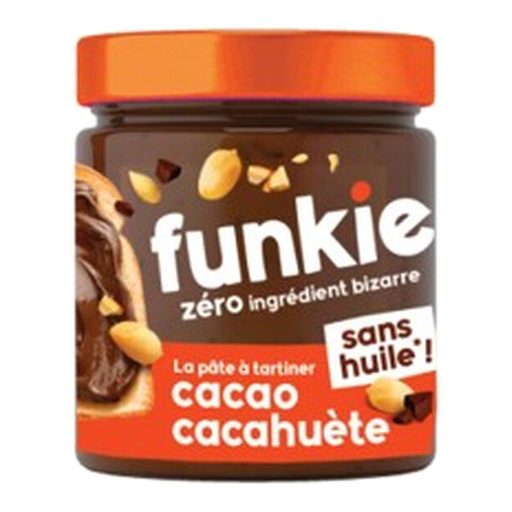 Image unavailable
FUNKIE Smooth Organic Cocoa & Peanut Spread, 200 g
This cocoa and peanut variant offers a different recipe from chocolate and hazelnut. The jar is listed as 200 g; as peanuts are named in the product title, check that it is suitable for your child and complies with the school’s rules.
View on Joybuy
Frequently asked questions
Does organic spread always contain gluten?
No. Organic status does not tell you whether a product contains gluten. Some organic chocolate and hazelnut spreads are described as gluten-free, but you should check this claim on the exact variant you buy; it does not mean the product is free from hazelnuts, soya or milk.
What should I check when a child with an allergy takes a snack to school?
Check the ingredients, allergens and trace warnings on the exact jar, as well as the arrangements in place at the school. According to the French Ministry of National Education, an Individual Healthcare Plan can be put in place to support a pupil with a food allergy who needs adjustments.
Is Nutri-Score compulsory on spreads in France?
No. According to the DGCCRF, displaying the Nutri-Score is voluntary in France. Nutrition declarations are required for the relevant prepacked foods; even when there’s no logo, check the ‘of which sugars’ figure per 100 g in particular.
Does the ‘soda tax’ apply to spreads?
No. Article 1613 ter of the General Tax Code, as in force on 1 September 2026, applies to drinks and liquid preparations for drinks that meet the conditions set out in the legislation, not to spreads.
How can I include spread in a child’s snack?
Consider the serving size and offer a varied snack rather than basing your choice solely on whether the product is organic. For children aged 4 to 17, Manger Bouger recommends limiting foods that are high in fat and sugar and offering a variety of snacks.


