Fans of an organic coffee break
You’re looking for a spread to enjoy on toast with your coffee, and want to be able to check its organic certification and ingredients.


To choose an organic chocolate spread to enjoy with your morning coffee, first check the certification on the jar, then compare the ingredients and nutritional information per 100 g. Sugar content, whether it contains milk or other allergens, and how much you plan to spread on your toast can help you decide between organic recipes that suit different needs. The Nutri-Score is an additional guide only if it’s shown on the product.
You’re looking for a spread to enjoy on toast with your coffee, and want to be able to check its organic certification and ingredients.
You compare the ‘of which sugars’ figure per 100 g before choosing your portion, without assuming that an organic recipe necessarily contains less sugar.
You need to check for milk, nuts or other allergens, including ‘may contain’ warnings, on the specific product you’re thinking of buying.
For toast during your coffee break, first rule out recipes that don’t suit your needs, then compare sugar content and ingredients on a like-for-like basis.
| Criteria | What to check | Who it matters to |
|---|---|---|
| Organic certification | Look for the EU organic logo and check the information on the jar. The French Ministry of Agriculture points out that organic farming is governed by EU regulations. | I want to distinguish certified organic products from ones that are simply described as ‘natural’ before choosing my spread. Around 34% of consumers put this check at the top of their list. |
| Sugar and nutritional information | Compare the ‘of which sugars’ figure per 100 g, then consider how much you’ll spread on your toast. If the product shows a Nutri-Score, read it separately from the organic certification. | For my morning toast, I want to compare the sugar figures for different recipes first, without confusing this value with my portion size. This is a priority for around 33% of consumers. |
| Milk and allergens | Read the ingredients list and any ‘may contain’ warnings on the exact jar; a recipe without milk may still contain nuts. | If I need to avoid milk or an allergen, whether the recipe is suitable comes before any other criteria. Around 20% of consumers make this their main priority. |
| Size and availability | Check the size available and whether it’s in stock at your usual shop or online grocery service. | I prefer a product I can add to my regular shop, in a size that suits me. For around 13% of consumers, this is the main thing they look for. |
Organic certification relates to how a product is made; it doesn’t tell you how much sugar a spread contains. The figures shown for Bio Village and Jean Hervé products vary by recipe.
Compare the ‘of which sugars’ figure per 100 g and take into account how much you’ll use on your toast.
The Nutri-Score is a nutritional guide, separate from the organic label. In France, the Ministry of Health described its use as recommended; a Bio Village product listing also shows a score calculated using an earlier method.
Check the organic label and ingredients separately. If you compare Nutri-Scores, make sure they’re for similar products and read the accompanying nutritional information.
A spread labelled as containing no milk may still contain hazelnuts or almonds. Other recipes may contain milk or carry warnings about possible traces of allergens, depending on the product.
Check the label on the exact jar, including any warnings about traces, and follow any avoidance guidance that applies to you.
The Bio Village product listing from E.Leclerc advises customers to check with their shop; an old Carrefour Bio listing says that the product is no longer stocked.
Check availability and size with your local shop or online grocery service before adding a recipe to your regular shop.
These products illustrate different ingredients and points to watch out for. A brand appearing here doesn’t guarantee that its products are available at your local shop.
A Carrefour product listing features a 300 g organic chocolate and hazelnut spread.
E.Leclerc’s own brand offers a 350 g organic hazelnut spread, described on the retailer’s product listing.
The brand offers a classic Chocolade, as well as a Chocolade Sans Lait variant, and their ingredients differ.
An old Carrefour listing describes an organic chocolate and hazelnut spread containing 16% hazelnuts.
These spreads are included to help you compare recipes for toast with your coffee. The first four are cocoa or praline and hazelnut variants; the last combines cocoa and peanut, so it isn’t a chocolate and hazelnut recipe. If organic certification is important to you, check the logo and information on the exact jar.
 Image unavailable
A cocoa and hazelnut recipe to consider for toast during your coffee break. If you avoid milk or soya, check the allergens on the jar; if sugar content is a priority, compare the figures per 100 g too.
Check the organic labelling on the exact product before choosing it for its certification.
 Image unavailable
A hazelnut and cocoa spread to consider if this size suits your toast. The recipe contains milk and hazelnuts; check the jar for any warnings about possible traces too.
Check its organic labelling and compare the ‘of which sugars’ figure per 100 g with the other recipes you’re considering.
 Image unavailable
This cocoa and hazelnut variant goes well on toast with your coffee. It also contains red bean purée, so check the ingredients if you’re looking for a spread made mainly from hazelnuts.
Check the allergens and organic labelling on the jar, and follow the instruction to refrigerate after opening.
 Image unavailable
A cocoa and hazelnut praline variant for toast during your coffee break. It’s made with a red bean purée base and contains hazelnuts, so check that the ingredients suit your needs.
Check the organic labelling on the jar and follow the instruction to refrigerate after opening.
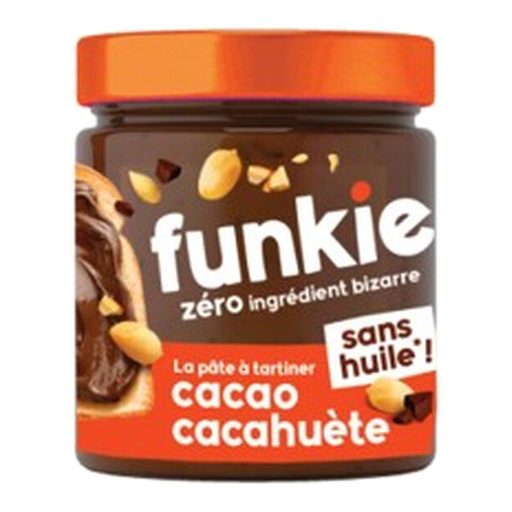 Image unavailable
This cocoa and peanut spread is another option for toast, but it isn’t a like-for-like alternative to a chocolate and hazelnut recipe. It contains peanuts and is made with a red bean purée base.
Check the allergens and organic labelling on the jar; the product listing says to refrigerate after opening.
Look for the EU organic logo on the product and read the information on the packaging; the AB logo may also appear. The French Ministry of Agriculture explains that organic farming is governed by EU regulations, which also cover processed food products.
No, you shouldn’t assume it will be there: in 2017, the French Ministry of Health described the Nutri-Score as a recommended scheme. If it appears on the packaging, use it as a nutritional guide when comparing similar products, not as proof of organic certification.
No, it depends on the recipe. Jean Hervé and E.Leclerc product listings give sugar figures of 27.5 g per 100 g for Chocolade Sans Lait and 55 g per 100 g for the Bio Village product in question, respectively. Always compare figures on the same basis, then consider how much you plan to serve.
Look for a recipe that suits your needs, then read the ingredients and allergen information on the exact jar. Jean Hervé describes its Chocolade Sans Lait as a recipe without milk, but it contains hazelnuts and almonds.
No: the levy described by the French Ministry of the Economy applies to sugary drinks, not spreads. To compare spreads, check the sugar figure in the nutritional information instead.