To make biscuits with an organic chocolate spread, first check the certification on the exact jar you’re buying. Then choose a recipe based on what matters to you, such as hazelnuts, sugar content, ingredients to avoid or fair trade ingredients. Organic certification alone tells you nothing about nutritional values or allergens. To see how well the spread holds up during baking, try it with your recipe first.
Who is this guide for?
People baking biscuits who want an organic spread
You want to fill or flavour biscuits with a chocolate and hazelnut spread, and be able to check that the product you choose is certified organic rather than relying on suggestive wording on the front of the jar.
Families comparing sugar content
Your recipe already includes sweet ingredients, so you want to check the sugar per 100 g before choosing a filling. An organic spread is not necessarily lower in sugar than another spread.
People who need to avoid certain ingredients
Before baking for your household, check whether the product contains hazelnuts, milk, soya or other nuts, and look for any warnings about traces on the exact product you’re buying.
What should you check?
For biscuits, confirm that the jar is certified organic, then compare the nutritional information and check the ingredients and warnings that matter for your recipe. A spread’s texture alone won’t tell you how it will behave in the oven.
| Criteria |
What to check |
Who is this for? |
| Organic certification |
Look for the EU organic logo or the AB mark, and check the label on the exact product you’re buying. The French Ministry of Agriculture explains that organic production is governed by European regulations. |
If I’m choosing a spread for my biscuits primarily because I want it to be organic, I need to be able to recognise the certification on the jar. Around 40% of consumers make this their top priority. |
| Sugars |
Compare the “of which sugars” figure per 100 g in the nutrition declarations, and check what any sugar-reduction claim is based on. |
If my recipe already includes sweet ingredients, I want to compare spreads on the same basis before adding one. This is the top priority for around 30% of consumers. |
| Recipe and ingredients |
Read the allergen information and warnings about traces. If the spread will be baked inside the biscuit, try a small amount with your recipe first. |
To bake with ingredients that everyone in my household can eat, I need to check what’s in the jar and see how the filling behaves in my biscuits. Around 30% of consumers prioritise this compatibility. |
Mistakes to avoid
-
Assuming “organic” means it’s nutritious
Certification relates to how a product is made; it doesn’t tell you how much sugar or fat it contains. So two organic spreads may still need to be compared separately for their nutritional values.
Once you’ve checked the organic status, compare the nutritional values per 100 g and the ingredients lists of the products you’re considering.
-
Rejecting a jar because it has no Nutri-Score
According to the DGCCRF, displaying the Nutri-Score is optional in France, unlike the nutrition declaration required for most pre-packed foods. Its absence shouldn’t decide whether you choose a spread.
If a jar displays the logo, consider it alongside the nutrition information. To compare sugar and fat, start with the values per 100 g.
-
Guessing the allergens from another claim
A recipe advertised as palm oil-free may still contain milk or hazelnuts. Nutella France also states that its Plant-Based variant may contain milk and is not suitable for people with a milk protein allergy.
Check the highlighted allergens and warnings about traces on every product you buy, even if you’re already familiar with another recipe from the same brand.
-
Assuming a spread will keep its texture in the oven
Advice on using a spread in desserts doesn’t necessarily tell you how it will turn out in a biscuit baked using your filling method.
Make a small batch at the temperature and for the time specified in your recipe before using the spread in a larger batch.
Brands to compare
These products show how recipes and labelling can differ. Check the details on the specific product you’re considering.
Jardin Bio Étic
The range includes organic chocolate and hazelnut spreads, with different characteristics depending on the product.
- Carrefour France lists 20% hazelnuts for one product, and separately offers a reduced-sugar version compared with the market average used in its comparison.
- The version described as reduced in sugar contains hazelnuts and milk. Its product information also warns that it may contain traces of other nuts.
Ethiquable
An organic cocoa and hazelnut spread whose Carrefour France product information states that it contains no palm oil and includes fair trade ingredients.
- The product information suggests using this spread in homemade desserts, but doesn’t specify how it performs when biscuits are baked.
- The recipe contains hazelnuts, milk, butter and whey. It also warns that it may contain traces of other nuts and soya.
Nutella
The classic recipe offers a point of comparison for chocolate and hazelnut spreads, but it is distinct from the organic products mentioned here.
- Nutella France lists sugar, hazelnuts, cocoa, palm oil and milk among the ingredients in its classic recipe. Bear these in mind when considering your preferences.
- The classic recipe is not described as organic. The Plant-Based variant is a separate product and, according to Nutella France, is not suitable for people with a milk protein allergy.
Spreads available on Joybuy
These cocoa spreads are described as organic and could be suitable for biscuits: four recipes combine cocoa and hazelnuts, while one combines cocoa and peanuts. Check the certification, nutrition information and allergens on the jar you choose. How well it holds up during baking will depend on your recipe.
 Image unavailable
RIGONI DI ASIAGO Nocciolata organic cocoa and hazelnut spread, 250 g
Worth considering if you’re looking for a cocoa and hazelnut spread to fill biscuits. Check the organic logo and allergens on the jar, then try baking it with your recipe.
View on Joybuy
 Image unavailable
LUCIEN GEORGELIN organic hazelnut and cocoa spread, 400 g
For a biscuit recipe where you’d like a hazelnut and cocoa spread, check the certification and any milk or nut warnings on the label. Try the filling in a small batch first.
View on Joybuy
 Image unavailable
FUNKIE organic hazelnut and cocoa spread, smooth, 200 g
A hazelnut and cocoa option to consider for a filling. Check the jar for certification, allergens and sugar per 100 g. Try it before using it for a whole batch.
View on Joybuy
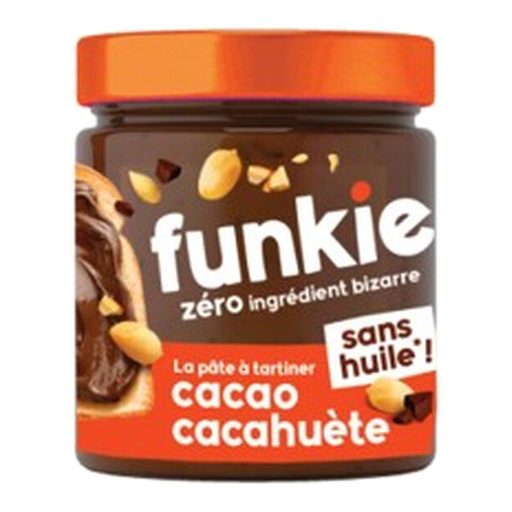 Image unavailable
FUNKIE Smooth organic cocoa and peanut spread, 200 g
Only consider this if a cocoa and peanut spread suits your biscuits and the people who’ll be eating them: it isn’t a hazelnut recipe. Check the certification, allergens and sugar per 100 g on the jar, then try baking it.
View on Joybuy
 Image unavailable
FUNKIE organic Praline spread, smooth, 200 g
If you’re considering a praline-style filling, check the label for certification, cocoa content and hazelnuts. Try a small batch before choosing this spread for your biscuits.
View on Joybuy
Frequently asked questions
How can you tell if a spread is organic?
Look for the EU organic logo or the AB mark on the exact product, then read its ingredients list. The French Ministry of Agriculture notes that organic certification is governed by European regulations; wording that simply suggests a product is “natural” is no substitute for checking.
Does a jar of spread have to display the Nutri-Score?
No. According to the DGCCRF, the Nutri-Score is optional in France. The nutrition declaration, which is required for most pre-packed foods, lets you compare sugar and fat per 100 g, whether or not the logo is displayed.
Is a plant-based spread suitable if you have a milk allergy?
Not necessarily. Nutella France states that its Plant-Based variant may contain milk and is not suitable for people with a milk protein allergy. For any other product, check its own ingredients and warnings rather than relying on the word “plant-based” alone.


