For a mid-morning snack, first choose a product with clearly identifiable organic credentials, then compare the ingredients, sugars per 100 g and the portion you plan to eat. Organic describes how a product is made, not whether it is low in sugars. The format and allergens can also help you choose between a cereal bar, a chocolate biscuit and a piece of chocolate.
Who is this choice for?
For an easy-to-carry snack
If you have a snack at work, in class or while you’re out and about, check the weight of each item and whether it’s individually wrapped. A bar that you portion yourself may not be as easy to slip into a bag as a ready-to-go snack bar.
For comparing sugars
If the ingredients guide your choice, compare the ‘of which sugars’ figure per 100 g, then check the amount in the portion you’ll eat. The word ‘organic’ is no substitute for checking this, nor is the Nutri-Score when one is shown.
For meeting a dietary requirement
If you need to avoid milk, wheat, tree nuts or peanuts, check the ingredients and allergen information for the exact product you’re considering. If you need a gluten-free product, look for an explicit claim on that product: an organic label isn’t enough.
What should you look for first?
A chocolate cereal bar, a biscuit bar and portionable chocolate don’t all serve exactly the same purpose. Start with what matters most for your snack, then compare products of the same type.
| What matters |
What to check |
Who is it for? |
| Sugars and ingredients |
The ‘of which sugars’ figure per 100 g and per portion; the ingredients, separately from the organic claim. |
If I want to compare two snacks without relying on the organic label alone, I need to know how much sugar is in the portion I’ll eat. Around 45% of consumers would prioritise this comparison. |
| Snack format |
The weight of each item, the packaging and the product type: cereal bar, biscuit bar or portionable chocolate. |
Between activities, I’m looking for an amount and packaging suited to a small appetite, without assuming that a chocolate bar and a snack bar are equally easy to carry. Convenience would be the main concern for around 33% of consumers. |
| Dietary suitability |
The ingredients and allergen information for the exact product; an explicit claim if you need it to be gluten-free. |
If I need to avoid an ingredient, the product’s suitability comes before its format or sugar content. This would be the priority for around 22% of consumers. |
What common misconceptions should you avoid?
-
Assuming ‘organic’ means ‘low in sugar’
How a product is made and how much sugar it contains are two different things. Carrefour, for example, lists glucose syrup and sugar in the ingredients of one of its organic chocolate cereal bars.
Look for the product’s organic mark, then check the ingredients list and the ‘of which sugars’ figure per 100 g and per portion separately.
-
Thinking the Nutri-Score is compulsory
The DGCCRF confirms that displaying it is voluntary in France. So its absence alone isn’t enough to judge the ingredients of a snack bar.
If it appears on the packaging, use it as a guide when comparing similar products. Also check the nutritional information and ingredients.
-
Assuming the organic label tells you about allergens
An organic chocolate recipe may contain milk or wheat, as shown by the ingredients of a Carrefour Bio biscuit bar. Organic status doesn’t tell you whether a product is suitable for a gluten-free diet.
Check the label on the exact product you’re buying, and look for a ‘gluten-free’ claim on that product if you need one.
-
Applying the sugary drinks tax to snack bars
Article 1613 ter of the French General Tax Code, published by Légifrance, applies to non-alcoholic drinks. It isn’t a factor when comparing solid chocolate bars.
For these products, focus instead on the ingredients, stated sugar content, allergens, portion size and organic labelling.
Brands to know
Carrefour Bio
The brand offers an organic chocolate cereal bar and an organic chocolate biscuit bar, among other products. These are two distinct formats, so compare their labels accordingly.
- Carrefour’s product pages provide detailed ingredient information for the products mentioned.
- The cereal bar mentioned contains glucose syrup and sugar; check the ingredients of the product you’re interested in.
Bio Village (Marque Repère / E.Leclerc)
E.Leclerc’s range includes an organic milk-filled chocolate bar and organic chocolate bars, which differ in how you eat them and how you portion them.
- These formats let you choose between a filled snack bar and chocolate you can portion yourself.
- The filled bar’s name mentions milk; if you need to avoid it, check the exact product label.
Bjorg
Bjorg’s range includes organic cereals and biscuits. These categories may suit a mid-morning snack, but they aren’t interchangeable with a chocolate bar.
- The range includes several types of product, so you can compare them based on the format you’re looking for.
- Check the category, ingredients and dietary information for each product rather than making assumptions based on the brand.
A chocolate option on Joybuy
This 40 g organic milk chocolate with hazelnuts is a good fit if you fancy chocolate mid-morning. If you’re specifically looking for a cereal or biscuit bar, check the product type before choosing.
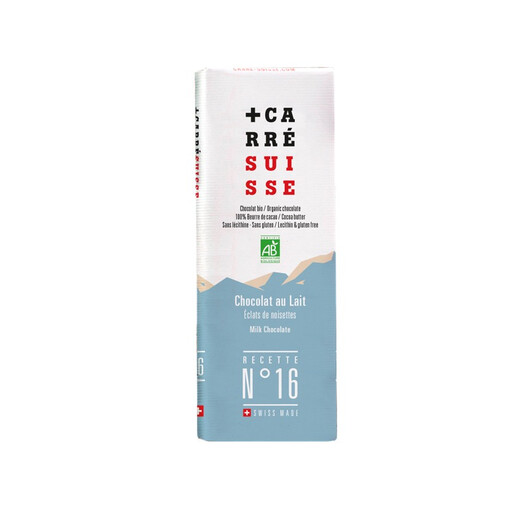 Image unavailable
CARRE Organic Milk Chocolate with Hazelnuts, 40 g
This 40 g format is a good choice if you’d prefer chocolate to a cereal bar for your snack. Compare the sugars shown on the label, and check the packaging if individual wrapping matters when you’re taking it with you.
View on Joybuy
Frequently asked questions
Is the Nutri-Score compulsory on a chocolate bar in France?
No. According to the DGCCRF, displaying it is voluntary, while a nutrition declaration is generally compulsory for prepacked food. If the Nutri-Score is shown, compare it across products of the same type and also check the nutritional values per 100 g.
Is a chocolate bar subject to the sugary drinks tax?
No. Article 1613 ter of the French General Tax Code, published by Légifrance, applies to non-alcoholic drinks, not solid chocolate bars. To compare chocolate bars, check the ‘of which sugars’ figure on the label.
What does ‘organic’ mean for a chocolate bar?
Organic relates to production standards and labelling, not the absence of sugars or allergens. For processed food, ADEME states that at least 95% of the agricultural ingredients must come from organic farming. Look for the organic mark and check the ingredients of the product you’re considering.
How should I choose if I need to avoid gluten or milk?
Don’t assume a product is suitable just because it’s organic. Check the ingredients and allergens for the exact product. If you’re looking for a gluten-free option, make sure that product is explicitly labelled as such. One organic chocolate biscuit bar from Carrefour contains wheat and milk.


