For a night in front of the telly, first choose a bar or sharing bar with verifiable organic certification, then compare the ingredients and nutritional values per 100 g. A sharing bar you can break into pieces is ideal for sharing, while an individual bar saves you from having to break off squares. Either way, the flavour you’re after, the sugar content and the allergens depend on the exact recipe.
Who is this choice for?
Those looking for organic certification
If organic certification is important to you, check the certification marks that apply to the specific product. The French Ministry of Agriculture explains that organic farming is governed by a European regulatory framework: a green colour or the word “natural” is no substitute for checking this.
Those comparing sugar content
The organic label alone doesn’t tell you how much sugar a product contains. As the DGCCRF explains, the nutrition declaration per 100 g lets you compare recipes in different formats.
Guests with allergies
Before sharing the chocolate, check the allergens highlighted in the ingredients list and any precautionary statements about possible traces on the packaging of the product you’ve chosen.
What should you look for first?
For an organic chocolate bar or sharing bar to enjoy during a night in front of the telly, certification is your first filter. The other criteria will help you choose between recipes and formats to suit your guests.
| Criterion |
What to check |
Who is it for? |
| Organic certification |
Look for the relevant organic marks, including the EU organic logo or the AB mark, and check the specific product. |
For my evening, I want a genuinely organic product, not just packaging that suggests it is; around 34% of consumers put this proof first. |
| Sugars and nutritional values |
Compare the “of which sugars” line and the energy per 100 g for the products you’re considering. |
If I’m choosing between several recipes, I want to compare their sugar content on the same basis; around 33% of consumers say this is their top priority. |
| Allergens |
Read the highlighted ingredients and any precautionary statements about possible traces on the packaging. |
If a guest needs to avoid certain ingredients, I can’t choose based on the organic label alone; around 20% of consumers prioritise whether a recipe is suitable for them. |
| Format and flavour |
Choose between a sharing bar you can break into pieces and an individual bar, then check the type of chocolate and any added ingredients. |
When I’m with others, I want to share squares; on my own, I might prefer a portion that’s already separate. Format and flavour are the top priority for around 13% of consumers. |
Common misconceptions to avoid
-
Assuming “organic” means “low in sugar”
Organic certification alone doesn’t set the sugar content of a chocolate bar. For example, Kaoka lists 29 g of sugars per 100 g for its organic 70% dark chocolate bar. That figure applies to this specific product, not to all organic chocolate.
Compare the “of which sugars” line per 100 g across the recipes you’re interested in.
-
Ruling out a product because it doesn’t have a Nutri-Score
In France, displaying a Nutri-Score is voluntary, according to the DGCCRF. Its absence doesn’t mean a chocolate bar is non-compliant or has any particular nutritional profile.
If it appears on the packaging, use it as an additional guide and check the nutrition values too.
-
Thinking a chocolate bar is subject to the “soda tax”
The scale published in the Official Bulletin of Public Finances applies to non-alcoholic drinks, not chocolate bars. So this levy tells you nothing about the ingredients in the bar you’re considering.
To compare two bars, check their ingredients and sugar content per 100 g.
-
Assuming you can tell which allergens are present from the “organic” label
An organic recipe may contain ingredients that some guests need to avoid. The DGCCRF explains that allergens present in the ingredients must be highlighted on the label.
Before serving the product, read the packaging you receive, including any statements about possible traces.
Brands to know
These brands offer examples of organic chocolate bars and snacks in different formats. Check each product before buying: a sharing bar or cereal bar may not be the chocolate bar you’re looking for.
Kaoka
Worth considering if you prefer a dark chocolate bar you can break into squares rather than an individual bar.
- Kaoka offers, among other products, a 100 g organic and fair trade 70% dark chocolate bar.
- For this product, the brand lists 29 g of sugars per 100 g and warns that it may contain milk, nuts and cereals containing gluten.
Ethiquable
The brand offers organic and fair trade chocolate bars, including dark and milk chocolate varieties.
- The different recipes let you choose the type of chocolate you prefer.
- Check the ingredients, added inclusions, allergens and nutritional values for each bar.
Bonneterre
Bonneterre offers a range of organic and fair trade chocolate bars.
- There are several types of bar to suit different recipe and flavour preferences.
- If cocoa traceability matters to you, check the details for the batch you choose: the brand announced temporary changes to its sourcing in 2026.
Bjorg
A brand to explore if you’re interested in an individual organic snack made with dried fruit or nuts.
- Bjorg offers, among other products, an individual cashew and cranberry bar.
- A bar of this kind isn’t necessarily chocolate-flavoured, so check the recipe and allergens if you’re specifically looking for chocolate.
An individual option on Joybuy
For an individual portion during a night in front of the telly, this selection features an organic milk chocolate and hazelnut bar. If you’d rather share a bar you can break into pieces or choose dark chocolate, use the criteria above to compare suitable products.
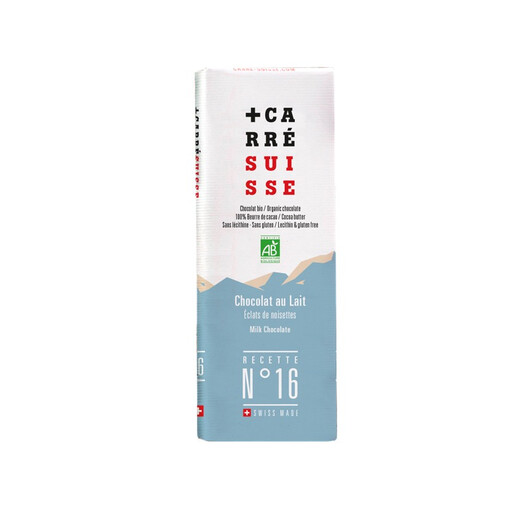 Image unavailable
CARRE organic milk chocolate with hazelnuts, 40 g
The 40 g size may suit you if you’d prefer an individual bar rather than a sharing bar to break into pieces during your evening in front of the telly.
The product listing mentions code FR-BIO-01. Before choosing this milk chocolate and hazelnut recipe, check the packaging for certification, sugars per 100 g and allergen information.
View on Joybuy
Frequently asked questions
Is Nutri-Score compulsory on chocolate bars in France?
No. The DGCCRF says that displaying a Nutri-Score is voluntary. For most pre-packed foods, however, the nutrition declaration lets you compare energy, fat and sugars per 100 g, among other things.
Does the “soda tax” apply to chocolate bars?
No: the scale published in the Official Bulletin of Public Finances applies to non-alcoholic drinks, not chocolate bars. To choose a bar, compare its ingredients and the sugars listed per 100 g instead.
How can you check whether a bar or sharing bar is organic?
Look for the relevant certification marks on the product packaging, including the EU organic logo or the AB mark. The French Ministry of Agriculture describes organic certification as part of a European framework; packaging that simply suggests a natural product isn’t enough.
What should you check before sharing a chocolate bar if a guest needs to avoid allergens?
Read the allergens highlighted in the ingredients list and any precautionary statements about possible traces on the packaging of the product you’re serving. An organic recipe alone doesn’t rule out milk, nuts or cereals containing gluten.
What should you check when storing pre-packed chocolate?
Check the best-before date and follow the storage instructions on the packaging. The DGCCRF explains that pre-packed chocolate must carry this date; check the details on the product you’ve bought.


