What should you check before choosing?
For a snack to take with you, start by deciding what type of bar you want, then check the specific product: a cocoa cereal bar, a chocolate protein bar and a seed bar don’t meet the same needs.
| What to consider |
What to check |
Who it’s for |
| Organic identification |
Look for an organic label on the product page or packaging, then check the ingredients for the specific variety you’ve chosen. |
If organic status matters more to me than taste or pack size, I want to be able to verify it on the product. Around 28% of consumers prioritise this. |
| Sugars and Nutri-Score |
Compare sugars per 100 g and per portion; use Nutri-Score to compare similar products when it is displayed. |
When choosing between two similar bars, I check their sugar content rather than assuming an organic recipe is low in sugar. This is the top priority for around 28% of consumers. |
| Allergens and ingredients to avoid |
Read the declared allergens and any ‘may contain’ statements on the packaging of the exact variety. |
If a bar is for someone with an allergy or who avoids certain ingredients, I need to check its composition before sharing it. Around 17% of consumers put this check first. |
| Protein and fibre |
Compare values on the same basis and take portion size into account; check the other nutritional information too. |
Between meals, I might look for a bar based on its protein or fibre content, but that doesn’t tell me how good it is overall. This is the top criterion for around 16% of consumers. |
| Portability |
Check how many bars are in the pack, the pack weight and the portion size. |
If I’m planning several snacks to take in my bag or share, I first need to know how the bars are packed. Around 11% of consumers prioritise this. |
Brands to compare
These examples refer to specific products, not to the brands’ entire ranges. The Bjorg bar mentioned below is not a chocolate bar.
Carrefour Bio
Carrefour France offers organic chocolate cereal bars in a box of six, intended for breakfast or as a snack.
- The product page identifies the ingredients listed as organic.
- The recipe contains glucose syrup and sugar, so check the sugars in the nutritional information.
Bio Village (Marque Repère, E.Leclerc)
E.Leclerc offers organic dark chocolate cereal bars and organic chocolate bars filled with milk: these are two distinct categories.
- The product pages let you compare sugars per 100 g: 33.0 g for the cereal bar and 40.3 g for the milk-filled bar.
- E.Leclerc gives them Nutri-Scores of D and E respectively; check the ingredients and portion size too.
Good Moov
The organic dark chocolate protein bar offered by Carrefour France is aimed at people comparing protein per portion.
- The product page lists 10 g of protein per 46 g bar.
- The recipe contains soya, milk and almonds, among other ingredients; check the allergens on the packaging.
Bjorg
The organic Amandes Coco bar is another type of snack to take with you, but only consider it if chocolate isn’t essential.
- Bjorg lists 14 g of sugars, 18 g of protein and 8.9 g of fibre per 100 g for this product.
- The product page also lists 596 kcal per 100 g and several allergens; this isn’t a chocolate bar.
An organic option on Joybuy
This selection features an organic cereal bar filled with cocoa and hazelnut, suitable for a snack on the go. Before planning several portions, compare the pack size and label with your needs.
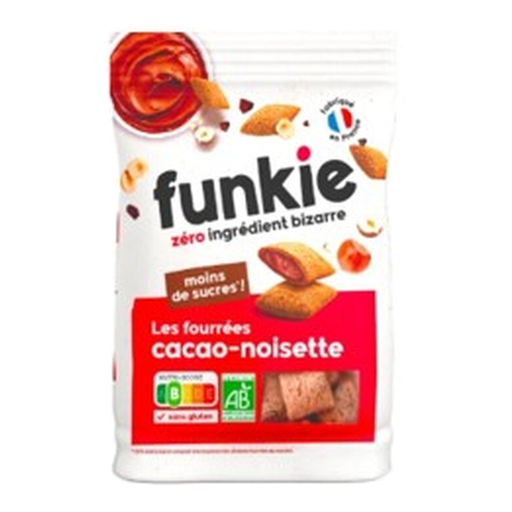 Image unavailable
FUNKIE Organic Hazelnut Cocoa, filled cereal bars, 250 g
Worth considering if you’re looking for organic cereal bars filled with cocoa and hazelnut for a snack on the go. The pack is listed as 250 g; check the number of bars and the nutritional information per portion for the variety you choose. If you have an allergy, check the allergens on the packaging before eating.
View on Joybuy
Frequently asked questions
Does the French tax on sugary drinks apply to chocolate bars?
No. The scale published by the Bulletin officiel des Finances publiques-Impôts on 24 December 2025 covers contributions on non-alcoholic drinks, not chocolate bars. Sugar content is still worth checking in a bar’s nutritional information.
Is Nutri-Score compulsory on chocolate bars in France?
No. Santé publique France explains that producers choose whether to display it. If it appears on two comparable bars, it can help you interpret the ingredients and nutritional values; its absence alone doesn’t tell you anything conclusive about the product.
How can you tell if a bar is organic?
Look for an explicit organic label on the product page and packaging of the specific product you choose, rather than relying on an impression that the recipe is ‘natural’. The Ministry of Agriculture points out that organic farming is regulated by European legislation.
Is an organic bar automatically suitable for someone with an allergy?
No. Organic status doesn’t tell you which allergens a bar contains. The Good Moov organic dark chocolate bar contains soya, milk and almonds, among other ingredients, while the Bjorg Amandes Coco bar contains peanuts, sesame and nuts, among other ingredients. Always check the label and any ‘may contain’ statements for the specific variety.
When should you take these snacks to Music Day?
Music Day takes place on 21 June, according to the Ministry of Culture. For the next event or a similar outing, work out how many portions to take by checking the actual contents of each box.


