Hosts planning treats to share
You’re looking for several bars that are explicitly labelled organic, to hand out to guests, while still being able to check the ingredients in each pack.


For sharing treats at a Christmas gathering, choose a multipack that is explicitly labelled organic, then check the ingredients and allergens for the exact product. If you’re looking for a morning snack instead, a cereal or dried fruit bar serves a different purpose: it isn’t necessarily a chocolate bar. In either case, compare the sugar content per 100 g rather than assuming that an organic label tells you about the nutritional profile.
You’re looking for several bars that are explicitly labelled organic, to hand out to guests, while still being able to check the ingredients in each pack.
You’re more interested in a bar to take with you. Check whether it’s a cereal bar, a dried fruit bar or a chocolate bar: they’re different options for different needs.
Before offering the same recipe to several people, you need to be able to check its ingredients and allergens, particularly cereals containing gluten if this is relevant to your guests.
First decide whether you want to hand out individual bars or serve chocolate in pieces. Then check the labelling on the exact product.
| Criteria | What to check | Who is it for? |
|---|---|---|
| Organic status | The organic label and the labelling on the exact product, rather than just the word “natural”. | For a Christmas table featuring organic products, I want to be able to identify which products are organic. Around 33% of consumers would make this their top priority. |
| Ingredients and allergens | The ingredients list and allergens for each recipe or flavour. | If several people need to be able to choose from the bars on offer, I need to know what they contain before serving them. Around 27% of consumers would make ingredient suitability their top priority. |
| Sugars and nutritional values | The “sugars” figure per 100 g and the amount planned per person. | When comparing two packs, I prefer to compare their nutritional values on the same basis rather than rely on the organic label. Around 20% of consumers would prioritise this comparison. |
| Format | The number of bars and the type of product: cereal bar, chocolate bar or chocolate to serve in pieces. | For a party, I want treats I can hand out; for the morning, I’m more likely to want an individual snack to take with me. Around 20% of consumers would make format their first consideration. |
An organic recipe can still contain sugar or glucose syrup, as shown in the ingredients list for Carrefour Bio chocolate cereal bars.
Compare the “sugars” figure per 100 g in the nutritional information, and consider how much you plan to serve.
France’s Ministry of the Economy confirms that displaying the Nutri-Score is voluntary in France. Its absence alone is therefore not enough to judge a bar’s nutritional profile.
If it is displayed, read it alongside the other information on the pack. To compare sugar content, check the nutrition declaration.
The Carrefour Bio product page lists oats, wheat and barley in its chocolate cereal bar. The ingredients in another product or flavour may be different.
Read the ingredients and allergen information for every product you plan to offer your guests.
Carrefour offers a box of six organic chocolate cereal bars, weighing 138 g in total: a format worth considering if you’re planning to hand out individual portions.
E.Leclerc offers a 138 g box of six organic dark chocolate cereal bars under this brand, as well as a separate 125 g organic milk-filled chocolate product.
Bjorg’s Fruit and Honey bar is better suited to anyone looking for an organic snack to take with them.
Alter Eco offers a range of chocolate made with organically grown ingredients and highlights its commitment to fair trade.
This smaller chocolate bar is suited to a chocolate tasting, rather than handing out a pack of individual bars. If organic status is essential to your choice, check that the finished product is labelled organic.
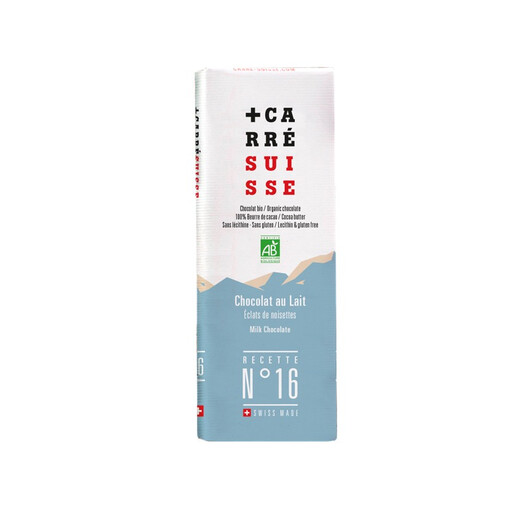 Image unavailable
This 40 g milk chocolate and hazelnut bar is an option to consider if you’d rather serve chocolate than pre-portioned bars. Its product page lists certified organic ingredients. Before offering it to your guests, check that the finished product is labelled organic and read the allergen information on the packaging.
Check that the exact product carries an organic indication and the relevant labelling under the European framework described by Agence Bio. The word “natural” alone doesn’t mean that a bar is organic.
No. France’s Ministry of the Economy says that the Nutri-Score is voluntary. For the prepacked foods covered by the rules, the nutrition declaration lets you compare sugar content per 100 g, among other things.
Read the ingredients and allergen information for each product and flavour you plan to serve. The product page for Carrefour Bio chocolate cereal bars lists oats, wheat and barley, among other ingredients; don’t assume another recipe has the same ingredients.
No. The section of the French General Tax Code published by Légifrance covers non-alcoholic drinks, not chocolate bars. To compare the sugar content of two bars, check their nutritional information instead.