Parents who want to check it’s organic
You want to choose your chai based on a recognised certification and a clear ingredients list, rather than relying on the word ‘organic’ alone on the packet.


To choose an organic chai for breakfast, first check its certification and ingredients, then decide whether you’d prefer a spiced black tea or a herbal infusion. Black tea contains caffeine. Even if an infusion’s ingredients don’t list black or green tea, you should still read the label carefully, particularly for liquorice.
You want to choose your chai based on a recognised certification and a clear ingredients list, rather than relying on the word ‘organic’ alone on the packet.
You’re comparing black tea chai with a herbal infusion, while taking into account your other caffeinated drinks throughout the day. This is especially worth considering if you’re pregnant, planning a pregnancy or breastfeeding.
You’re looking for a recipe whose ingredients don’t list black or green tea. Check the other plants it contains too, particularly liquorice, and don’t assume that the word ‘infusion’ guarantees it is caffeine-free.
Worth considering: if you’re looking for a spiced tea at breakfast and want to factor its caffeine into your daily intake.
Bear in mind: the presence of black tea alone doesn’t tell you how much caffeine is in your cup.
Worth considering: if you’d like a spiced drink and prefer a recipe that doesn’t list black or green tea in its ingredients.
Bear in mind: this choice doesn’t guarantee a ‘caffeine-free’ label; some recipes also contain liquorice.
To compare recipes, start with the label on the exact product you’re considering: organic certification, the type of tea and the other ingredients each answer different questions.
| Criteria | What to check before buying | Who is this for? |
|---|---|---|
| Certification and ingredients | Look for the EU organic logo or another organic certification displayed on the product, then read the full ingredients list. | I want to identify the organic product and know what’s in my cup before choosing. Around 30% of consumers are said to make this their top priority. |
| Tea and caffeine | Check the ingredients for black or green tea, and take into account other sources of caffeine you consume during the day. | If I’m keeping an eye on my caffeine intake, choosing between black tea and a herbal infusion comes before the flavour profile. This is said to be the priority for around 40% of consumers. |
| Flavour and preparation | Compare the spices listed, the format and the brewing instructions for the product you’ve chosen. | For breakfast, I’m mainly looking for a spiced recipe that fits into my routine; around 30% of consumers are said to prioritise this. |
An organic recipe may contain black tea. The amount of caffeine you consume also depends on how the drink is prepared and what else you have throughout the day.
Before choosing a herbal infusion instead, check whether black or green tea is listed in the ingredients of the exact product.
Anses warns that consuming products containing liquorice in large amounts and repeatedly may pose health risks, including high blood pressure and hypokalaemia.
Check the ingredients for liquorice and take its presence into account if you’re thinking of drinking this infusion regularly. If you have a health condition, are taking medication or are unsure, ask a healthcare professional for advice.
A product page may still be viewable even when the item is no longer available to buy. For example, Carrefour marked its Organic Spiced Chai Black Tea as unavailable on the product page we checked.
If you plan to buy the same recipe regularly, check its availability with the relevant retailer before settling on this format.
Kusmi Tea describes Kashmir Tchaï bio as a spiced black tea, sold in a tin of 20 tea bags.
Auchan’s listing for Spiced Chai describes an organic black tea recipe and includes brewing instructions.
Ethiquable’s organic Darjeeling Tchaï lets you compare a recipe that specifies the proportions of black tea and spices.
The organic Chai herbal infusion listed by Auchan combines basil, verbena, liquorice, orange and spices, among other ingredients. The ingredients list we checked doesn’t include black or green tea.
The listing for Carrefour Bio’s Organic Spiced Chai Black Tea describes a pack of 20 tea bags weighing 32 g, containing black tea, cinnamon, ginger, cardamom and cloves.
These two Pukka products offer a way to explore both breakfast options: a chai herbal infusion and a black tea chai. For either one, check the packaging for organic certification, ingredients and any information relevant to how you plan to use it.
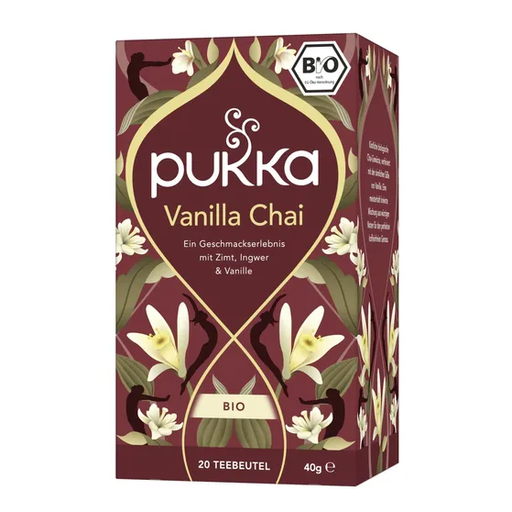 Image unavailable
If you prefer a chai herbal infusion for breakfast, check the ingredients for this product rather than assuming it comes with a ‘caffeine-free’ guarantee.
The recipe lists liquorice. If you plan to drink it regularly, bear in mind Anses’ warning about consuming liquorice in large amounts and repeatedly.
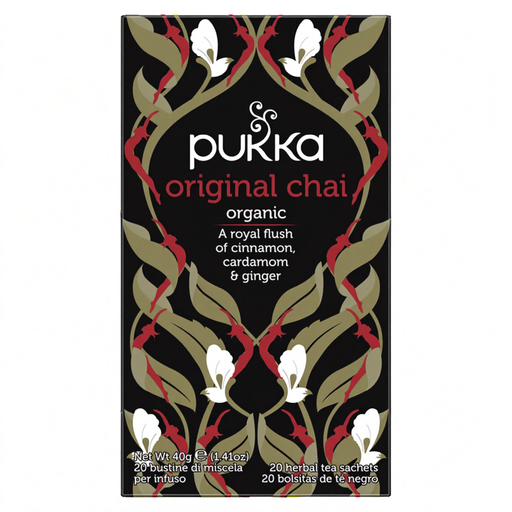 Image unavailable
If you’d like a black tea chai, factor this source of caffeine in alongside your other drinks throughout the day.
The recipe also lists liquorice. Check the brewing instructions and organic certification on the packaging of the product you choose.
Look for the EU organic logo and check the exact product details on its packaging. France’s Ministry of Agriculture explains that organic certification is governed by a European framework. Then read the ingredients to find out whether your chai contains black tea, spices or other plants.
Yes. Black tea is a source of caffeine, even in an organic recipe. If you’re pregnant, planning a pregnancy or breastfeeding, take all your caffeinated drinks into account and seek advice tailored to your circumstances if needed. Organic certification doesn’t tell you how much caffeine is in your cup.
No. The word ‘infusion’ alone doesn’t mean a drink is caffeine-free. The ingredients list we checked for Pagès’ organic Chai herbal infusion doesn’t mention black or green tea, but check the ingredients and any information on the packaging of the product you buy.
Liquorice is particularly important to consider if you plan to drink the infusion regularly. Anses warns of the risks of consuming products containing liquorice in large amounts and repeatedly; the listing for Pagès’ organic Chai herbal infusion states that it contains 15% liquorice.