For a child aged 1 to 3, start by choosing a cereal product that’s suitable for their age and the texture they can manage: organic infant cereal to prepare, or, depending on what they’re used to, bread or a simple porridge. Manger Bouger’s guidance includes a cereal product alongside growing-up milk and a piece of fruit or fruit purée. The organic logo doesn’t mean you can skip checking the ingredients, nutrition information and allergens.
Who is this guide for?
Parents planning breakfast for children aged 1 to 3
You’re looking for a cereal option to include as part of a meal, not something to replace everything else. For this age group, Manger Bouger’s examples pair growing-up milk and fruit or fruit purée with a cereal product, such as bread or porridge.
Parents who care about organic certification and ingredients
You want to identify an organic product, then compare its ingredients and nutrition information. The certification framework described by the Ministry of Agriculture relates to how the product is made; it doesn’t replace reading the label.
Parents checking cereals, allergens and texture
You’re comparing the main cereal, the age guidance and the texture intended for your child. Good Goût and HiPP Biologique offer products including wheat-based recipes and cereal blends, so always check the label for the specific product.
What should you check first?
For a toddler’s breakfast, start with their age and the texture, then compare the ingredients in the specific product you’re considering.
Organic infant cereal
Worth considering: if you’re looking for a cereal preparation with an age recommendation and preparation instructions on the packaging.
Check: the age recommendation alone doesn’t confirm that the recipe, allergens and texture are suitable for your child.
Simple organic bread or porridge
Worth considering: for a child aged 1 to 3 who can manage the texture, as part of a breakfast that also includes milk and fruit or fruit purée.
Bear in mind: you’ll need to adapt the preparation, texture and portion to suit your child.
Standard breakfast cereals
Worth considering: only if the ingredients and texture of the specific product are suitable for your child.
Remember: even when organic, this category doesn’t necessarily carry age guidance comparable to infant cereal.
| Criteria |
What to check |
Who is it for? |
| Age and texture |
The stated age and the texture after preparation, or the texture of a product that needs chewing. |
If my child is trying a new texture, I want to choose something they can manage at breakfast. Around 31% of consumers put this suitability first. |
| Ingredients and sugars |
The ingredients list and the “sugars” line in the nutrition information, comparing like-for-like products. |
When choosing between two recipes, I’d rather look at what’s in them than rely on the claims on the front of the pack. This is the top priority for around 31% of consumers. |
| Organic certification |
The EU organic logo, followed by the label on the product you’ve chosen. |
Before comparing recipes, I want to be able to identify the product’s organic certification. This is the first check for around 23% of consumers. |
| Gluten and allergens |
The cereal used and the allergens listed on the exact product’s packaging. |
If I need to check a cereal or allergen, I can’t rely on the product range’s name alone. Around 15% of consumers make this their main criterion. |
Mistakes to avoid
-
Assuming “organic” means “suitable for toddlers”
Organic certification regulates how a product is made, as explained by the Ministry of Agriculture. On its own, it doesn’t tell you the recommended age or the product’s texture.
Once you’ve checked the certification, read the age guidance, ingredients and nutrition information for the specific product.
-
Focusing only on “no added sugars”
This claim doesn’t tell you everything about the product. Anses notes that sugars can appear under different names in food.
Compare the ingredients list and the “sugars” line for equivalent products and reference quantities.
-
Choosing a blend without checking which cereals it contains
The infant recipes from Good Goût and HiPP Biologique don’t all use the same cereals; some contain wheat. An organic label doesn’t mean a blend is suitable for someone avoiding gluten.
Check the ingredients and allergens on the exact product’s packaging. If your child has a diagnosed allergy, follow the advice of the healthcare professional supporting them.
-
Making cereal the whole of breakfast
Manger Bouger’s examples for children aged 1–3 include a cereal product with growing-up milk and a piece of fruit or fruit purée.
Choose a format your child can manage and serve it as part of the meal, rather than automatically treating it as a replacement for the other components.
Brands to know
Babybio
Babybio offers a range of organic infant cereals, with products labelled as suitable from 6 months.
- The brand describes its range as having “no added sugar or salt”.
- Check the age guidance, allergens and preparation instructions on the packaging for your chosen flavour and format.
Good Goût
Good Goût offers organic infant cereals made with different types of cereals, with age guidance varying by product.
- The brand says its infant cereal range includes recipes with no added sugars.
- For a wheat-based product or a blend, check the allergens, age guidance and ingredients on the specific packaging.
HiPP Biologique
HiPP Biologique offers an infant “5 Cereals” product, labelled as suitable from 6 months.
- The product listing carries the “no added sugars” claim.
- This blend contains wheat, so check the ingredients and allergens if you need to monitor gluten.
An infant cereal option on Joybuy
This product is an option if you’re looking for infant cereal to prepare for breakfast. Bread, simple porridge and standard breakfast cereals are also worth considering, depending on your child’s age and the texture they can manage.
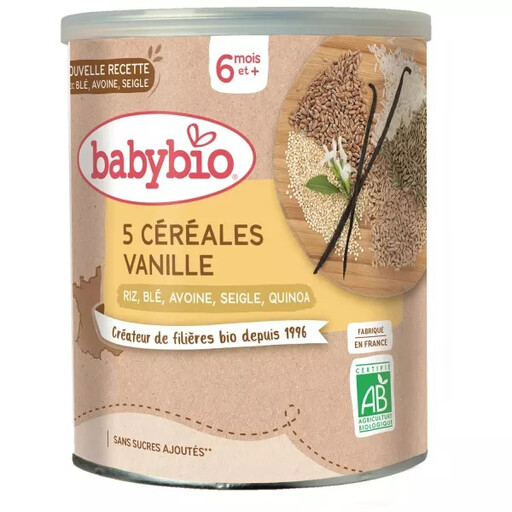 Image unavailable
Baby Bio Cereal Quinoa Vanilla 6M, 220 g
A quinoa and vanilla cereal preparation to consider if you’re looking for a product whose name indicates that it’s suitable from 6 months. Before buying, check the packaging for preparation instructions, nutrition information and allergens to make sure they meet your child’s needs.
View on Joybuy
Frequently asked questions
How can you identify organic cereals in France?
Look for the EU organic logo and, where applicable, the AB mark. The Ministry of Agriculture explains that organic farming is governed by a European framework. Separately, check the age guidance, ingredients and allergens for the product you’ve chosen.
Does a child aged 1 to 3 need infant cereal?
Not necessarily. Manger Bouger’s examples for this age group also include bread and porridge as cereal options, alongside growing-up milk and a piece of fruit or fruit purée. Choose a form and texture your child can manage.
Does “no added sugars” mean sugar-free?
No. This claim doesn’t replace checking the “sugars” line in the nutrition information or reading the ingredients. Anses notes that sugars can appear under different names in food.
How can you check for gluten and other allergens?
Read the ingredients and allergens listed on the packaging for the exact product, especially if it’s a cereal blend. If your child has a diagnosed allergy, choose a product that follows the advice of the healthcare professional looking after them.


