Anyone who wants to check organic certification
If certification is your top priority, look for the EU organic logo, known as the Euro-leaf, and the inspection details shown alongside it. The AB logo may also appear on the packaging.


When choosing organic cereal bars as part of your weekly shop, first check the certification details on the packaging, then compare the nutritional information per 100 g and the ingredients. Flavour, the number of bars and allergens can then help you choose between fruit, seed or chocolate recipes; the organic label alone won’t tell you everything you need to know.
If certification is your top priority, look for the EU organic logo, known as the Euro-leaf, and the inspection details shown alongside it. The AB logo may also appear on the packaging.
To choose between fruit, chocolate or seed recipes, compare the ingredients, nutritional information per 100 g, pack weight and number of bars.
The recipes mentioned here may contain ingredients such as wheat, barley, oats, peanuts or tree nuts. The organic label is no substitute for checking the ingredients and any ‘may contain’ warnings.
For your weekly shop, start with the factors that determine whether a product is suitable for you — certification and allergens, if relevant — before comparing recipes and pack sizes.
| Criterion | What to check | Who is this for? |
|---|---|---|
| Organic certification | Look for the Euro-leaf and, next to the logo, the code of the inspection body and the origin of the agricultural raw materials. The AB logo may also be shown. | I want to recognise a certification rather than rely on the word ‘natural’ on a box; around 33% of consumers put this first. |
| Nutritional information | Compare the sugars, fat, protein and salt per 100 g across cereal bars. | If I’m choosing between several organic recipes, I want to compare their nutritional information on the same basis; this is the main criterion for around 27% of consumers. |
| Allergens | Read the highlighted ingredients and ‘may contain’ warnings for each recipe. | If I need to avoid an ingredient, I need to know exactly what the bar contains; around 20% of consumers prioritise this check. |
| Pack size for the week | Check the net weight, number of bars and ingredients for each flavour you choose. | When planning several snacks, I want a suitable number of bars without assuming that two flavours have the same recipe; around 20% of consumers put this need first. |
The organic label tells you about how a product is made, not how much sugar every recipe contains. For example, E.Leclerc product listings show 28 g of sugars per 100 g for Bio Village strawberry and 33 g per 100 g for Bio Village dark chocolate.
Once you’ve checked the organic certification, compare the nutritional information per 100 g and the ingredients of the recipes you’re interested in.
An organic bar may contain almonds, hazelnuts or peanuts. A ‘gluten-free’ claim on one product doesn’t, by itself, tell you whether it contains these other ingredients.
Check the ingredients and any ‘may contain’ warnings on every pack, even if you already know the brand.
Pack sizes vary: E.Leclerc lists Bio Village strawberry as a box of six bars weighing 138 g, while Auchan.fr lists Happy Bio hazelnut and chocolate as four bars of 25 g each.
When planning your shop, check the number of bars, the net weight and whether the flavours are ones you’ll actually want to take with you.
These products give you examples of recipes and pack sizes to compare. The details below apply to the products named, not every product from each brand.
Carrefour.fr lists an organic cereal bar with seeds and almonds.
E.Leclerc lists organic cereal bars in strawberry and dark chocolate flavours, both sold in boxes of six bars weighing 138 g.
Bjorg lists a Dried Fruit and Honey bar containing ingredients such as peanuts, almonds and pumpkin seeds.
Auchan.fr lists organic apricot cereal bars in a pack of six, with the Euro-leaf and AB logo shown on the product listing.
Auchan.fr lists an organic hazelnut and chocolate recipe in a pack of four 25 g bars.
If you’re planning snacks as part of your weekly shop, this Joybuy pick is a hazelnut and cocoa cereal bar. Check the label before buying.
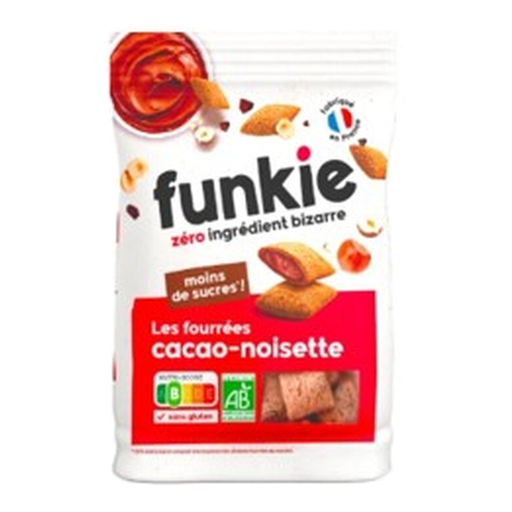 Image unavailable
This hazelnut and cocoa recipe may appeal if you’re planning snacks for the week. The pack is listed as weighing 250 g.
Before choosing it as an organic option, check the certification details on the packaging. Also check the nutritional information per 100 g, the number of bars and the exact information about peanuts: the details provided on this point don’t match.
On prepacked organic food sold in the European Union, look for the Euro-leaf, which is compulsory in most cases, as well as the inspection body’s code and an indication of the origin of the agricultural raw materials, shown near the logo. The AB logo may also appear. The European Commission explains that using the organic logo requires at least 95% of the agricultural ingredients to be organic, subject to the conditions that apply to other ingredients.
No. Organic certification and sugar content are based on different criteria. The product listings mentioned here show that Auchan.fr gives 17.5 g of sugars per 100 g for Happy Bio hazelnut and chocolate, while E.Leclerc gives 28 g per 100 g for Bio Village strawberry and 33 g per 100 g for Bio Village dark chocolate. Compare the figures for each product rather than relying on the label alone.
First compare the nutritional information per 100 g, then check the net weight and number of bars to plan your snacks for the week. The DGCCRF states that nutritional information is given per 100 g or 100 ml; using this standard measure helps you avoid comparing values for portions of different sizes.
Yes. The DGCCRF states that allergens in prepacked foods sold in France must be highlighted in the ingredients list. Check for ‘may contain’ warnings too: depending on the product, the recipes mentioned may contain gluten-containing cereals, peanuts, almonds, hazelnuts or soya.