Hikers planning several breaks
If you’d like to spread your snacks throughout your walk, check how many bars there are, their individual weight and how easy they are to carry. FFRandonnée recommends choosing small, lightweight foods.


For a hike, first choose a bar whose organic certification you can verify, then compare the portion size, ingredients and storage instructions. Smaller bars are easy to spread across your breaks. If you’re considering a recipe with seeds or nuts, check its nutritional information and allergens rather than assuming it provides more energy per bar. FFRandonnée recommends taking small, lightweight foods, with an energy intake suited to your route.
If you’d like to spread your snacks throughout your walk, check how many bars there are, their individual weight and how easy they are to carry. FFRandonnée recommends choosing small, lightweight foods.
To decide how much to take on your outing, compare the energy listed per 100 g with the actual weight of one bar. For recipes with seeds or nuts, you should also check the fat content and allergens.
Check the organic certification of the exact product, then read its ingredients, nutritional information and allergen statements. The word “natural” is not a substitute for organic certification.
First confirm that the bar is certified organic, then check that its size and label suit the conditions of your hike.
| Criteria | What to check | Who is it for? |
|---|---|---|
| Organic certification | Look for organic certification on the exact product, and read the ingredients list too. | I want to tell the difference between an organic bar and a recipe simply marketed as natural. Around 30% of consumers put this check at the top of their list. |
| Size and portability | Compare the weight of each bar, the number of portions and the storage instructions. | To take several breaks without carrying a whole box, I need portions that are easy to divide up in my bag. This is the main priority for around 30% of consumers. |
| Nutrition per portion | Compare the energy value per 100 g with the weight of one bar; check the sugars and fat content too. | If the length or intensity of my outing changes, I want to know what each bar actually provides. Around 20% of consumers put nutrition per portion first. |
| Allergens | Read the allergens highlighted on the exact product packaging, along with any statements about traces. | If I need to avoid an ingredient, the ingredients matter more than the size or recipe. Managing allergens is the top priority for around 20% of consumers. |
Organic refers to how a product is made. On its own, it doesn’t tell you whether the portion size, ingredients or portability are right for your route.
Once you’ve checked the organic certification, compare the bar’s weight, energy, sugars, fat content and storage instructions.
A seed or cereal bar may also contain nuts or carry a “may contain traces” warning. Carrefour France, for example, warns that its Carrefour Bio chocolate bar may contain traces of milk, peanuts and nuts.
Check the ingredients list and any trace warnings on the exact packet, even if you’re already familiar with the brand.
A label on the front of the pack is no substitute for checking the ingredients and nutritional information you need to compare two portions.
Check the sugars, energy and fat per 100 g, then check the weight of each bar. Use the Nutri-Score as additional information when it’s shown.
A chocolate recipe may be less practical in a bag left in the sun. FFRandonnée recommends avoiding chocolate when the sun is strong.
For a hot-weather outing, consider a recipe without chocolate and follow the storage instructions on the packaging.
These products let you compare specific sizes and ingredients, but a brand name is no substitute for reading the label of the bar you choose.
Carrefour France offers organic cereal bars in chocolate and a seed-and-almond recipe, with two different ingredient lists to check.
E.Leclerc’s organic range includes a strawberry cereal bar sold in a box of six.
Auchan France lists organic seed-and-almond cereal bars in a pack of four, with a stated total weight of 100 g.
This product combines a cereal bar identified as organic with a hazelnut and cocoa filling. To decide whether it suits your breaks, check the number of bars, the portion size and the storage instructions.
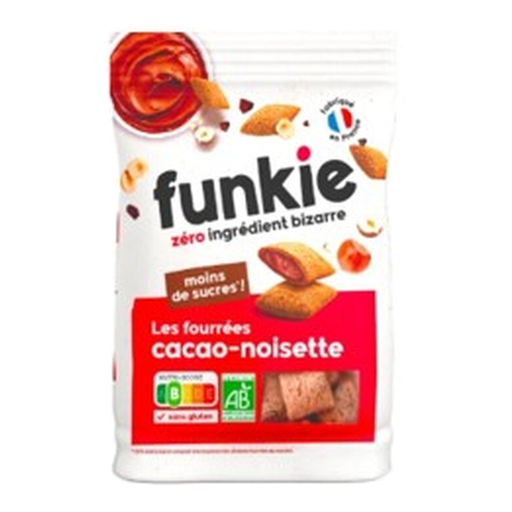 Image unavailable
Worth considering if you’re looking for an organic hazelnut and cocoa cereal bar for your hiking breaks. The pack is listed as weighing 250 g: check how many bars it contains and how much each one weighs so you can plan your portions. Check the nutritional information per bar and the allergen statements on the exact packaging, especially if you avoid nuts or peanuts. The storage instructions say to keep it in a cool, dry place and refrigerate after opening.
Check the organic certification on the packaging or product page for the exact product rather than relying on the word “natural” alone. The Ministry of Agriculture explains that organic production is governed by European regulations; that alone doesn’t tell you the bar’s nutritional values.
Compare the weight of each bar with the energy and other nutritional values listed per 100 g, then check the ingredients and allergens. The Directorate-General for Competition Policy, Consumer Affairs and Fraud Control explains that nutrition declarations are given per 100 g or 100 ml, so be sure to check the actual weight of each portion too.
No. Organic certification doesn’t tell you how much food to take for a particular route. FFRandonnée recommends taking the type, duration and intensity of your outing into account; plan your snacks and hydration accordingly.
If your route is very sunny, think about how well the bar will hold up in your bag: FFRandonnée recommends avoiding chocolate in these conditions. Consider a recipe without chocolate and check the storage instructions for the product you choose.