Shoppers who want to check organic certification
You want to identify a certification on the packaging rather than rely on the product name alone. Agence Bio says the Euro-leaf confirms compliance with European regulations on organic farming.


When shopping for organic products, start by checking the bar’s organic certification, then choose a recipe that suits your allergen requirements and how you plan to use it. Compare the ingredients, nutritional values per 100 g and portion size: an organic label alone doesn’t tell you how much sugar or fat a bar contains.
You want to identify a certification on the packaging rather than rely on the product name alone. Agence Bio says the Euro-leaf confirms compliance with European regulations on organic farming.
You’ll need to check each recipe before choosing, particularly if you avoid peanuts, tree nuts or cereals containing gluten. The DGCCRF reminds shoppers that allergenic ingredients must be highlighted on the labels of prepacked foods.
Whether you’re having one for breakfast or as a snack away from home, the weight of each bar and whether it comes in individual wrappers can matter just as much as choosing a fruit, chocolate or seed recipe.
First, check that the bar is organic and that the ingredients suit your needs. Then compare the nutritional information and format of the specific bar you’re considering.
| Criteria | What to check | Who is this for? |
|---|---|---|
| Organic certification | Look for the Euro-leaf, the origin of the agricultural ingredients and the reference number of the certification body. The AB logo may also appear on the packaging. | When I shop for organic products, I want to be able to identify the certification on the packaging. Around 30% of shoppers put this check first. |
| Ingredients and allergens | Read the highlighted allergens and check for any ‘may contain’ warnings on the variant you’re considering. | If I need to avoid an ingredient, I can’t rely on another flavour from the same brand. For around 30% of shoppers, ingredient suitability comes before other criteria. |
| Nutritional values | Compare the sugar and fat content per 100 g, then check the values per bar where these are provided. | To choose between a seed recipe and a chocolate bar, I want to know what’s in the portion I’ll eat. Around 20% of shoppers make this their top priority. |
| Portions and portability | Check the number of bars, their weight and whether they come in individual wrappers. | If I take a bar for breakfast or a snack, the packaging needs to suit my journey. Around 20% of shoppers put convenience first. |
Organic doesn’t mean ‘low in sugar’. Auchan’s product information lists 33 g of sugar per 100 g for its Bio Chocolat bar and 25 g per 100 g for Bio La Vie Abricots. These are two different recipes.
Compare the values per 100 g and per bar where available, and don’t draw conclusions from just one figure.
Depending on the recipe, the bars mentioned contain almonds, peanuts or hazelnuts; some also warn that other allergens may be present.
If you have an allergy or need to avoid an ingredient strictly, check the ingredients and any ‘may contain’ warnings on the exact pack you’re buying.
Heat and humidity can affect the texture of cereal bars.
Follow the instructions on the pack and reseal it as directed after opening.
The range includes an organic Seed and Almond bar.
The range includes chocolate bars and a seed and almond recipe.
Bjorg offers a Fruits Secs et Miel bar made with ingredients including peanuts, almonds and organic pumpkin seeds.
The Abricots bar combines cereals and fruit in a 21 g bar.
This hazelnut and cocoa-filled cereal bar could be an option for a snack or breakfast. If organic certification is important when you shop, check the logos and claims on the packaging before choosing it.
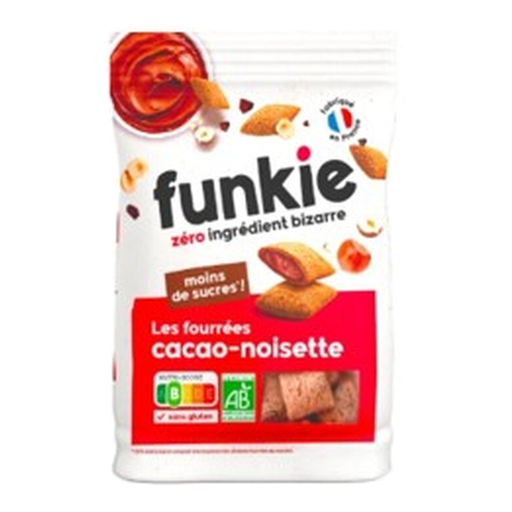 Image unavailable
A hazelnut and cocoa recipe to consider if you’re looking for a cereal bar to enjoy as a snack or in the morning. Check the organic certification and allergens on the packaging: the information about peanuts is inconsistent. Also check the nutritional information per portion and how the bars are packaged if you plan to take them with you.
For a prepacked food of European origin that meets the requirements for using the EU organic logo, look for the Euro-leaf. Agence Bio says it confirms compliance with European regulations on organic farming. Also check the stated origin of the agricultural ingredients and the reference number of the certification body. The AB logo may also appear.
No. To check the sugar content, read the nutritional information for the specific product. It’s best to compare values per 100 g across different formats, then check the values per bar where provided. According to Santé publique France, displaying the Nutri-Score is voluntary; if it appears on the product, it doesn’t replace this information.
Read the ingredients list and any ‘may contain’ warnings on the packaging of the variant you’re buying. The DGCCRF states that allergenic ingredients must be highlighted on prepacked food labels. Don’t assume that one flavour has the same ingredients as another.
Not necessarily. The DGCCRF says a product may still be consumed after its best-before date if the packaging is intact, although some of its flavour and quality may have deteriorated. Follow the storage instructions on the pack.