Parents keeping an eye on sugar
You’re looking for an organic drink for breakfast or a meal and want to compare the sugar content per 100 ml, without assuming that the organic label tells you how much sugar it contains.


When choosing an organic almond drink to serve with a meal for a fussy child, check for the organic logo, then compare the ingredients and sugar content per 100 ml: ‘organic’ does not mean ‘sugar-free’. You could try a recipe with a higher almond content for its flavour, but don’t assume your child will prefer it or that it contains less sugar. Check the allergen information for the almond drink you choose. For a child under 1, it must not replace breast milk or infant formula, as Santé publique France and Anses advise.
You’re looking for an organic drink for breakfast or a meal and want to compare the sugar content per 100 ml, without assuming that the organic label tells you how much sugar it contains.
You’re considering a drink with a different almond content to see which recipe your child accepts, while comparing the ingredients and sugar content separately.
You need to check the label on the exact drink you’re considering. If a food allergy means adjustments are needed at school, follow medical advice and, where applicable, the individual care plan when organising meals.
Start by identifying an organic drink, then compare the recipes according to your main priority: declared sugar content, suitability for your child or trying a different flavour. A higher almond content alone won’t tell you whether your child will accept it.
| Criteria | What to check | Who is it for? |
|---|---|---|
| Organic status and sugar | Look for the EU organic logo or the French AB logo, then read the ingredients and the ‘of which sugars’ line per 100 ml. | I want to choose an organic recipe without assuming the label tells me how much sugar it contains. Around 42% of consumers would put this comparison first. |
| Allergens and age | Check the ingredients and any ‘may contain’ statements. Take your child’s age into account and, where necessary, follow medical advice for school meals. | If my child has an almond allergy, or is under 1, I first need to rule out an unsuitable use. Around 33% of consumers would make this their priority. |
| A recipe to try | Compare the almond content, ingredients and pack size before planning to try it with a meal. | My child refuses some drinks and I’d like to try a different recipe, without relying on the almond content to predict their preference. Around 25% of consumers would prioritise trying a different recipe. |
Carrefour Bio’s Amande Intense Bio recipe contains cane sugar, and Carrefour states that it has 4 g of added sugars per 100 g. E.Leclerc also lists cane sugar in Bio Village Amande Intense Bio, which contains 4.1 g of sugar per 100 ml.
Once you’ve checked for the organic logo, compare the ingredients and the ‘of which sugars’ line on a like-for-like basis.
Santé publique France and Anses advise that plant-based drinks, even when fortified with calcium, do not meet the nutritional needs of children under 1.
For a child of this age, don’t replace breast milk or infant formula with an almond drink.
The plant-based drinks mentioned here list almonds as an ingredient. Any allergy or school-meal instructions should relate to the foods that are actually involved, not the everyday term ‘almond milk’.
Read the ingredients and any ‘may contain’ statements for each product. If your child has a diagnosed allergy, follow medical advice and, for school, the individual care plan if there is one.
Auchan Bio and Ethiquable product information says to refrigerate and consume within 5 days of opening. Check the specific guidance on the carton you buy.
For a first try, choose a suitable pack size or plan to use it in a way that works for your family within that time.
If your child doesn’t accept the drink and the carton stays open beyond the stated time, some of it may have to be thrown away.
These brands offer different organic almond drink recipes. Compare the specific product rather than relying on the brand name alone.
The range includes Amande Intense Bio and a separate Sans Sucres Ajoutés Bio product.
At E.Leclerc, the range includes an organic almond drink called Sans sucres and an Amande Intense Bio recipe.
The brand offers a 1 L carton of organic almond drink called Sans Sucres Ajoutés.
Auchan lists Ethiquable’s organic plant-based almond drink, Sans Sucres, in a 1 L carton.
This Joybuy product is an option if you’re looking for an organic almond drink with a higher almond content. If sugar is your priority, check the ingredients and label before choosing it.
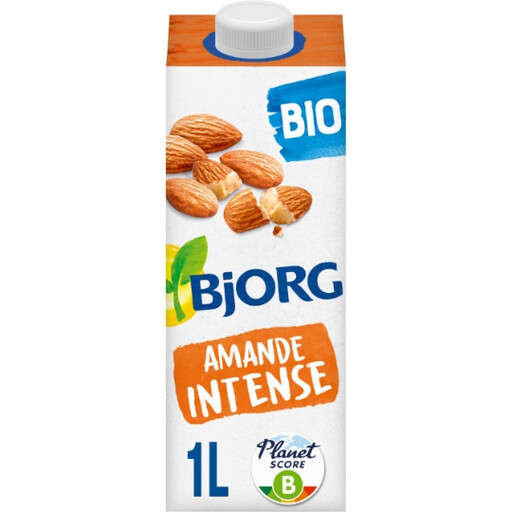 Image unavailable
You could try this recipe if you’d like to offer a different almond content at breakfast, without assuming your child will prefer it.
The Joybuy product information states that it contains 7% almonds. Check the ingredients and nutrition information on the carton: the product information is inconsistent about cane sugar and added sugars. The drink contains almonds, so also check for any ‘may contain’ statements if these are relevant to your child.
Look for the EU organic logo or the French AB logo on the product you choose. The French Ministry for the Economy states that at least 95% of the ingredients in a processed product bearing the organic label must come from organic farming. Check the ingredients, sugar content and allergens separately.
No. An almond drink must not replace breast milk or infant formula for a child under 1. Santé publique France and Anses state that plant-based drinks, even when fortified with calcium, do not meet nutritional needs at this age.
Check the ingredients and any ‘may contain’ statements on the exact product, as the products mentioned list almonds. According to the French Ministry of National Education, an individual care plan can set out the adjustments needed at school for a pupil with a food allergy. Follow the instructions established for the child concerned.
Follow the guidance on the carton you buy. Auchan’s product information for the Auchan Bio and Ethiquable drinks mentioned here says to refrigerate and consume within 5 days of opening. This timeframe doesn’t automatically apply to other products.