For your child’s lunchbox, choose water for everyday drinking and keep orange juice for occasional treats. If you buy juice, adjust the amount to your child’s age: Manger Bouger recommends no more than half a glass a day for children under 11, then one glass a day. ‘No added sugars’ does not mean ‘sugar-free’, so also check the product description, serving size and storage instructions.
Who are these choices for?
Parents looking to limit sugary drinks
You’d like to put juice in your child’s lunchbox now and again, without making it an everyday drink. Manger Bouger recommends choosing water and limiting sugary drinks. The amount of juice you serve matters even when the label says ‘no added sugars’.
Parents of children who prefer juice without pulp
Texture may influence your choice. However, check the product description and ingredients for the specific product you’re considering: juice without pulp, nectar and fruit drinks don’t necessarily have the same ingredients.
Families who prepare lunchboxes in advance
The container size and storage instructions become important if you’re dividing juice between several lunchboxes. Some products sold in the chilled aisle need to stay refrigerated, including during transport.
What should you check for a lunchbox?
Start by deciding whether the lunchbox will contain water or, occasionally, juice. If you choose juice, decide how much to serve before comparing labels and containers.
| Criteria |
What to check |
Who it’s for |
| Portion and frequency |
Your child’s age, the amount actually poured and what else they drink during the day. Manger Bouger recommends no more than half a glass of juice a day for children under 11, then one glass a day. |
I want to offer juice now and again without treating the whole bottle as one serving. For around 40% of consumers, controlling the amount and frequency would be the priority. |
| Ingredients |
The product description, ingredients list and ‘of which sugars’ figure per 100 ml. According to the EUR-Lex summary, fruit juice contains no added sugars by definition, but does contain sugars naturally present in the fruit. |
If I’m looking for pure juice, I don’t want to mistake ‘no added sugars’ for ‘sugar-free’ or confuse juice with nectar. Ingredients would be the top priority for around 30% of consumers. |
| Transport and texture |
Whether it contains pulp, the container size and storage instructions, particularly for a chilled product. |
My child prefers a smooth texture and their lunchbox has to stay in transit until lunchtime. I need to choose a product I can store as instructed on the packaging. Around 20% of consumers would put this practicality first. |
| Preparing several lunchboxes |
How many portions you can actually serve and how long the juice can be kept after opening. |
When I’m preparing several lunchboxes, I want to use a large pack without serving too much juice or keeping any beyond the recommended time. This would be the main concern for around 10% of consumers. |
Mistakes to avoid
-
Taking ‘no added sugars’ to mean ‘sugar-free’
Orange juice may contain no added sugars and still contain naturally occurring sugars. So this claim isn’t a reason to serve more juice.
Compare the product description, ingredients and ‘of which sugars’ figure per 100 ml, then decide separately how much to pack.
-
Assuming the container size is a child’s portion
A carton or individual bottle won’t automatically match the recommended amount for your child’s age. Manger Bouger recommends no more than half a glass of juice a day for children under 11, then one glass a day.
Measure the amount you plan to serve rather than relying on the pack size.
-
Confusing juice, nectar and fruit drinks
Packaging featuring oranges may refer to products with different descriptions and ingredients. The brand name alone doesn’t tell you what’s in the recipe.
Read the product description and ingredients for the specific product you intend to buy.
-
Forgetting about storage during transport
Auchan’s listing for a Tropicana pure orange juice without pulp says it must be stored at a maximum of 7 °C and consumed within five days. These instructions apply to this particular product, not all orange juices.
Check the instructions on your product and make sure you can follow them until lunchtime and after opening.
Brands to consider, depending on the product
These examples can help you spot useful information on a label. The pack sizes and instructions mentioned apply only to the specific products listed.
Tropicana
Auchan lists a 1 L product of pure orange juice without pulp.
- The Auchan listing describes it as orange juice without pulp.
- This product must be stored at a maximum of 7 °C and consumed within five days. Check whether these conditions work for your child’s lunchbox.
Joker
Some products without pulp are described as pure juice or juice made from concentrate.
- The Auchan listing for a Joker pure juice product states that its sugars occur naturally in the fruit.
- Check the description of the product you choose: ‘no added sugars’ does not mean ‘sugar-free’.
Carrefour Extra
Carrefour lists, among other products, a 50 cl bottle of pure orange juice without pulp.
- The 50 cl size makes it easy to check the container’s volume before deciding how much to pour.
- The whole bottle shouldn’t be treated as a child’s portion. Also check the storage instructions for the product you choose.
Marque Repère / Jafaden (E.Leclerc)
The E.Leclerc catalogue features several types and sizes of orange juice, including a pack of 4 × 20 cl cartons of Jafaden pure juice.
- The 20 cl cartons have a clearly defined volume that you can compare with the amount planned for your child.
- A whole carton won’t automatically match the amount recommended by Manger Bouger for children under 11.
Pampryl
Check the ingredients for each product rather than assuming that anything bearing this name is pure orange juice.
- The product description and ingredients list show you what’s in the product you’re considering.
- An orange and mandarin drink listed by Jus de Fruits Caraïbes contains water and sugar. This recipe, listed outside mainland France, does not represent the products sold there.
An orange juice to consider on Joybuy
This 1 L orange juice with pulp could be an option for occasional consumption, served in an amount suited to your child’s age. The title flags that it’s close to its date, so check this before buying.
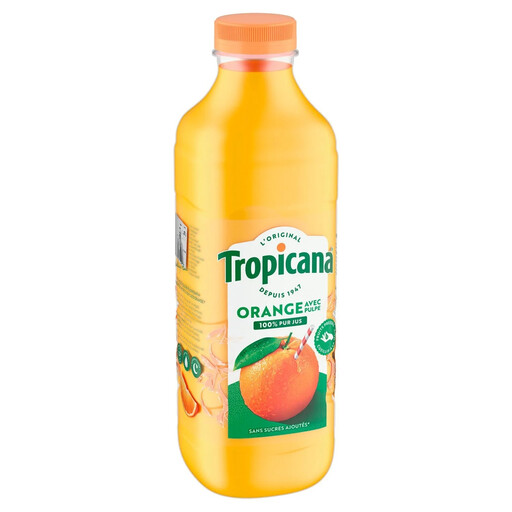 Image unavailable
Tropicana orange juice with pulp, 1 L — close to its date
Worth considering for an occasional measured serving, if your child likes pulp.
The 1 L container is not a child’s portion. The title flags that it’s close to its date: check the date shown before buying, along with the storage instructions for transport and after opening.
View on Joybuy
Frequently asked questions
Is orange juice labelled ‘no added sugars’ sugar-free?
No. It contains sugars naturally present in oranges. The EUR-Lex summary explains that fruit juice contains no added sugars by definition. To find out how much sugar is in the product you’ve chosen, check the ‘of which sugars’ figure per 100 ml.
How much juice should I pack in my child’s lunchbox?
Manger Bouger recommends no more than half a glass of juice a day for children under 11, then one glass a day. Take into account any juice your child has already had that day and measure the amount you serve: the size of a bottle or carton doesn’t determine the portion.
How can I tell the difference between pure juice, juice made from concentrate and nectar?
First, read the product description on the packaging, then check the ingredients list for the specific product. These terms refer to different categories. Don’t infer the recipe or sugar content from the packaging colour or brand name alone.
Can you take chilled juice with you until lunchtime?
Yes, as long as you follow the storage instructions for the product you’ve chosen throughout the journey. For example, an Auchan listing says to store a Tropicana pure orange juice without pulp at a maximum of 7 °C. Make sure your equipment can maintain the temperature stated on the product.


